Palpitations or breathlessness: check the need for urgent care first
If you currently have palpitations that do not go away, or palpitations with chest pain, shortness of breath, feeling faint or fainting, get emergency medical help. In Japan, call 119. Do not drive yourself or try Kyushin first while waiting to see whether it works.
Sudden difficulty breathing, sustained chest pressure, sudden dizziness so severe that you cannot stand unaided, altered consciousness, or sudden one-sided weakness or speech difficulty also need emergency help. In Japan, call 119 and follow the dispatcher’s instructions. Do not give medicine to an unconscious person.
If a concerning episode like the one above has stopped, you still need urgent medical assessment. Feeling better now is not a reason to skip assessment.
Arrange medical review if palpitations keep returning, happen more often, last longer than a few minutes, or occur when you have a heart condition or a family history of heart problems, even if you currently feel well.
These warning signs are not an exhaustive list. Having none of them does not establish that an OTC medicine is suitable for you. Symptoms alone do not identify their cause; do not assume tiredness, stress or age explains them. Outside Japan, use your local emergency number.
This guide covers the Japanese product Kyushin Capsule F, 救心カプセルF. Its specific purpose is to separate 10 or 30 capsules in the box, one capsule per dose, and the three-capsule basis of the ingredient table, then explain intact-capsule and blister handling. These are label-reading facts, not a pathway for choosing a cardiac medicine yourself.
Japanese sources checked: 11 November 2026. Based on the manufacturer’s currently linked Q621N-B leaflet and the matching PMDA product record. This is not a 2026 reformulation announcement, an individual diagnosis or a first-person product review.
Look for the full name, not just “Kyushin”
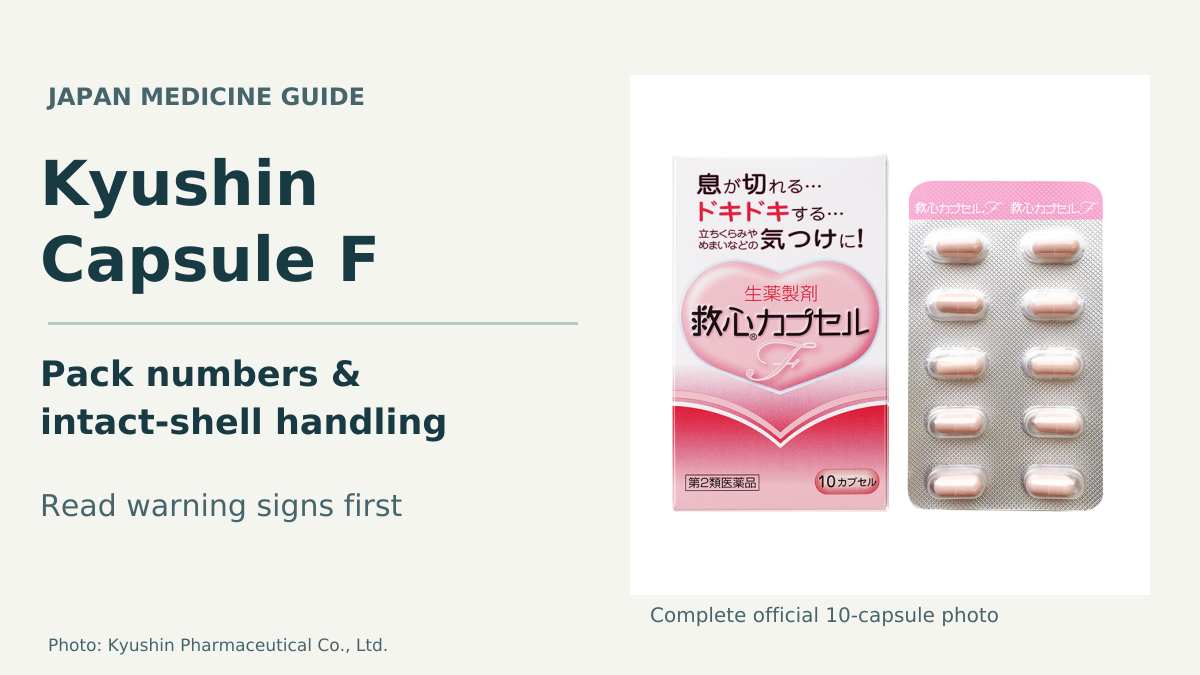
Kyushin Capsule F is a Japanese Class 2 OTC medicine sold by Kyushin Pharmaceutical. It consists of pale-pink capsules in PTP blister sheets inside a paper box. The manufacturer currently lists 10-capsule and 30-capsule packs.
The usual dark-brown Kyushin pills, 救心錠剤 tablets and Capsule F are separate formulations. If your product is the small pills, use the Kyushin pills-only guide. Do not borrow another formulation’s dose or switch between or combine these medicines yourself.
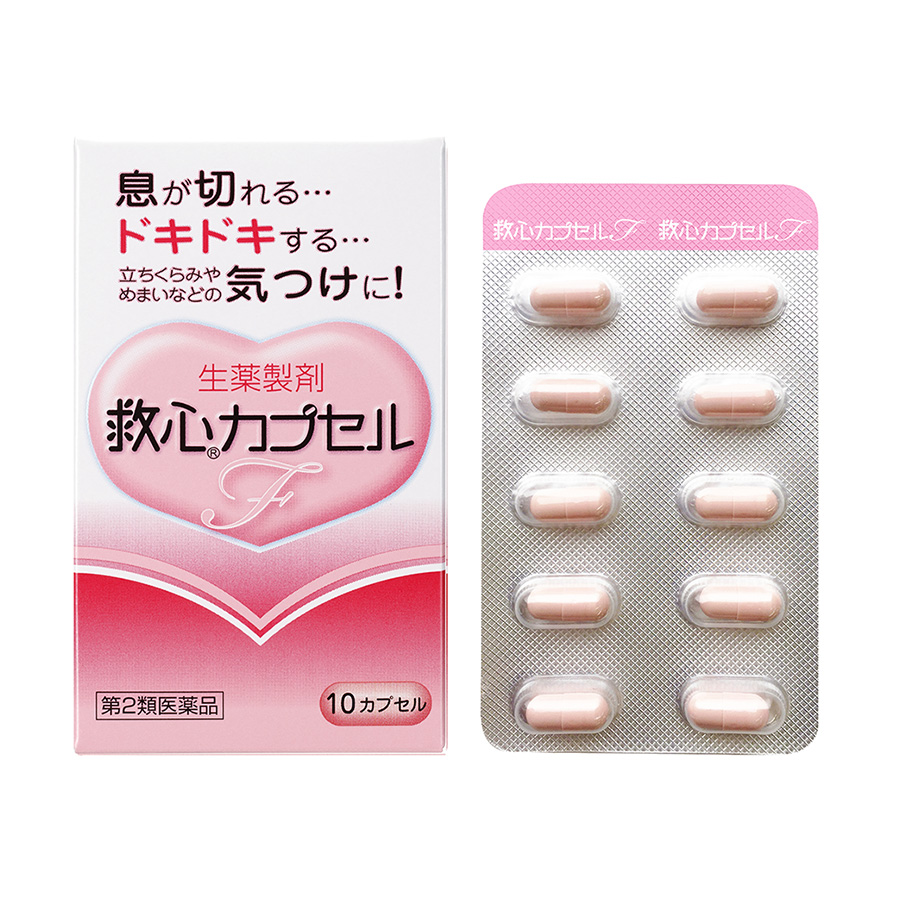
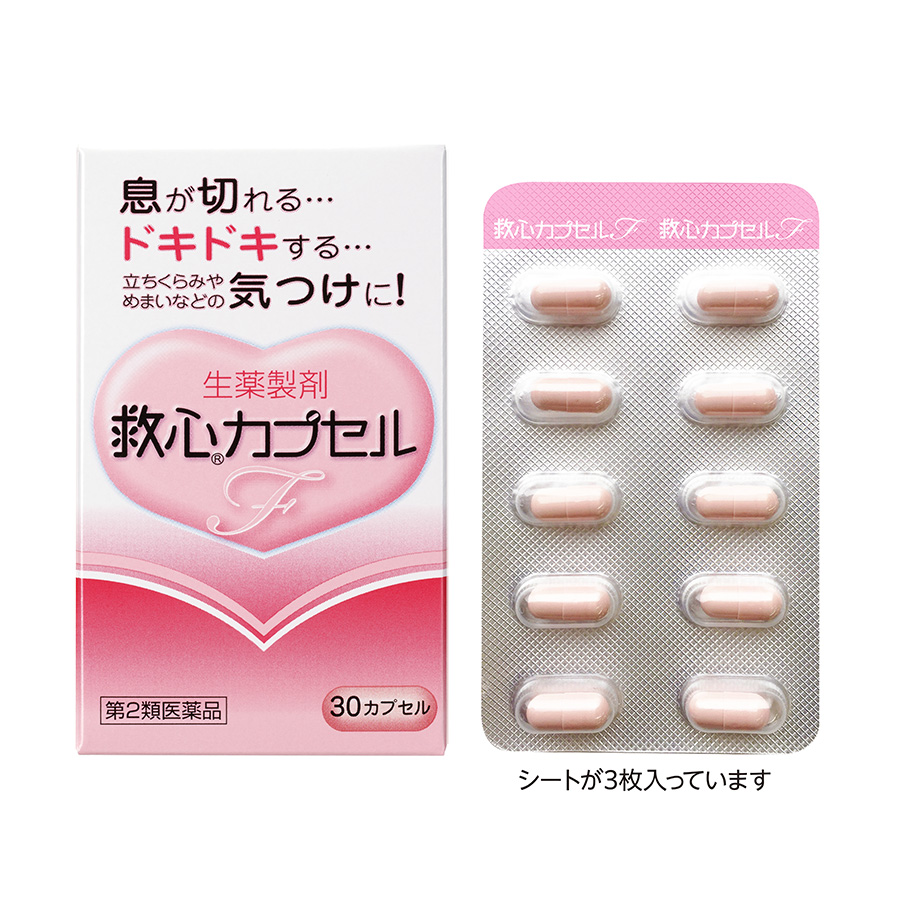
These complete photos are currently linked by the manufacturer and help identify the product. They do not confirm the packaging or stock at any particular shop. Both numbers are pack quantities, not treatment courses or amounts you should finish.
The Japanese labelled indications are 息切れ、どうき、気つけ: shortness of breath, palpitations and the Japanese label term kitsuke (気つけ). The last term is retained here rather than translated as resuscitation, waking an unconscious person or an energy boost. These symptom terms do not identify the cause or establish whether this product is appropriate for you.
It does not replace emergency care or prescribed treatment and is not a supplement for preventing heart disease or blood clots. Do not diagnose an arrhythmia from how palpitations feel and then treat it with this product.
Check combinations and consultation requirements before the dose
The leaflet says not to take other cardiotonic medicines
Do not take other cardiotonic medicines while taking this product. The manufacturer’s FAQ, which includes Capsule F, also advises avoiding digitalis medicines such as digoxin (ジゴキシン) and methyldigoxin (メチルジゴキシン), and other products containing senso (センソ), such as Rokushingan.
These are examples, not a complete list of safe and unsafe combinations. Do not stop, reduce or replace prescribed medicine in order to take Capsule F. Ask a doctor or pharmacist to check everything you use. An unlisted medicine or supplement is not automatically compatible.
The leaflet requires advice before use for these groups
- People receiving medical treatment.
- People who are pregnant or may be pregnant.
Consult a doctor, pharmacist or registered medicine seller in Japan before use. Also disclose breastfeeding, allergies, other health conditions, and all prescription, OTC and traditional medicines and supplements. These disclosures are additional preparation for a consultation, not an invented list of leaflet contraindications.
Children under 15 must not take it. Meeting the age requirement does not establish suitability. Symptoms that need assessment must still be addressed according to the priorities at the start of this guide.
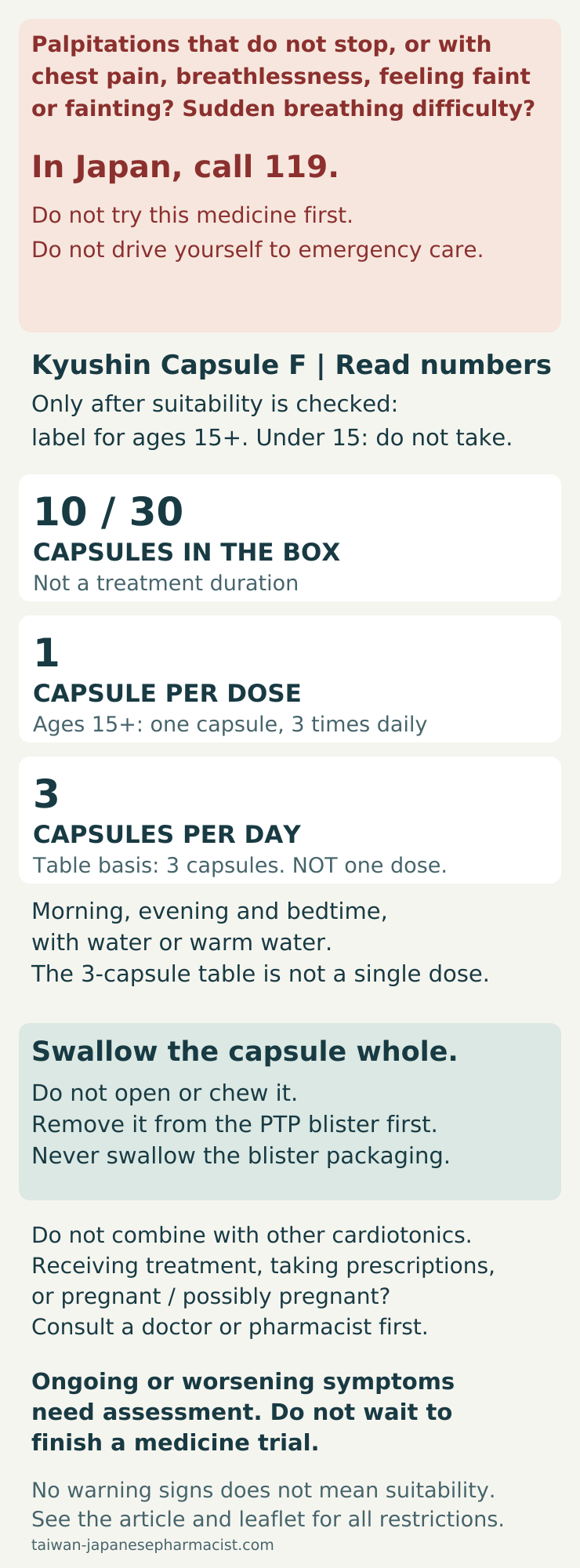
10/30, 1 and 3 answer different questions
The following explains the label. Whether symptoms have been appropriately assessed, whether the medicine is suitable and whether combinations are acceptable must be checked before considering its directions. This is not a symptom-based self-selection flowchart.
- 10/30: how many in the box?
- Pack capacity. It does not define a treatment course or mean that the box should be finished.
- 1: how many per dose?
- The labelled single dose for ages 15 and over is one capsule. Under 15: do not take.
- 3: what is the table based on?
- Ingredient amounts are given per three capsules, also the labelled daily total. Not one dose.
- Ages 15 and over: one capsule per dose, three times daily.
- Timing: morning, evening and before bedtime, with water or warm water.
- Under 15: do not take. Do not improvise a smaller children’s dose.
- Handling: remove the capsule from its PTP blister and swallow it whole. Do not chew it or remove its contents.
The manufacturer’s FAQ says the morning and evening doses may be taken before or after food. That does not change the schedule to “after breakfast, lunch and dinner.” Do not combine the three doses, add a dose because symptoms continue or shorten intervals yourself.
Eight ingredients, all stated per three capsules
The following retains the manufacturer’s per-three-capsule basis without converting it to a per-capsule table. Translations assist reading; keep the exact Japanese ingredient names when checking the product.
- Senso
センソ - 5 mg
- Go-o
ゴオウ - 4 mg
- Powdered deer antler
ロクジョウ末 - 5 mg
- Ginseng
ニンジン - 25 mg
- Powdered saffron
サフラン末 - 4.5 mg
- Pearl
真珠 - 7.5 mg
- Ryuno (borneol)
リュウノウ - 2.7 mg
- Animal bile
動物胆 - 8 mg
These are labelled crude-drug ingredient quantities, not an efficacy ranking or a basis for switching or combining products. Some ingredients are animal-derived and the shell contains gelatin, so this is not an all-plant formulation. If you have allergies or dietary restrictions, take the complete leaflet to a healthcare professional.
Capsule F lists eight ingredients; the ordinary Kyushin pills list nine. Their formulas and directions must be read separately. One Capsule F should not be thought of as “two pills put into a capsule,” and ingredient counts do not tell you which product is stronger or more suitable.
Keep the shell intact and never swallow the blister
- Push the capsule out of the PTP sheet. Press the raised blister to release it through the foil, separating it from the foil and plastic packaging.
- Swallow the whole capsule with water or warm water. Do not bite, open or empty it, or put its contents under the tongue. The manufacturer’s FAQ warns that chewing it or taking the contents out can cause tongue or mouth numbness.
- Never swallow the PTP blister. The leaflet warns that accidentally swallowing the sheet can injure the lining of the oesophagus. Check that you are holding only the capsule before taking it.
If you cannot swallow the capsule, ask a doctor or pharmacist rather than opening, dissolving or otherwise changing it. Do not cut the blister into tiny single-capsule pieces to save space. See the PTP blister carrying and accidental-swallowing guide for that separate packaging risk.
The 5–6-day stopping rule is not permission to wait
Rash, redness, itching, nausea or vomiting after taking it: stop immediately and take the leaflet to a doctor, pharmacist or registered medicine seller for advice.
No improvement after 5–6 days of use: stop and seek advice with the leaflet. This means days, not doses, and it is not a course that must be completed.
Do not wait 5–6 days through palpitations that do not go away, warning signs, worsening symptoms or repeated episodes. Follow the emergency and assessment advice above. Buying a larger box, starting another pack or increasing the dose does not replace medical assessment.
Keep the medicine in a cool, dry place away from direct sunlight and out of children’s reach. Do not transfer it into another container or use it after expiry. Keep the original box, PTP sheets and leaflet for checking or taking to a consultation.
Tell the clinician when symptoms started, how long each episode lasts, whether there was chest pain or fainting, and every medicine taken and when. Bring the full product name, 救心カプセルF, rather than describing it only as “Kyushin.”
Official sources and image credits
Checked: 11 November 2026. Product facts were checked against the manufacturer’s currently linked Q621N-B leaflet and the matching PMDA product record. Emergency assessment guidance is separately based on FDMA and NHS sources. Shopping-media coverage, popularity and personal trials are not evidence of effectiveness.
Product, directions and medicine combinations
- Kyushin Pharmaceutical: Capsule F, 10/30-capsule packs and ingredients
- Manufacturer’s current Q621N-B leaflet (Japanese PDF)
- PMDA: Kyushin Capsule F record / matching product leaflet (Japanese PDF)
- Manufacturer FAQ: administration and not chewing or emptying capsules
- Manufacturer FAQ: formulations and combinations to avoid
- Manufacturer: ordinary Kyushin pills, for different-formulation identification only
Emergency warning signs and medical assessment
- Japan FDMA: ambulance guide and 119 (English PDF)
- NHS: Heart palpitations (reviewed 17 March 2026; UK emergency numbers are not used as Japanese numbers in this guide)
Product photographs and original diagram
Product photographs: 救心製薬株式会社 / Kyushin Pharmaceutical Co., Ltd. The official 10-capsule image and official 30-capsule image identify the full product name, pack count and number of sheets; the packaging has not been redrawn. Images and related rights belong to their respective rights holders. Attribution does not mean individual reuse permission was obtained or that the manufacturer sponsors or endorses this guide. See the manufacturer’s website terms. The label-reading diagram is original to this site, not a manufacturer’s chart.