Does the “S” on a Gaster10 box mean a stronger medicine? All three current Japanese forms contain famotidine 10 mg per dose. The useful difference is how you take them, with an extra safety restriction for S tablets. First, a pharmacist needs to check whether Gaster10 is suitable for you.

I’m Irene, a Taiwan-born, Japan-licensed pharmacist working in a Japanese drugstore. Let’s make sense of the three boxes, including the powder that still needs water and the S tablet that can dissolve in your mouth.
Product information checked: 12 October 2026. This guide covers the Japanese-market Gaster10 range.
Before choosing a box
Gaster10 is a Class 1 OTC medicine in Japan. It is sold by a pharmacist, who checks your symptoms, age and other medicines. A shop being open does not mean its pharmacist is available; check before making a special trip.
The labelled age range is 15 to 79 years inclusive. Under 15 and age 80 or over: do not take it. People aged 65–79 must consult a doctor or pharmacist before use. Pregnancy or possible pregnancy, relevant medical treatment, other medicines, and breastfeeding can change whether you can use it. Read the safety checklist below before using any of the forms.
Get urgent medical help instead of shopping if you vomit blood or coffee-ground-like material, pass black, tarry stools, or develop severe or sudden abdominal pain. Sudden persistent chest pressure or pain, especially with sweating, breathlessness, faintness or pain spreading to an arm, jaw or back, needs emergency assessment. Do not assume it is heartburn.
After the pharmacist confirms it is suitable:
- Prefer swallowing one small tablet with water? Compare regular Gaster10.
- Prefer a measured sachet of fine powder? Compare Gaster10 Powder. Take it with water or warm water.
- Want the option of taking it without water? Compare Gaster10 S Tablets. Do not use S tablets if you have phenylketonuria (PKU).
Match these three Japanese packs
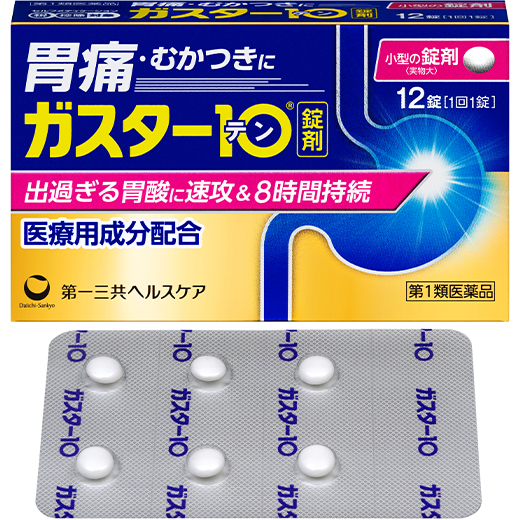
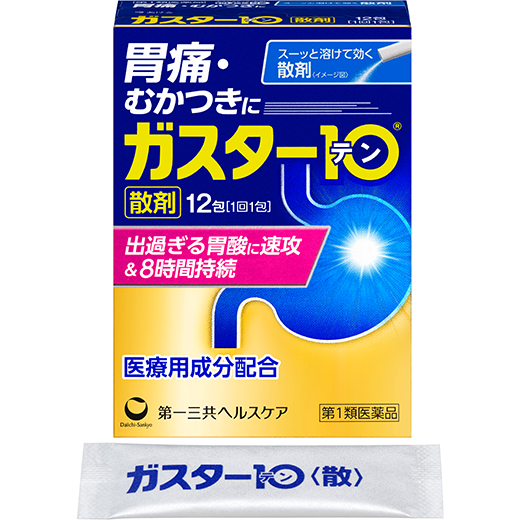
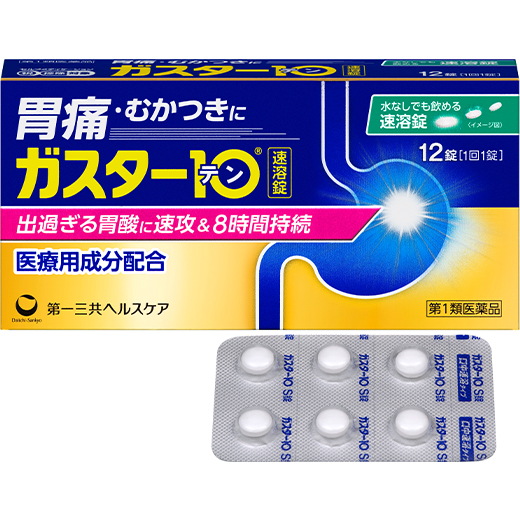
The current manufacturer range lists these three forms, each in 6-dose and 12-dose packs. Photos are identification aids, not a statement that every shop has each size. Older online pages also show liquid and pink packs. The liquid’s manufacture ended in April 2017; the separate “Reverse Control” powder and S tablets ended manufacture in March 2025. They are outside this current three-form comparison. Manufacturing end dates do not tell you when a particular shop’s stock ran out.
The quick comparison
| Form | One dose | How to take it |
|---|---|---|
| Regular Gaster10 | 1 tablet | Swallow with water or warm water |
| Gaster10 Powder | 1 sachet, 0.5 g | Take with water or warm water |
| Gaster10 S Tablets | 1 tablet | Dissolve in the mouth and swallow, or take with water or warm water |
Shared: famotidine 10 mg per dose, the same labelled symptom uses, the same age range and the same dosing limits. Choose one form; do not combine them.
Regular tablets: a small coated tablet
The regular version is a 7 mm sugar-coated tablet in blister packaging. It is a straightforward option if you are comfortable swallowing a small tablet with water. Take the tablet out of the blister first; never swallow the packaging.
Powder: a sachet with a cooling sensation
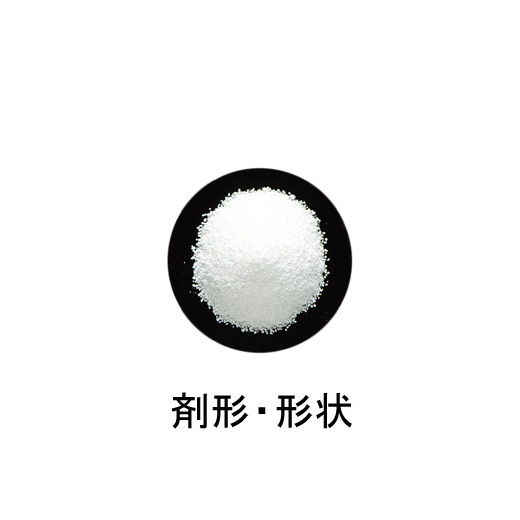
Each sachet contains 0.5 g of fine powder, including 10 mg of famotidine. The manufacturer describes a cooling sensation from l-menthol. A sachet avoids counting tablets, but it is not the water-free option. Follow its water or warm-water instructions.
S tablets: water is optional, swallowing is still necessary
Take an S tablet out of its blister packaging first. It dissolves with moisture in the mouth. After dissolving, swallow the medicine with saliva, or use water or warm water. The leaflet says the medicine is not absorbed through the lining of the mouth. It can also be swallowed with water like an ordinary tablet without changing its effect.
S tablets contain l-menthol and aspartame, an L-phenylalanine compound. This is why their leaflet specifically prohibits use in people with PKU. A fast-dissolving tablet should not be treated as a solution for unexplained difficulty swallowing; that symptom needs medical advice.
Neither the cooling feeling nor the word “S” establishes stronger or faster symptom relief than the other forms.
What does Gaster10 treat?
Famotidine is an H2 blocker that reduces excessive stomach-acid secretion. The Japanese OTC indications are stomach pain, stomach heaviness, heartburn and queasiness. The manufacturer also includes heartburn caused by acid reflux within its symptom use.
These symptoms can have different causes. This guide does not diagnose acid reflux disease, and Gaster10 is not a self-treatment plan for recurring reflux, an ulcer or another diagnosed stomach condition. Do not use it for symptoms outside the label, for diarrhoea, or in advance of a large meal as a preventive measure.
How often can you take it?
For an eligible person aged 15–79, follow the pharmacist’s advice and the leaflet for the chosen form:
- When a labelled symptom occurs, take one dose: 1 regular tablet, 1 powder sachet or 1 S tablet. Meals do not determine the timing; it may be taken before, after or between meals.
- If symptoms have not settled, a second dose may be taken at least 8 hours after the first. No more than 2 doses in a day. Do not take extra doses or switch forms to get around this limit.
- Stop when symptoms settle. This is not a fixed twice-daily schedule or a course that must be finished.
- No improvement after 3 days: stop and consult a doctor or pharmacist, taking the leaflet with you.
- Do not continue for more than 2 weeks. If you still need it at that point, stop and see a doctor. This is a maximum limit, not permission to wait two weeks with worsening symptoms.
Avoid alcohol while taking it. If you accidentally exceed the labelled dose, stop and promptly contact a doctor or pharmacist with the package or leaflet.
The safety checklist for all three forms
Do not take Gaster10 if any of these apply
- You have had an allergic reaction to famotidine or another H2 blocker.
- You are receiving medical treatment for a blood disorder; kidney or liver disease; heart disease; a stomach or duodenal disease; or an immune-system condition such as asthma or rheumatism.
- You are receiving steroids, antibiotics, anticancer medicines or azole antifungals through a medical institution.
- A doctor has previously told you that you have low red blood cells, low platelets, low white blood cells or another blood-count abnormality.
- You are under 15, age 80 or over, pregnant or possibly pregnant.
- S tablets only: you have PKU.
Do not take other stomach or intestinal medicines while taking Gaster10. That includes adding another OTC stomach remedy because the first dose has not worked. Show the pharmacist the exact products you already use, including prescriptions, supplements and medicines bought outside Japan. Do not stop prescribed treatment to make yourself eligible for an OTC product.
Breastfeeding: the Japanese leaflets say either not to take the medicine or to avoid breastfeeding if taking it. Ask a doctor or pharmacist about a suitable alternative and an individual feeding plan before use. If you have already taken a dose, contact them for advice rather than deciding when to restart breastfeeding from a generic drug guide.
Consult a doctor or pharmacist before use
This applies to anyone receiving other medical treatment or taking other medicines; anyone with previous medicine-related allergies; and people aged 65–79. Also seek advice before use if you have symptoms such as sore throat, cough or high fever, unexplained weight loss, or persistent abdominal pain. The “consult first” list does not override a “do not take” condition above.
Heartburn on most days, repeated vomiting, food sticking when you swallow, or symptoms that keep returning also call for medical assessment rather than repeated OTC purchases.
Stop and get help for possible side effects
Stop promptly and consult a doctor or pharmacist if you develop a rash, redness, itching or swelling; an irregular pulse; faintness or a seizure; or feel unusually unwell, exhausted, feverish or have a sore throat after taking it.
Stop taking it and get immediate medical attention for breathing difficulty, throat swelling or impaired consciousness; persistent or rapidly worsening signs such as widespread rash, red eyes, lip sores or high fever; unexplained muscle pain, marked weakness or reddish-brown urine; yellow skin or eyes; reduced urine or widespread swelling; new or persistent symptoms such as breathlessness, dry cough or fever; or unusual bruising, bleeding or marked pallor. These are examples of warning signs; they do not all have to occur together. The leaflets warn of rare severe allergic, skin, muscle, liver, kidney, lung and blood reactions.
Constipation, loose stools, diarrhoea or dry mouth that persists or worsens also means stopping and consulting. Do not wait for the 3-day review point if a concerning reaction appears.
Keep the medicine in its original packaging in a cool, dry place out of direct sunlight and children’s reach. Do not use it after its expiry date.
Three shopping questions worth asking
Is S the stronger version?
All three provide 10 mg of famotidine per dose. S changes how the tablet is taken and adds a PKU restriction; it is not a higher-dose option.
Can I take the powder without water?
Its instructions specify water or warm water. The water-optional form in this range is S Tablets.
Can I buy it when the drugstore is open late?
Ask whether a pharmacist is available to sell Class 1 OTC medicines. Bring your medicine list and explain who will take it, how long symptoms have lasted and what you have already tried. You can show the Japanese package name and ask: 「薬剤師さんに相談できますか?」 (“May I speak to the pharmacist?”)
My starting point would be to check that Gaster10 is suitable, then choose the form you can take correctly. If you are also comparing another stomach-medicine family, the Cabagin Alpha Plus tablet and granule guide explains those packs separately. That is background reading, not a suggestion to combine them with Gaster10.
Official sources and medical guidance
Checked 12 October 2026. This is general information about Japanese products; read the leaflet supplied with your pack and obtain individual advice from the pharmacist.
- Daiichi Sankyo Healthcare: current Gaster10 range and three-form product guide
- Japanese leaflets: regular tablets, powder, S tablets
- Manufacturer: dosage-form differences, heartburn from reflux, why the two-week limit matters, manufacture-ended products, store-search cautions
- Japan Ministry of Health, Labour and Welfare: medicine sales system
- NHS: heartburn and acid reflux, chest pain, vomiting blood, stomach ache