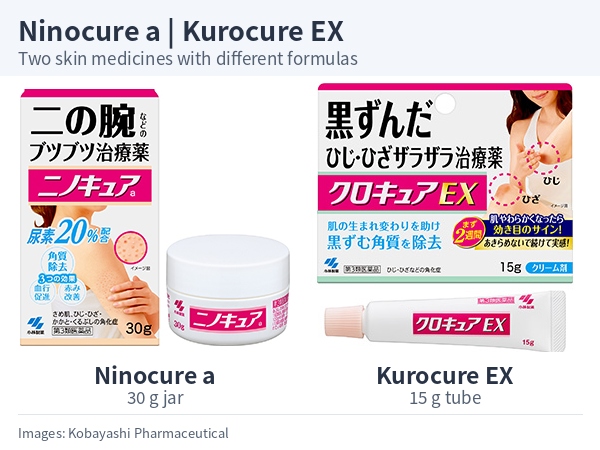

Hi, I’m Irene, a Taiwan-born pharmacist licensed in Japan and working in a Japanese drugstore. One of these packages shows an upper arm; the other draws attention to elbows and knees. The pictures help you find them, but the ingredient list and the condition of your skin are what make the comparison useful.
Which one should you look at first?
- Ninocure a: the 30 g jar is marketed for rough, small bumps on the upper arms and similar areas. Consider it when that kind of keratin-related roughness fits the labelled uses and the skin is intact.
- Kurocure EX: the 15 g tube is marketed for hard, darkened, rough skin on elbows and knees. Its formula adds gamma-oryzanol and has more tocopherol acetate, while keeping the same urea concentration.
- Neither is a suitable choice for scratched-open, cracked, eroded or red-swollen inflamed skin. Those areas are specifically excluded by both leaflets.
Both contain 20% urea and their formal indication lists overlap. The arm picture does not confine Ninocure a to arms, and Kurocure EX’s name does not make it a treatment for every dark mark. These are Japanese Category 3 OTC medicines, rather than everyday facial skincare.
Recognize the current products
Ninocure a: ニノキュアa, 30 g
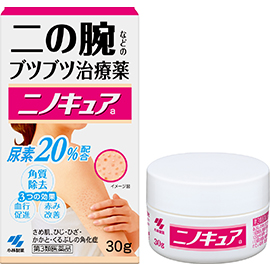
Look for the pink ニノキュア name, an upper-arm picture and “尿素20%” on the box. The current formal product name is ニノキュアa. It is a cream in a 30 g jar.
The manufacturer describes urea as softening and removing built-up keratin associated with rough bumps. Ninocure a also contains tocopherol acetate and monoammonium glycyrrhizinate. The latter is an anti-inflammatory ingredient, but this does not cancel the warning against using the product on eroded or red-swollen inflamed skin.
Kurocure EX: クロキュアEX, 15 g
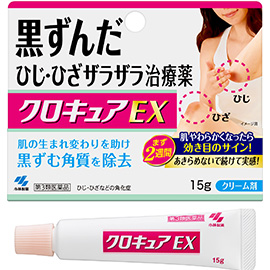
Look for クロキュアEX, elbow/knee imagery and a 15 g tube. The manufacturer’s focus is rough, darkened, thickened skin in these areas, with urea helping remove the thickened outer layer.
This is a cream with four active ingredients. Its current inactive-ingredient list also includes fragrance; the current Ninocure a list does not list fragrance. If you have a known ingredient allergy, check the complete leaflet rather than judging by the package colour or the number of actives.
What is actually different in the formulas?
| Active ingredient, amount per 100 g of medicine | Ninocure a | Kurocure EX |
|---|---|---|
| Urea | 20 g, or 20% | 20 g, or 20% |
| Monoammonium glycyrrhizinate | 0.5 g | 0.5 g |
| Tocopherol acetate, a vitamin E derivative | 0.5 g | 2 g |
| Gamma-oryzanol | Not included as an active | 1 g |
The urea concentration is identical. Kurocure EX has four times the tocopherol acetate concentration, but that number alone does not establish four times the benefit or that it is the better choice for every person. The other ingredients and bases differ too.
Urea is the keratin-softening ingredient. The maker describes tocopherol acetate as supporting circulation and skin metabolism, and monoammonium glycyrrhizinate as reducing inflammation. The comparison should therefore start with the type and condition of the rough skin, rather than treating “EX” or an extra ingredient as a guarantee of a better result.
The labelled uses overlap more than the boxes suggest
Both leaflets list:
- Rough skin on the fingers
- Keratosis, or thickened skin, on the elbows, knees, heels and ankles
- Dry skin in older adults
- Rough, scaly skin described in Japanese as さめ肌
Ninocure’s upper-arm positioning helps explain a common shopping question. One cause of small rough bumps is keratosis pilaris, in which keratin builds up in hair follicles. However, a package picture cannot diagnose every bump. If you are uncertain what you are treating, or the skin is painful, inflamed or changing, ask a pharmacist or doctor before choosing.
Kurocure EX’s “darkened elbows and knees” wording is tied to rough, thickened keratin. Its formal indication list does not establish a general treatment for freckles, melasma or every form of pigmentation. Do not use either product as a facial whitening cream or facial exfoliant.
The exclusions are the most important part of the choice
Do not apply either product to:
- The skin around the eyes, or mucous membranes
- Scratches, other open wounds, or fissures/cracks
- Areas where the skin is peeling in a scab-like way
- Inflamed areas with erosion or red swelling
A heel can be thick and rough, but it can also be split open. The leaflet includes heel keratosis as a use while excluding the cracked part. That distinction matters more than simply matching the body part on the label.
The same applies to redness. The manufacturer discusses anti-inflammatory ingredients, but the explicit red-swollen/eroded-skin exclusion still applies. If you cannot tell whether the area fits, show it to a pharmacist rather than trying to interpret a promotional phrase on its own.
Before using either medicine, consult a doctor, pharmacist or registered salesperson if you are receiving medical treatment or have had allergic symptoms from medicines. Children must use the product under a parent’s or responsible adult’s supervision; have the child’s skin problem checked if the diagnosis or suitability is unclear.
How to use either cream
- Check the skin and the product. Confirm that the intended area fits the labelled uses and has none of the exclusions above. Check the expiry date and read the leaflet in your package.
- Apply an appropriate amount several times daily. Both labels instruct rubbing the cream into the affected area. Use only on the indicated affected skin, externally; do not spread it over the face as basic skincare.
- Keep medicine away from the eyes and mucosa. Do not touch them with cream still on your hands. If cream gets into an eye, rinse immediately with water or lukewarm water; see an ophthalmologist if symptoms are severe.
- Stop for a reaction. Rash/redness, itching, pain, heat, tingling or scab-like peeling can be adverse effects. Stop immediately and consult, taking the leaflet or package with you. Irritation is not a sign that the cream needs to be rubbed in harder.
- Review at about two weeks. If there is no improvement after about two weeks, stop and consult. This is a review point, not a promise that bumps or darkened roughness will disappear within two weeks.
- Close and store properly. Keep tightly capped in a cool, dry place away from direct sunlight and children. Do not decant into another container. Kurocure EX can occasionally cause yellowing if it gets on clothing.
Be gentle with rough bumps
For keratosis pilaris, NHS guidance recommends mild, unperfumed washing products, cool or lukewarm baths/showers and avoiding harsh scrubs, scratching or picking. Ask a pharmacist about suitable moisturising care. This is general skin-care guidance; it does not change the Japanese medicines’ directions or make them suitable for broken or inflamed skin.
Irene’s takeaway
For a quick shelf decision, remember Ninocure a: 30 g jar, upper-arm rough-bump focus; Kurocure EX: 15 g tube, darkened rough-elbow/knee focus. Then check the shared 20% urea, the different additional ingredients and, most importantly, whether the skin is intact and suitable. You do not need to assume that one is “arm only”, that EX is universally better, or that using both is necessary.
Official sources
Product information checked on 14 October 2026. Follow the leaflet supplied with the product you buy.
- Kobayashi Pharmaceutical: current Ninocure a product information
- Ninocure a Japanese leaflet
- Kobayashi Pharmaceutical: Kurocure EX product information
- Kurocure EX Japanese leaflet
- Official Ninocure a English reference leaflet
- Official Kurocure EX English reference leaflet
- NHS: keratosis pilaris and gentle skin care