
I'm Irene, a Japanese-licensed pharmacist working in a Japanese drugstore. I was born in Taiwan and moved to Japan at around age 10. With Nature Made's similar yellow labels, I would check two things before comparing the numbers: does the product include minerals, and how many tablets make one day's serving?
Start here: minerals first, daily amount second
This guide covers three Japanese-market formulas. A Nature Made bottle bought in another country may have different contents.
- Looking for a vitamin formula without the seven-mineral blend? The Japanese Multi Vitamin contains 12 vitamins and is taken at a suggested one tablet daily. It contains milk ingredients.
- Considering vitamins plus minerals? Compare Multi Vitamin & Mineral with Super Multi Vitamin & Mineral. The ordinary version is two tablets a day; Super is one. Their daily mineral totals are the same, but some vitamin amounts differ.
- Already taking separate iron, zinc, calcium or another multivitamin? Check the combined labels before adding either mineral formula. “More complete” is not a reason to double up.
These products supplement food intake. They are not medicines for treating or preventing disease, and a balanced diet still comes first. If you do not know what you need to supplement, a pharmacist can help you review your diet, medicines and existing products.
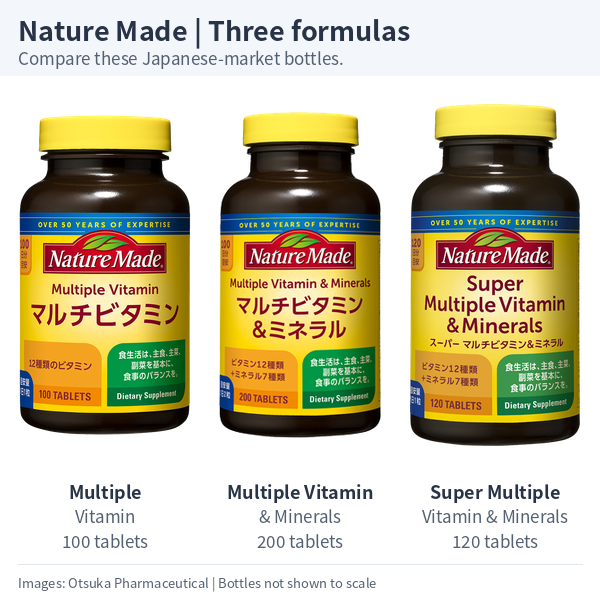
Recognise the Japanese names and bottle counts
Multi Vitamin: 12 vitamins, one tablet a day
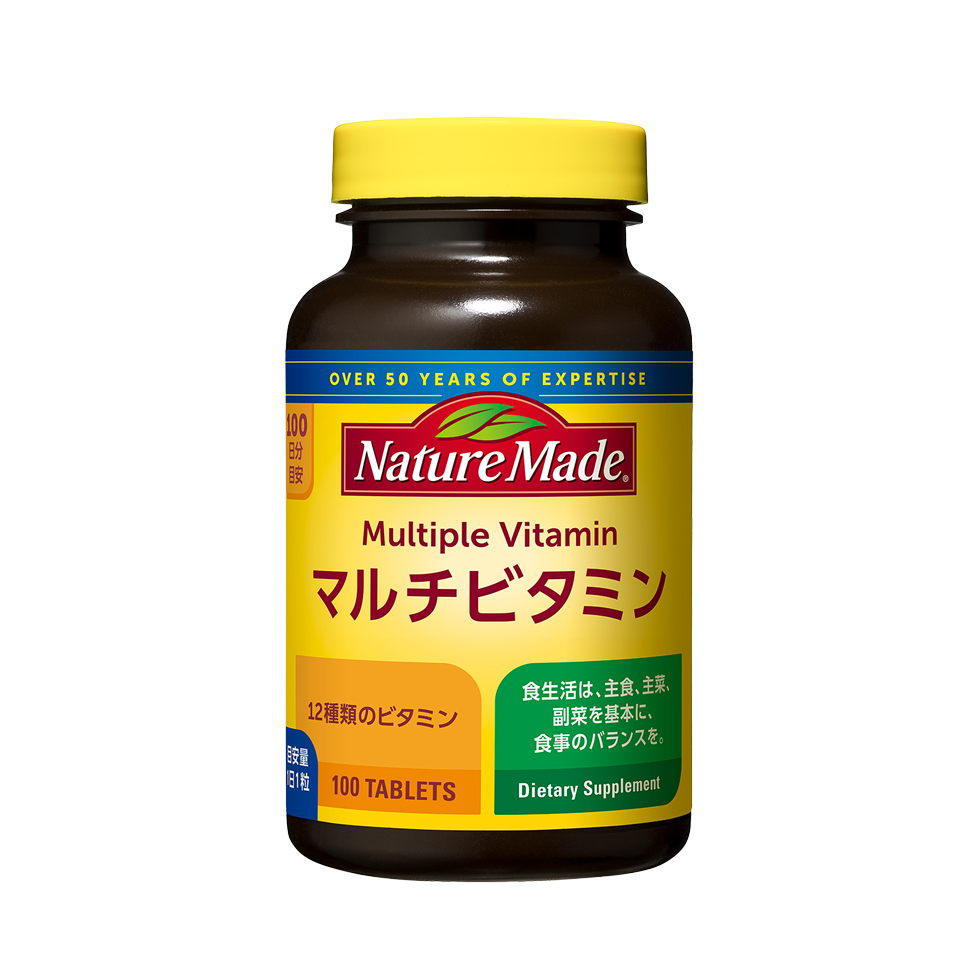
Look for マルチビタミン without “&ミネラル.” The pictured bottle contains 100 tablets for 100 days; a 50-tablet/50-day bottle is also listed. Its ingredients include lactose and agar. It does not provide the seven-mineral formula compared below.
Multi Vitamin & Mineral: two tablets a day
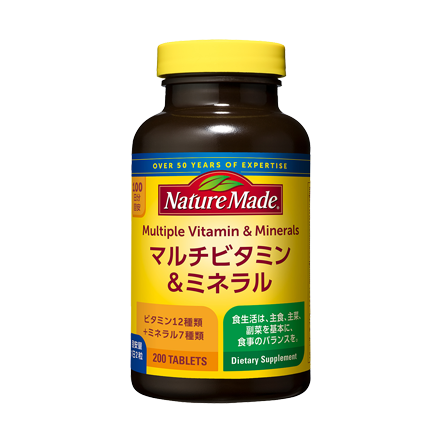
Look for マルチビタミン&ミネラル. It combines 12 vitamins and seven minerals. The pictured 200-tablet bottle lasts 100 days, not 200 days; the 100-tablet bottle lasts 50 days at the suggested amount.
Super Multi Vitamin & Mineral: one larger tablet a day
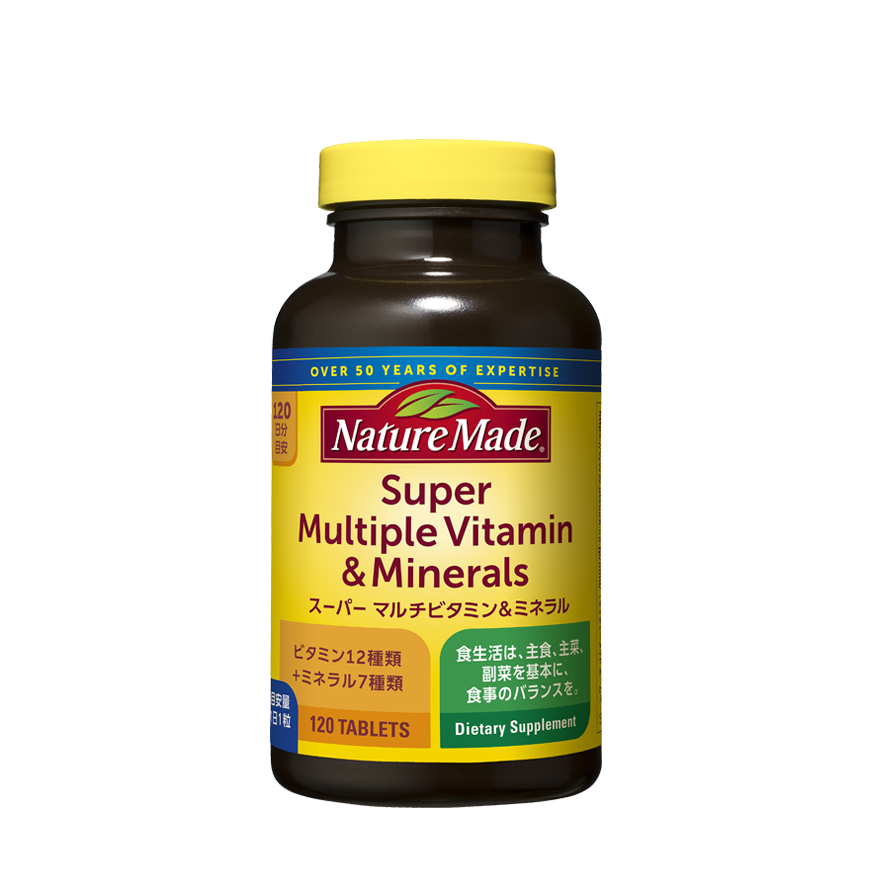
Look for スーパーマルチビタミン&ミネラル or “Super Multiple Vitamin & Minerals.” The 120-tablet bottle lasts 120 days at one daily tablet. Its advantage for someone who has selected this formula is fewer tablets to count, not automatically more nutrition or easier swallowing.
Packaging and formulas can change. Match the Japanese name, daily serving and ingredient list on your bottle, rather than relying on the yellow cap or an overseas product photograph.
What changes in a full day's serving?
The comparison is one Multi Vitamin tablet, two ordinary mineral tablets, or one Super tablet. It is not a one-tablet-versus-one-tablet comparison.
| Item per suggested daily serving | Multi Vitamin: 1 tablet | Multi Vitamin & Mineral: 2 tablets | Super: 1 tablet |
|---|---|---|---|
| Vitamins included | 12 vitamins | 12 vitamins | 12 vitamins |
| Seven-mineral blend | Not included | Included | Included |
| Vitamin A | 600 μg | 1,200 μg | 1,200 μg |
| Vitamin C | 300 mg | 150 mg | 125 mg |
| Vitamin D | 5 μg | 5 μg | 10 μg |
| Vitamin E | 26.8 mg | 26.8 mg | 9 mg |
| Current declared allergens | Milk | None of the listed allergens | None of the listed allergens |
In each mineral-containing daily serving, 900 μg of the 1,200 μg vitamin A total is derived from beta-carotene. This is part of the listed vitamin A total, not an extra 900 μg to add to it.
The following eight B-vitamin amounts are the same across all three daily servings: B1 1.5 mg, B2 1.7 mg, B6 2 mg, B12 3 μg, niacin 15 mg, pantothenic acid 6 mg, biotin 50 μg and folate 240 μg.
Both mineral formulas provide the same daily amounts: calcium 200 mg, magnesium 100 mg, zinc 6 mg, iron 4 mg, copper 0.6 mg, selenium 50 μg and chromium 20 μg. “Minerals” does not mean every mineral is included or every dietary need is covered.
Irene's comparison tip: Super has more vitamin D, but less vitamin C and E than the ordinary mineral version's two-tablet serving. That is why “Super” cannot be read as “twice as strong.” The useful choice is the formula that fits the supplementation you actually need.
One tablet is not necessarily easier to swallow
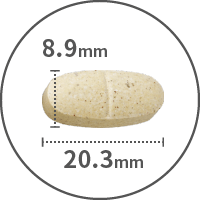
The official tablet illustration gives Super's dimensions as approximately 20.3 × 8.9 mm. The ordinary mineral tablet is approximately 16.1 × 9.2 mm, and the vitamin-only tablet approximately 18.9 × 8.4 mm. These are tablet dimensions, not a guarantee that a particular person can swallow them comfortably.
The Super product caution specifically warns older people about choking because the tablet is large. If you have difficulty swallowing tablets, do not force it or assume one tablet is easier than two; ask a pharmacist about a suitable alternative.
Important checks before starting
- Children: all three products say infants and children should not take them. Do not divide an adult daily serving to make a child's dose.
- Pregnancy or planning pregnancy: the vitamin-only Multi carries a specific warning to avoid excessive vitamin A intake when planning pregnancy or within the first three months. Have the exact formula and other supplements checked with your clinician; these comparisons are not a prenatal-supplement recommendation. Seek individual advice during breastfeeding too.
- Medicines or ongoing treatment: Otsuka recommends consulting a doctor or pharmacist about combinations, because interactions can occur.
- Avoid overlap: both mineral formulas warn that excessive zinc can interfere with copper absorption. Check other zinc, iron, calcium and vitamin supplements rather than adding them automatically.
- Allergies: Multi Vitamin contains milk ingredients. Current official pages declare none of the listed allergens for the two mineral versions, but this does not guarantee freedom from every possible allergen. During product transitions, your own bottle's ingredient and allergy labels take priority. Do not assume an older or overseas bottle matches the current Japanese web page.
All three are Japanese foods with nutrient function claims. This category does not mean the individual product has been approved to treat a condition. The labels say taking more does not cure disease or provide greater health benefits.
A simple daily routine
- Confirm the full name and daily amount: Multi Vitamin one tablet; Multi Vitamin & Mineral two tablets; Super one tablet. Keep the daily totals in mind when switching products.
- Take the tablets with water. There is no medicine-style fixed dosing time. Otsuka suggests after a meal as a practical option and suggests spreading products with two or more daily tablets across the day.
- Store away from heat, humidity and direct sunlight. Close the cap after use. For the mineral products, avoid wet hands or water droplets: the manufacturer warns that moisture can discolour the tablets.
- Keep the bottle away from children, and follow the instructions on your own pack. If you feel unwell after taking it, stop and seek advice rather than increasing the amount.
Before checkout, read “& minerals,” “one or two tablets per day,” and the allergy label. Those three checks are more useful than choosing the biggest bottle or the word “Super.”
Official sources
Product information checked on 14 October 2026. These figures describe the current Japanese official formulas; check the bottle you purchase.
- Otsuka: Multi Vitamin
- Otsuka: Multi Vitamin & Mineral
- Otsuka: Super Multi Vitamin & Mineral
- Otsuka: full product information and precautions
- Otsuka: Nature Made FAQ
- Otsuka official shop: Multi Vitamin storage and cautions
- Otsuka official shop: Multi Vitamin & Mineral storage and cautions
- Otsuka official shop: Super storage and cautions