- Start with medicine or food, then swallow or chew
- Match the complete package before choosing the format
- Keep medicine doses separate from food serving guides
- Saclophyl: 15 mg per tablet, for ages 15 and over
- BreathCare: swallowed capsules or chewable gummies
- Persistent bad breath: return to teeth, gums and the cause
- Official sources and image credits
Start with medicine or food, then swallow or chew
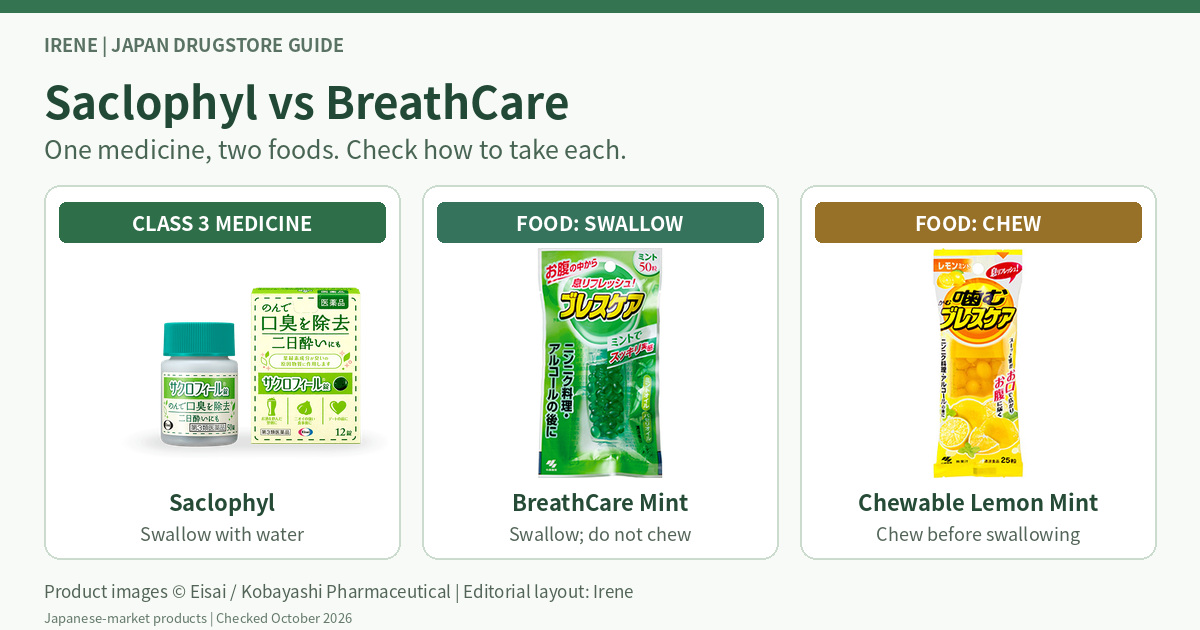
For the Japanese medicine, match “サクロフィール錠” and “第3類医薬品” on Saclophyl. For a refreshing food after a meal, choose the BreathCare format you prefer: swallowed capsules or chewable gummies. Similar green packaging does not mean the directions or purposes are interchangeable.
- Looking for a medicine labeled for removing bad breath? Saclophyl Tablets are a Japanese Class 3 OTC medicine for ages 15 and over, with a defined medicine dose.
- Prefer swallowing with a drink? BreathCare Mint (ブレスケア ミント) is a refreshing food capsule. Do not bite it open.
- Want a lemon-mint flavor in your mouth? Chewable BreathCare Lemon Mint (噛むブレスケア レモンミント) is a refreshing gummy food intended to be chewed.

I’m Irene, a Taiwan-born, Japan-licensed pharmacist working in a Japanese drugstore. On this shelf, I start with three label clues: 錠 for tablets, ミント for mint, and 噛む for chew. They make a much clearer shopping list than “those little green pills.”
This guide compares one medicine and two foods. It does not rank them as three equivalent treatments. Recurrent or persistent bad breath, especially with bleeding, sore or swollen gums, deserves a dental assessment.
Match the complete package before choosing the format
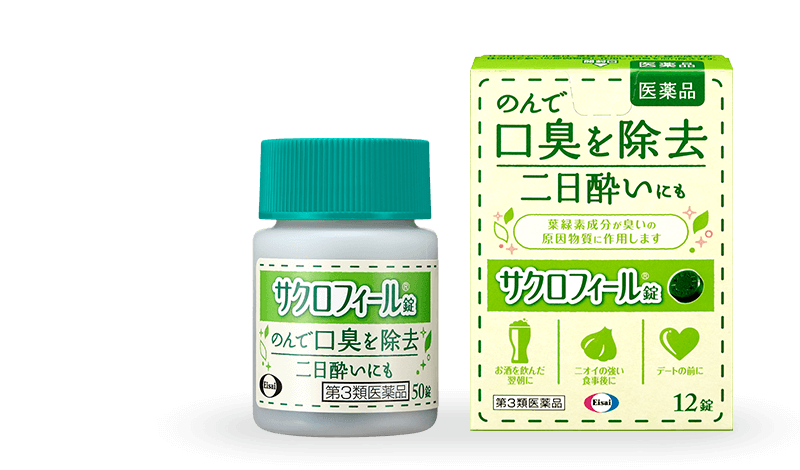
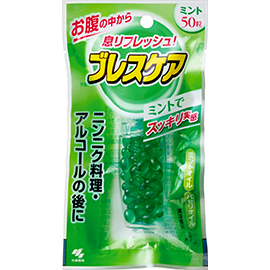
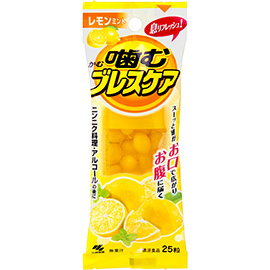
BreathCare also sells other flavors, Speed products and carbonated tablets. The ingredients and directions here apply only to the two named foods. Saclophyl’s 12- and 50-tablet sizes are pack choices, not different strengths. This guide covers Japanese-market products; check the local label for similarly named products sold elsewhere.
Keep medicine doses separate from food serving guides
| What to check | Saclophyl Tablets | BreathCare Mint | Chewable Lemon Mint |
|---|---|---|---|
| Japanese category | Class 3 OTC medicine | Refreshing food: capsules | Refreshing food: gummies |
| Main reason to consider it | A labeled medicine for removing bad breath | A format swallowed with a drink | A chewable format with flavor in the mouth |
| How to take it | With water or warm water; no need to chew or suck | Swallow with water or another drink; do not chew | Chew before swallowing |
| Amount each time | Ages 15+: 3–4 tablets | Serving guide: 2–3 capsules; 3–4 when particularly concerned | Serving guide: 1–2 pieces; 2–3 when particularly concerned |
| Frequency and age | 1–3 times a day; do not use under 15 | No medicine-style daily schedule on the food label; see children’s cautions below | No medicine-style daily schedule on the food label; see children’s cautions below |
| Check first | Medical treatment or pregnancy/possible pregnancy: consult first; persistent/worsening loose stools: stop and consult | Contains gelatin; check suitability before giving to a child; not a dental treatment | Contains gelatin and sugars; check suitability before giving to a child; not a dental treatment |
The food amounts are guides per serving, not daily limits. Do not borrow Saclophyl’s “1–3 times daily” schedule for either food. Kobayashi’s FAQ says these foods have no fixed daily amount, but eating large amounts may cause loose stools. Use the serving guide rather than repeatedly adding more for a stronger cooling sensation.
Saclophyl: 15 mg per tablet, for ages 15 and over
The active ingredient is sodium copper chlorophyllin, 15 mg per tablet (銅クロロフィリンナトリウム). Eisai describes this green ingredient as acting on odor-causing substances inside the body to remove bad breath. That product explanation cannot diagnose your breath as coming from your stomach or show that tooth decay or gum disease has been treated.
The Japanese labeled indications are removal of bad breath and hangover. Do not extend that wording into promises of faster alcohol clearance, lower blood alcohol or fitness to drive. A change in breath is not a measure of whether alcohol has cleared.
- 1. Check age and amountAges 15 and over: 3–4 tablets per dose, 1–3 times daily. Children under 15 must not take it; do not improvise a smaller child’s dose.
- 2. Take with waterUse water or warm water. The carton allows use when breath concerns you, within the stated dose limits. It does not require a before- or after-meal schedule, chewing or sucking.
- 3. Remove the blister firstFor the 12-tablet pack, push each tablet through the foil and remove it. Never swallow the blister packaging; it can injure the esophagus.
Who should ask first, and when should you stop?
- If you are receiving medical treatment: consult a doctor, pharmacist or registered medicine seller before use. Bring a list of other medicines for a check as well.
- If pregnant or possibly pregnant: Eisai’s separate current FAQ advises consultation before use. If breastfeeding or uncertain about your individual circumstances, check first too; absence of a specific statement is not blanket reassurance.
- If loose stools persist or worsen: stop taking it and consult with the carton or leaflet. This is the product’s stated stop-and-consult condition; it does not specify a three-day or one-week cutoff.
- If an illness is causing the odor: Eisai also advises treating that underlying condition. Repeatedly needing a breath product is a reason to investigate the cause.
Your tongue may temporarily turn green and the color fades with time. Stools may also appear green or smell less strong. Eisai attributes these changes to the ingredient’s color and deodorizing action. Do not dismiss other new symptoms as merely a color change.
Full active ingredient and inactive ingredients
Each tablet contains sodium copper chlorophyllin 15 mg. Inactive ingredients: corn starch, dl-menthol, magnesium silicate, calcium stearate and sucrose. Check the Japanese pack you have. A medicine’s inactive-ingredient list is not a food-allergen declaration.
Keep it cool, dry, out of direct sunlight and out of children’s reach. Do not transfer it to another container or mix in other medicines. Do not use it after expiry. For the 50-tablet bottle, discard the transport cushioning after first opening and keep the cap tightly closed.
BreathCare: swallowed capsules or chewable gummies
Mint capsules: swallow whole with a drink
Kobayashi classifies ブレスケア ミント as a refreshing food. The manufacturer describes menthol and parsley oil as refreshing components; its directions say do not chew, and swallow with water or another drink. The 50-capsule pack and 100-capsule Mint refill share the same ingredient list. The refill is not a different dose.
The serving guide is 2–3 capsules, or 3–4 when you are particularly concerned about breath. Choose it for the swallowed format, rather than biting the capsule for a stronger mint sensation.
Lemon Mint gummies: “噛む” means “chew”
Chewable BreathCare Lemon Mint is a refreshing gummy food. Kobayashi describes the refreshing components, including menthol and parsley oil, and flavor spreading in the mouth when it is chewed. Lemon-mint flavor and cooling sensation are manufacturer descriptions, not evidence that it removes odor better than the capsule.
The serving guide is 1–2 pieces, or 2–3 when particularly concerned. The 25- and 100-piece Lemon Mint packs share the same ingredient list. Do not substitute the ingredients of another fruit flavor.
Both contain gelatin (ゼラチン). Each official label lists gelatin in its declaration covering 28 food allergens. Avoid them if you are allergic to gelatin. For other food allergies, check the complete ingredients and the actual pack as well. Neither is a vegan option.
A food classification does not make it suitable for every child. The two product-label pages checked do not give a numerical minimum age. Before buying for a child, confirm the pack and ask the manufacturer or a pharmacist, particularly if the child cannot reliably swallow or chew the product.
Full food ingredient lists
BreathCare Mint: vegetable oil/fat (made in Japan), gelatin, parsley oil / flavoring, glycerin, sodium aspartate, antioxidant (Chinese bayberry extract), coloring (Green No. 3), sweetener (neotame).
Chewable BreathCare Lemon Mint: sugar (made in Japan), maltose, gelatin, starch syrup, starch, vegetable oil/fat, parsley oil / sorbitol, vitamin C, calcium lactate, flavoring, acidulants, thickening polysaccharides, emulsifier, glazing agent, coloring (carotenoids).
The order follows the Japanese labels; ingredients after the slash are food additives. These are food formulations, not quantities of Saclophyl’s medicinal active ingredient, so milligram comparisons would be misleading.
Keep both foods cool, dry and out of direct sunlight; use them promptly after opening. Close the 50-capsule and 25-gummy containers after use, and seal the 100-gummy pouch. Transfer capsule refills only into the specified BreathCare 50-capsule container, keeping the desiccant out of the bottle.
Kobayashi explicitly states that neither food affects blood alcohol concentration. A cooling sensation, mint flavor or change in breath cannot tell you whether it is safe to drive.
Persistent bad breath: return to teeth, gums and the cause
Bad breath can be associated with foods, tooth or gum problems, dry mouth and other causes. Smell alone does not diagnose the cause. Brush gently with fluoride toothpaste, clean between the teeth and gently clean the tongue, and keep up regular dental visits. See a dentist if bad breath remains after a few weeks of improved self-care, or if you have painful, bleeding or swollen gums, toothache or loose adult teeth. You do not need to finish a pack first.
For an everyday brushing product, the Clean Dental toothpaste comparison explains preventive care and flavor choices. If you are looking at a gum medicine, the Dent Health R and Bb guide explains finger-applied versus toothbrush-applied medicines. Their directions cannot be exchanged with those of the swallowed and chewed products here, and they do not replace dental treatment.
Irene’s shopping tip: send a photo showing the full name before buying for someone else. Confirm medicine or food, then “swallow with water” or “chew.” That is more useful than filling a basket with every green breath product.
Official sources and image credits
Japanese-market labels checked on 18 October 2026. Follow the complete labeling on your own pack. Product images belong to Eisai and Kobayashi Pharmaceutical and identify the products discussed. This guide does not replace individual medical or dental assessment.
- Eisai: Saclophyl Tablets, Japanese product information
- Eisai: current Japanese carton and directions
- Eisai: use during pregnancy or possible pregnancy
- Kobayashi Pharmaceutical: BreathCare food label, ingredients and directions
- Kobayashi Pharmaceutical: Chewable BreathCare food label, ingredients and directions
- Kobayashi Pharmaceutical: serving methods, quantities and excessive intake
- NHS: bad breath, self-care and when to see a dentist