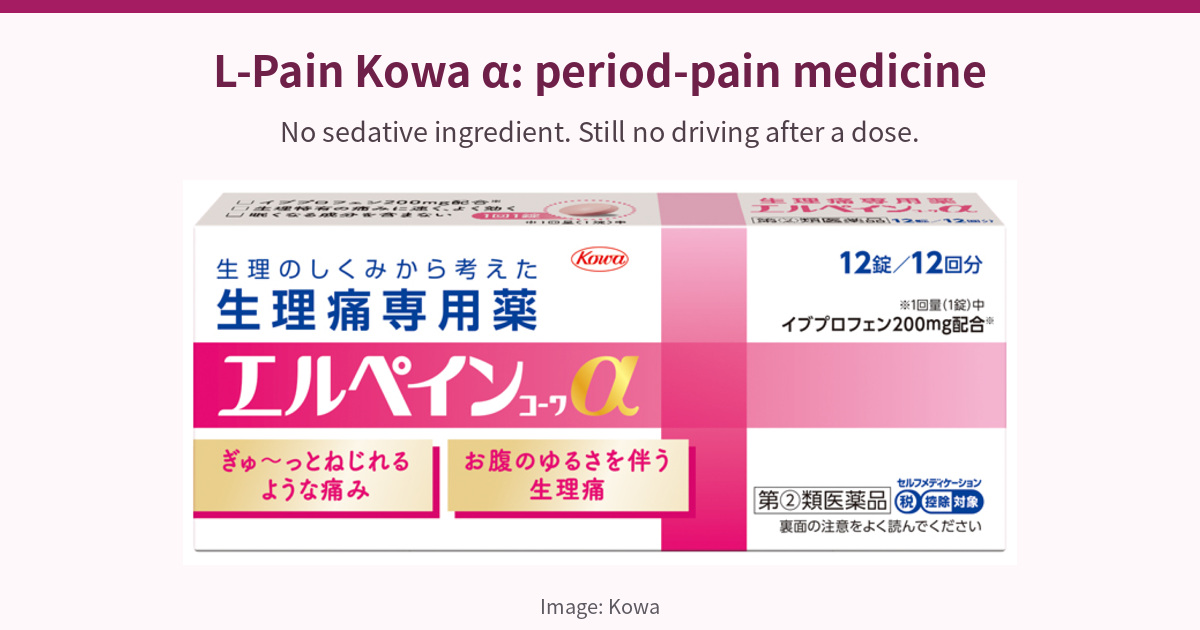
L-Pain Kowa α is a period-pain medicine, but having no drowsiness-inducing ingredient does not make it suitable for driving. Its Japanese leaflet prohibits driving or operating machinery after a dose because blurred vision and unusually strong glare can occur. Start with its intended use, your travel plans and what other medicines you have taken.

I’m Irene, a Taiwan-born, Japan-licensed pharmacist working in a Japanese drugstore. For a road trip, the phrase “less likely to cause drowsiness” can catch your eye. With this medicine, there is another warning to check before making plans.
Japan-market information checked on 19 October 2026, Japan time.
- Is this the medicine you meant to buy?
- Find the current alpha box
- One tablet, two active ingredients
- Why no driving if there is no sedative ingredient?
- Remember one tablet, four hours, normally two doses
- Who must not take it?
- Who needs advice before use?
- Check painkillers, stomach medicines and motion-sickness tablets
- Stop after three or four doses without improvement
- Two common shopping questions
- Official and clinical sources
Is this the medicine you meant to buy?
- Looking for period-pain relief: the labeled indication is menstrual pain, mainly lower abdominal pain associated with loose stools. Age, medical conditions and other medicines still need checking.
- Need to drive, ride a motorcycle or operate machinery: do not do so after taking it, even if you feel fully awake.
- Looking for headache, fever, PMS or ovulation-pain treatment: these are outside this product’s labeled use. It is also not a medicine to take in advance to prevent period pain.
The indication’s emphasis on period pain with lower abdominal pain and loose stools describes the symptoms this formula focuses on. “Mainly” is not a diagnostic test requiring you to decide suitability from bowel movements alone. Do not use it as a general diarrhea treatment or to self-diagnose unexplained abdominal pain.
Find the current alpha box
Look for the full Japanese name エルペインコーワα and the gold α on the pink-ribbon carton. Kowa’s English name is L-PAIN KOWA α. The image below shows the complete current 12-tablet box.
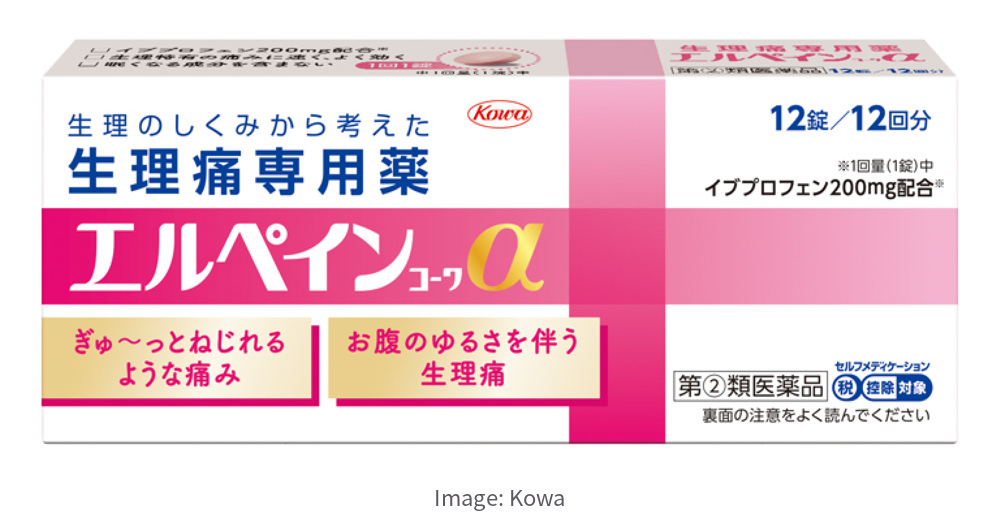
Alpha launched on 1 October 2025 with 200 mg of ibuprofen per tablet. The older L-Pain Kowa without alpha contained 150 mg per tablet and is now listed by Kowa as no longer in production. Older travel guides may show that version. The current 12- and 24-tablet packs contain the same formula; they are different pack sizes, not different strengths. Twelve tablets is the box content, not one dose.
One tablet, two active ingredients
This is a designated Class 2 OTC medicine in Japan, not a menstrual-health supplement. Each quantity below is for one tablet, the single labeled dose for ages 15 and over.
| Active ingredient | Amount per tablet | Role in the formula |
|---|---|---|
| Ibuprofen | 200 mg | Reduces excess production of prostaglandins involved in pain. |
| Butylscopolammonium bromide (scopolamine butylbromide) | 10 mg | Reduces excessive contractions of the uterus and intestines. |
The formula combines a pain-relieving ingredient with an antispasmodic. It contains no caffeine or added sedating pain-relief aid, but it still has side effects and restrictions. One tablet does not mean a weaker medicine or one suitable for everyone; milligram amounts of different drugs do not create a useful effectiveness ranking.
Why no driving if there is no sedative ingredient?
The antispasmodic ingredient has anticholinergic effects, which can interfere with the eyes’ ability to focus. L-Pain alpha’s own leaflet and Kowa’s FAQ warn about blurred vision and unusually strong glare. They explicitly prohibit driving and operating machinery after use.
Do not wait for blurred vision before following the no-driving rule. It applies after a dose even if you feel alert. The leaflet also lists sleepiness as a possible adverse reaction: no drowsiness-inducing ingredient is not a promise that you cannot feel sleepy.
Tell the pharmacist before buying if you need to drive, so your medicine and transport plans can be considered together. The four-hour gap between doses below is not a guaranteed waiting time after which driving becomes safe.
Remember one tablet, four hours, normally two doses
| Check | Japanese labeled directions |
|---|---|
| Age | 15 and over. Do not give to anyone under 15. |
| Single dose | 1 tablet with water or lukewarm water. |
| When | When symptoms occur, avoiding an empty stomach where possible. |
| Interval | At least 4 hours between doses. |
| Daily frequency | Normally up to 2 doses. A third dose is allowed only if symptoms return. |
This is not a fixed three-times-daily schedule. Do not take an early extra tablet because pain remains. Record when you take each dose, and do not borrow another painkiller’s tablet count or interval.
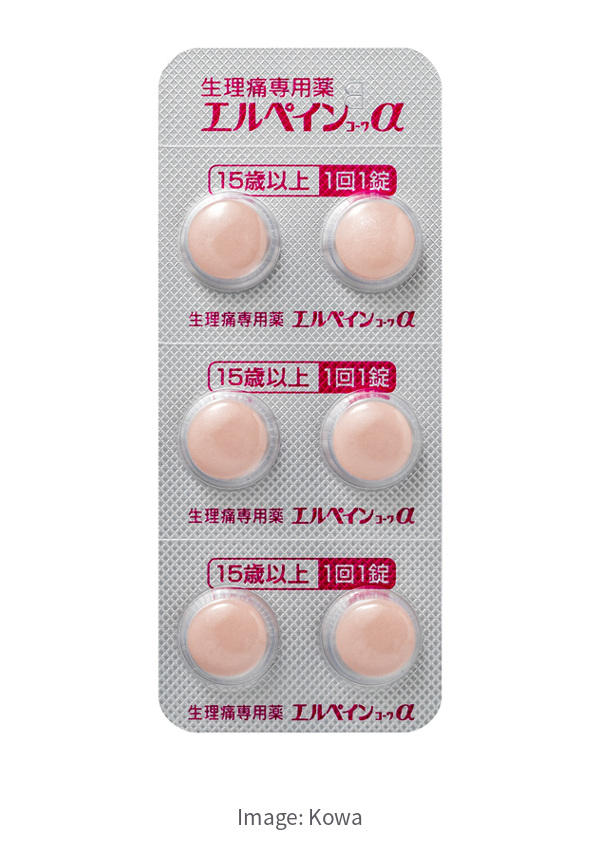
The blister itself is marked for ages 15 and over and one tablet per dose. Press the raised pocket to push a tablet through the foil, then swallow only the tablet, never the blister packaging. The six tablets shown in this strip are packaging, not a single dose.
Who must not take it?
- Anyone who has had an allergic reaction to this product or its ingredients, or asthma triggered by this medicine, a painkiller/fever medicine or a cold remedy.
- Anyone under 15, or within 12 weeks of their expected delivery date.
- Anyone diagnosed with glaucoma.
- Anyone currently receiving medical treatment for a stomach/duodenal ulcer, blood disorder, liver disease, kidney disease, heart disease or high blood pressure, or taking zidovudine (Retrovir).
Being treated for those conditions is a do-not-use restriction, not merely a general suggestion to ask first. Earlier pregnancy is not automatic permission to take it either; advice is required.
Who needs advice before use?
Ask a doctor, dentist, pharmacist or registered OTC seller first if you are receiving medical or dental treatment, are pregnant or may be pregnant, are breastfeeding, have a history of allergy to medicines or other substances, or have difficulty passing urine.
- A diagnosis of heart, kidney or liver disease, systemic lupus erythematosus (SLE), mixed connective tissue disease or bronchial asthma requires advice.
- So does a history of stomach/duodenal ulcer, ulcerative colitis, Crohn’s disease, blood disorder, liver disease or kidney disease.
If the current-treatment restriction above also applies, do not take it. Bronchial asthma requires prior advice; asthma previously triggered by painkillers or cold remedies is a do-not-use condition. The inactive ingredients include lactose. Show the full leaflet if you have an ingredient-allergy concern.
Check painkillers, stomach medicines and motion-sickness tablets
While taking this product, do not use other painkiller/fever medicines, cold remedies, sedatives, gastrointestinal pain-relief/antispasmodic medicines, stomach medicines containing scopolia extract, or motion-sickness medicines. On Japanese labels, scopolia extract appears as ロートエキス. This restriction is wider than avoiding duplicate ibuprofen: Kowa also names painkillers and cold medicines containing loxoprofen or paracetamol (acetaminophen).
If you have taken EVE, Bufferin, paracetamol or a motion-sickness medicine, show the pharmacist the exact product, dose and time. Four hours is not permission to switch freely between products. If you take the contraceptive pill, Kowa says to consult your usual doctor before use. Do not drink alcohol before or after a dose, or use the medicine continuously for a long period.
Stop after three or four doses without improvement
The Japanese leaflet says to stop and seek advice if symptoms have not improved after three or four doses, not three or four days. Take the leaflet with you; the pain may be related to a uterine condition. Seek gynecological care sooner if severe pain persists rather than waiting to reach that count.
Stop immediately and seek advice for possible adverse reactions such as rash, itching, stomach pain, nausea, dizziness, sleepiness, palpitations, difficulty urinating, blurred vision or unusual bleeding. Persistent or worsening constipation or dry mouth also means stop and seek advice. An unusually low body temperature, profound weakness or cold hands and feet requires stopping immediately and seeking advice.
Seek immediate medical care for breathing difficulty, confusion, crushing chest pain, sudden one-sided weakness or speech problems, vomiting blood, black/bloody stools, or high fever with a widespread rash or eroded lips. Yellow skin or eyes, markedly reduced urine with widespread swelling, or a severe headache with a stiff neck and fever also need immediate medical care. These are warning examples; do not wait for every symptom to appear.
New or unusual pelvic pain needs assessment
Sudden severe or worsening pelvic/lower abdominal pain, particularly with fainting, shoulder-tip pain, heavy vaginal bleeding or difficulty breathing, needs emergency assessment. Seek prompt medical help for pelvic pain with possible pregnancy, fever or unusual discharge. Increasingly painful or heavier periods, bleeding between periods, or pain that disrupts daily life also warrants a medical appointment rather than repeatedly changing to a higher-dose medicine.
Two common shopping questions
Can I take it before my period to prevent pain?
No. Kowa says it has no preventive indication and should be taken when symptoms occur. It also says not to use it for PMS or ovulation pain because its effects for those conditions have not been verified.
Is it interchangeable with EVE, Bufferin or Inochinohaha?
Check the exact product and its indication rather than grouping everything used around a period together. For general painkiller formulas, see the five-product EVE guide and four-product Bufferin comparison. If your shopping list says Inochinohaha, use the Inochinohaha range guide to identify that product. These are identification links, not advice to combine medicines.
Look for alpha, remember one tablet, and do not drive after a dose. Check restrictions and other medicines before deciding whether the labeled period-pain use fits. Keep the box and leaflet; store in a cool, dry place away from direct sunlight and children. Do not transfer tablets to another container, damage the blister foil or use expired medicine.
Official and clinical sources
- Kowa: current Japan product information and packaging
- Kowa: full original Japanese leaflet (2 pages)
- Kowa: English reference leaflet (3 pages)
- Kowa: medicine FAQ
- Kowa: alpha launch announcement, 1 October 2025
- Sanofi: anticholinergic and eye-focusing effects of the antispasmodic ingredient (2019 professional information, printed pages 22–23)
- NHS: period pain and changes requiring assessment
- NHS: pelvic-pain emergency warning signs
This guide helps identify Japanese products and explain their labels. It does not replace individual medical advice or the full leaflet supplied with the medicine. Ingredient pharmacology is used only to explain the eye effects; this product’s directions and restrictions come from Kowa’s Japanese leaflet.