Checked 19 October 2026 | Products sold in Japan
Herpecia Cream and Arasena S Cream are Japanese Class 1 OTC medicines for recurrent cold sores in people previously diagnosed and treated by a doctor. A first blister, an uncertain diagnosis, or a problem inside the mouth or around the eye needs medical assessment. Once eligibility is established, compare the active ingredient, allergy history and application schedule, rather than choosing the higher percentage.
 I’m Irene, born in Taiwan, licensed as a pharmacist in Japan and working in a Japanese drugstore. With these products, explaining your previous diagnosis matters more than choosing a brand first.
- Check whether this episode is suitable for OTC treatment
- Herpecia versus Arasena S: the practical differences
- When to start and how to apply
- Pregnancy, breastfeeding, other treatment and sensitive skin
- When to stop: five days is a review point, not a guarantee
- Keeping the tube while travelling
- If the problem is dryness or an ulcer inside the mouth
- Sources
Check whether this episode is suitable for OTC treatment
- Both are only for a recurrence on the lips or surrounding skin, after a doctor has previously diagnosed and treated your cold sores. Tingling or blisters alone cannot establish the diagnosis. Without that medical history, see a doctor first.
- Under six, a suspected first episode or widespread affected areas: do not self-treat with either cream. Being six or older does not automatically make someone eligible; the recurrence requirement still applies. Children need parental guidance and supervision.
- Fever or a widespread rash: seek medical assessment rather than choosing a cream. Arasena S explicitly prohibits use with these systemic symptoms.
- Eyes, the area around the eyes, inside the mouth and other body sites: these are outside the scope of self-treatment with these products. Eye symptoms need medical care. An ulcer inside your mouth is not the same treatment problem as an external cold sore.
Both are labelled “第1類医薬品”, Japan’s Class 1 OTC category, requiring a pharmacist’s assessment and medicine information at purchase. A current manufacturer listing does not guarantee local stock or eligibility for every customer.
Herpecia versus Arasena S: the practical differences
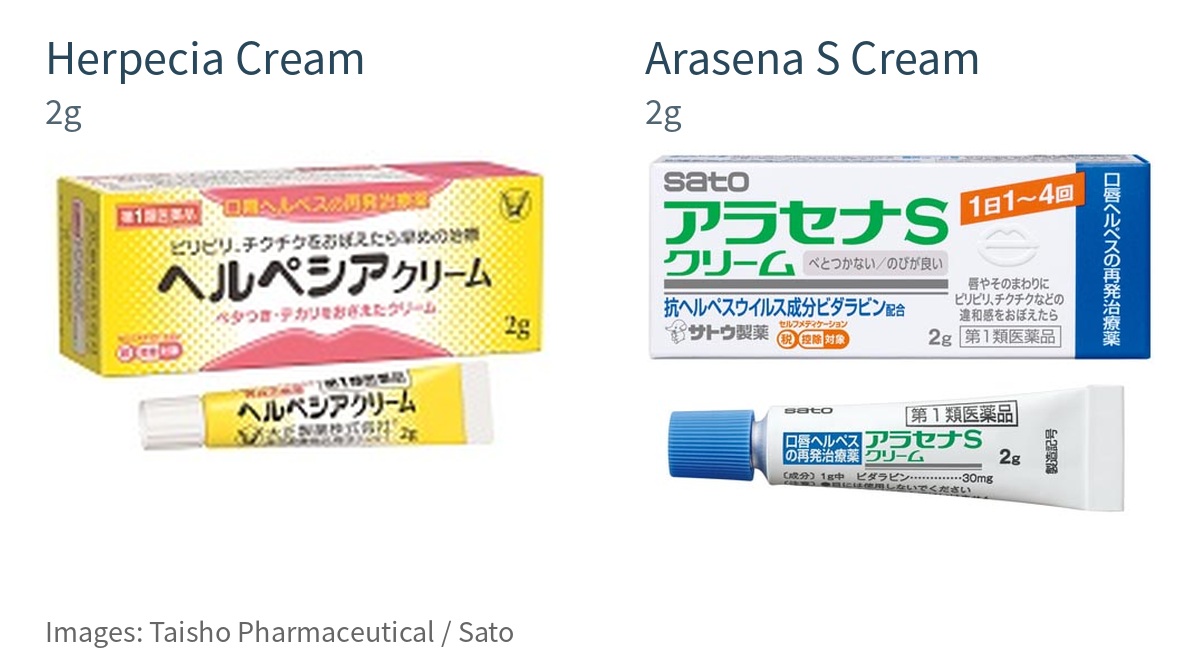
| What to check | Herpecia Cream | Arasena S Cream |
|---|---|---|
| Japanese pack name | Herpecia Creamヘルペシアクリーム; 2g; Taisho | Arasena S CreamアラセナSクリーム; 2g; Sato |
| Active ingredient per gram | Herpecia CreamAcyclovir 50mg (5%) | Arasena S CreamVidarabine 30mg (3%) |
| Daily applications | Herpecia CreamApply an appropriate amount 3–5 times a day | Arasena S CreamApply an appropriate amount 1–4 times a day |
| If it is not improving | Herpecia CreamStop and consult after about five days without improvement, or if it worsens | Arasena S CreamStop and consult after five days without improvement, or if it worsens |
| After opening | Herpecia CreamUse within six months and before the printed expiry date | Arasena S CreamUse within six months and before the printed expiry date |
Five per cent and three per cent describe different medicines, so they are not a strength ranking. Arasena S contains vidarabine, not acyclovir. Do not transfer one product’s application schedule to the other. This comparison covers the two creams only, not the separate Arasena S ointment.
Do not use Herpecia if you have previously had an allergic reaction to the product, its ingredients or a valacyclovir medicine. Arasena S must not be used by anyone with a previous allergy to that product or its ingredients. Do not assume that switching automatically makes treatment safe: have the pharmacist check your allergy and medication history. After those checks, choose a product whose labelled schedule you can follow; there is no need to layer both creams.
When to start and how to apply
For someone with a previous medical diagnosis and treatment whose current episode meets the recurrence criteria, both labels advise starting when the familiar early tingling or prickling appears on or around the lips. This is treatment of a recurrence, not symptom-free preventive skincare. Arasena S further says to start as early as possible, within five days of those early symptoms. That does not mean waiting five days before applying it.
- Wash your hands thoroughly before and after use. Confirm that the affected area is an eligible external lip site.
- Apply an appropriate amount at your chosen product’s labelled frequency. The manufacturers suggest after meals and bedtime as useful timing cues. Neither gives a fixed centimetre-long strip per application; “per gram” in the ingredient table is not a one-gram dose.
- Use externally only. Do not apply inside the mouth, lick the cream or get it in your eyes. If it enters an eye, rinse immediately with water or lukewarm water; seek an eye doctor if symptoms are severe.
- Close the cap securely, keep the carton and leaflet, and note the treatment start and opening dates. Make sure a family member does not mistake it for a product for their first-ever blister.
For a new Herpecia tube, turn the cap over and press its pointed end against the tube seal to open it. Do not assume every medicinal cream is applied in the same way as a lip balm.
Pregnancy, breastfeeding, other treatment and sensitive skin
Both leaflets require advice from a doctor or pharmacist before use if you are receiving medical treatment, pregnant or possibly pregnant, breastfeeding, have previously had an allergic reaction to medicines or other substances, have severe weeping or erosion of the affected skin, or have atopic dermatitis. External application does not remove these checks.
Tell the pharmacist about oral and topical medicines, especially prescribed antiviral treatment, so they can check for duplication and decide how to manage the episode. Do not stop prescribed medicine yourself or combine the creams as an improvised stronger treatment.
Check the inactive ingredients too
Herpecia lists glycerin, dimethylpolysiloxane, stearyl alcohol, propylene glycol, liquid paraffin, l-menthol, sorbitan stearate, polysorbate 60, parabens, citric acid and sodium citrate.
Arasena S lists stearic acid, palmitic acid, cetyl alcohol, self-emulsifying glyceryl monostearate, glycerin, D-sorbitol, sodium hydroxide, potassium hydroxide, parabens and “three other ingredients”. Those last three are not individually named in this leaflet. If you have a specific ingredient allergy, ask the pharmacist to check with the manufacturer rather than assuming the list establishes allergy safety.
When to stop: five days is a review point, not a guarantee
For either cream, stop immediately and take the leaflet to a doctor or pharmacist if you develop a rash, redness, swelling, itching, contact dermatitis or irritation after application. Herpecia also lists pain, dryness, burning, peeling and hives. Increasing discomfort is not something to push through as a sign the medicine is working.
Stop and seek advice if Herpecia has not helped after about five days, or Arasena S after five days, or if symptoms worsen at any point. Arasena S also prohibits prolonged continuous use: even when there is improvement, taking more than two weeks to heal may indicate a severe episode or another condition and needs medical assessment. This two-week warning never replaces the earlier five-day no-improvement rule. The Herpecia leaflet does not state a separate two-week limit; do not silently transfer that wording between products.
Keeping the tube while travelling
Keep both tightly capped, out of direct sunlight in a cool place and away from children. Do not transfer the cream into another container. Arasena S specifically requires a dry location at 30°C or below. Avoid leaving it in a hot car. Six months after opening is a storage limit, not permission to use the medicine continuously for six months; an earlier printed expiry date still takes priority.
If the problem is dryness or an ulcer inside the mouth
For dry, cracked lips or inflamed corners, the MOILIP lip cream guide explains a different medicine category; it is not a substitute for these antiviral creams. For ulcers inside the mouth, see the Traful versus Taisho Quick Care mouth-ulcer patch guide for those products’ eligibility rules. Do not put a mouth-ulcer patch on a suspected cold sore.
At the pharmacy, explain whether a doctor previously diagnosed and treated your cold sores, when this episode began, where it is, your age, any pregnancy or breastfeeding, allergies and current medicines. Those details are more useful than asking which cream is fastest.