Hochuekkito 41 is worth discussing when fatigue comes with the label’s whole pattern: low physical strength, little energy and reduced digestive function. A tiring day of sightseeing alone is not enough to choose it. If fatigue is unexplained, persistent or interfering with daily life, checking the cause comes before buying another fatigue remedy.

I’m Irene, a Taiwan-born, Japan-licensed pharmacist working in a Japanese drugstore. For this box, I would ask about your appetite, how long you have felt tired and everything else you take. Those details are more useful than asking for the “strongest” fatigue medicine.
Japanese OTC product information checked: 19 October 2026. Follow the leaflet supplied with your own pack.
First decide whether the symptom pattern fits
The Japanese indication describes someone with weak physical strength, low energy, reduced gastrointestinal function and a tendency to tire easily. Within that qualification, the listed uses are weak constitution, fatigue or malaise, weakness after illness or surgery, poor appetite, night sweats and the common cold.
These words describe the approved use of this exact product. They do not establish the cause of your symptoms. After an illness or operation, discuss persistent weakness with your treating team rather than adding a medicine independently.
- Tired with a poor appetite and weak digestion? Explain the complete picture to a pharmacist to check whether 41 is a suitable self-care option.
- Simply short of sleep after a busy trip? Make room for sleep, regular meals and a gentler itinerary. The word “fatigue” on a box does not make it a substitute for rest.
- Hoping to prevent colds or boost immunity? Those are not this product’s approved claims. “Common cold” appears only within the qualifying pattern above.
Rikkunshito 43 also includes easy fatigue in its digestive symptom pattern, but its approved uses focus on digestive complaints. A nearby number does not mean a stronger or weaker version of 41. If your main question is which digestive formula fits, see the Hangeshashinto 14 and Rikkunshito 43 guide. Do not combine them just because the descriptions overlap.
Hochuekkito is also a different kind of medicine from an Alinamin B-vitamin formula or a medicinal Hepalyse nutritional-support product. A shared mention of tiredness does not make the formulas interchangeable or justify taking them together.
Recognise the exact OTC box
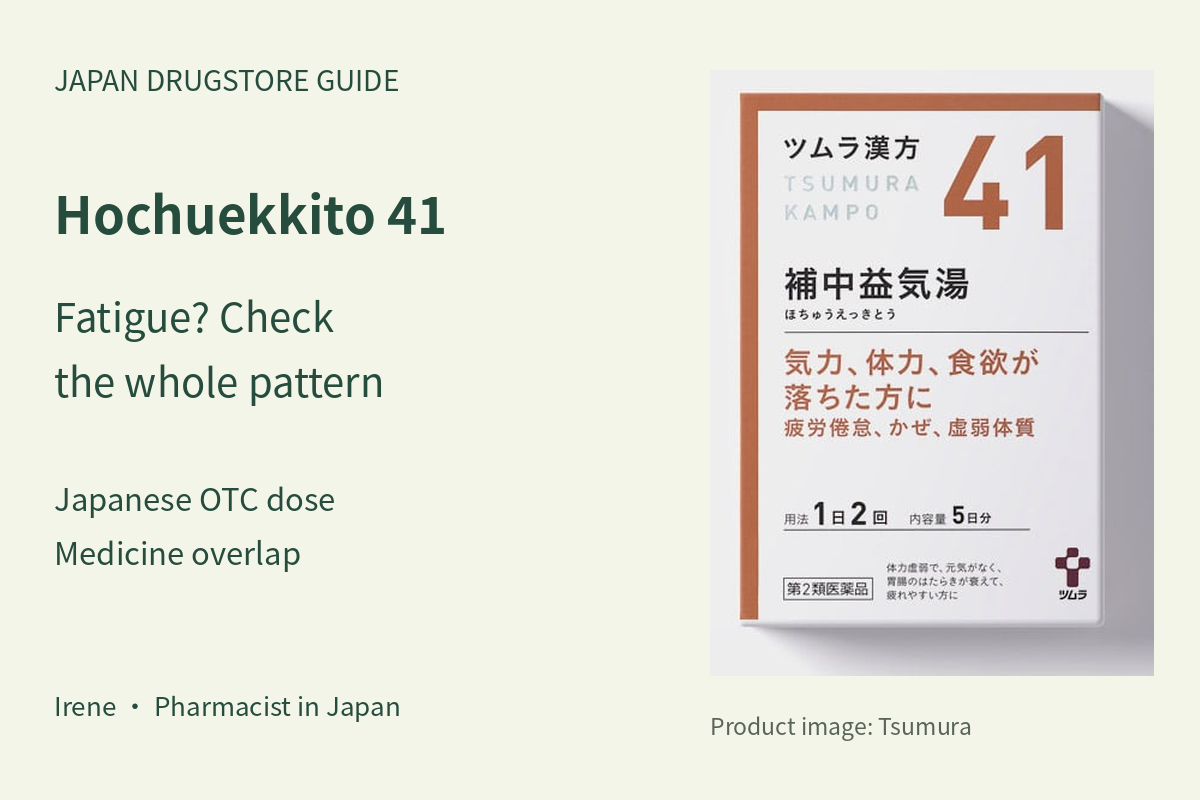
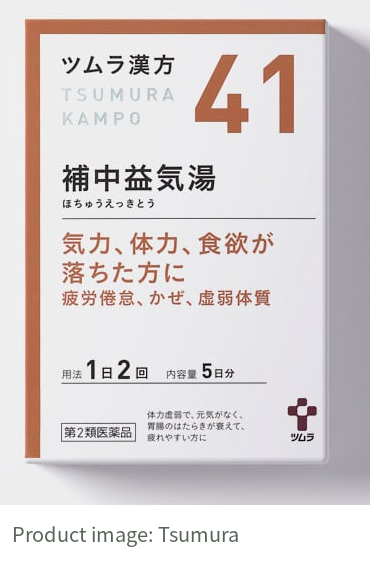
Look for ツムラ漢方補中益気湯エキス顆粒, Tsumura Kampo Hochuekkito Extract Granules, with number 41. It is a Japanese Class 2 OTC medicine. The current manufacturer page lists 10-sachet and 48-sachet packs. At the adult daily dose, these contain five and 24 days’ worth respectively; this is pack arithmetic, not a recommended treatment course.
Do not apply a prescription Tsumura dosing schedule, another maker’s sachet size or directions from a similarly named product sold elsewhere. The “half quantity” description of the extract is a formulation specification, not permission to double the OTC dose.
Two doses a day, before meals
Take the amount below twice daily before meals, with water or warm water. Tsumura explains “before meals” as about 30 minutes before eating. Choose two meals that fit your daily routine. This product’s directions say before meals; do not change that to three times a day based on another Kampo product.
| Age | Amount each time |
|---|---|
| 15 and over | 1 sachet (1.875 g) |
| 7–14 | Two-thirds of a sachet |
| 4–6 | Half a sachet |
| 2–3 | One-third of a sachet |
| Under 2 | Do not use |
The child doses are label information, not a recommendation to treat a tired child during travel. Have a clinician or pharmacist assess suitability and explain how to measure the fraction; do not estimate it by eye. Children must take it under an adult’s guidance and supervision.
These official images show the granules and individual sachet. The pictured granules are not a measured dose or a guide to dividing a sachet.
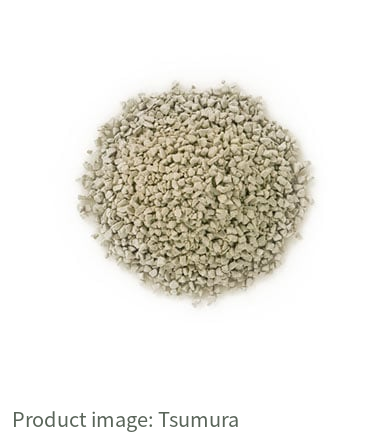
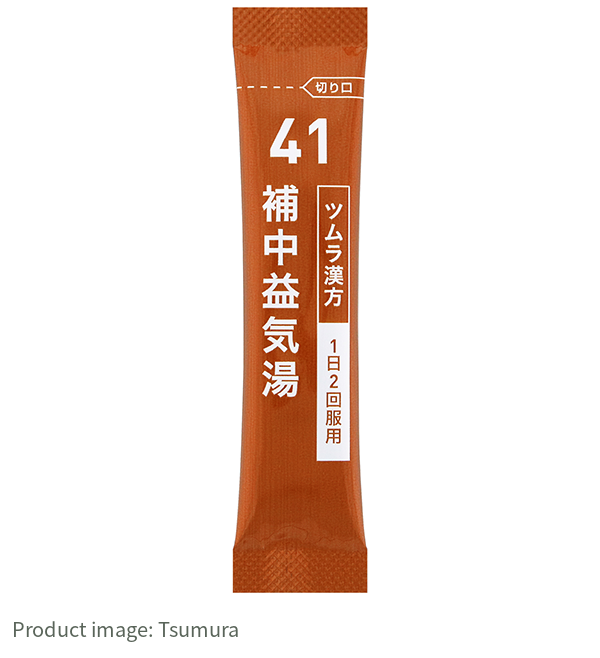
For a partly used sachet, fold over the opening and use the remainder within two days. Store in a cool, dry place out of direct sunlight and children’s reach. Do not use after expiry. The manufacturer notes that herbal ingredients can cause some variation in granule colour without changing efficacy.
Ten crude herbs, with licorice worth checking
The adult daily amount is two sachets: 3.75 g of finished granules containing 2.5 g of Hochuekkito extract (half quantity). The following are the crude-herb quantities used for that extract, not separate doses to prepare or add together as the weight of the finished granules.
| Crude herb | Label quantity |
|---|---|
| Astragalus root | 2.0 g |
| Atractylodes lancea rhizome | 2.0 g |
| Ginseng | 2.0 g |
| Japanese angelica root | 1.5 g |
| Bupleurum root | 1.0 g |
| Jujube | 1.0 g |
| Citrus unshiu peel | 1.0 g |
| Licorice (glycyrrhiza; kanzo / 甘草) | 0.75 g |
| Cimicifuga rhizome | 0.5 g |
| Ginger | 0.25 g |
Inactive ingredients are magnesium stearate and lactose hydrate. If an ingredient causes you concern, show the exact list to a pharmacist.
Bring a list or photographs of all your medicines before adding 41. Check whether any other medicines also contain licorice or glycyrrhizin. Licorice can cause a condition called pseudoaldosteronism, with high blood pressure and low potassium; severe low potassium can cause weakness or an irregular heartbeat. This is a reminder about overlapping licorice ingredients; ask a pharmacist to check all your medicines. Do not assume that a small listed herb amount makes stacking products safe.
Who should ask first, and when should you stop?
The product requires consultation with a doctor, pharmacist or registered OTC medicine seller before use if you are receiving medical treatment, are pregnant or might be pregnant, or have previously had a rash, redness, itching or a similar reaction to medicines or other substances.
Stop immediately and seek advice if rash, redness or itching occurs after taking it. Bring the leaflet. The manufacturer also lists these rare serious reactions. Stop taking it and seek immediate medical assessment if symptoms suggesting these serious reactions occur:
- Interstitial pneumonia: breathlessness or breathing difficulty when climbing stairs or with slight exertion, dry cough or fever, especially when these begin suddenly or persist.
- Liver dysfunction: fever, itching, rash, yellow skin or whites of the eyes, brown urine, whole-body tiredness or loss of appetite.
New or worsening tiredness after starting a fatigue medicine should not automatically be blamed on the trip, particularly with those other signs.
If there is no improvement after about one month, stop and consult with the leaflet. When taking it for a common cold, the label’s threshold is 5–6 days. These are stop-and-consult limits for nonresponse, not instructions to wait that long before seeking care.
When fatigue deserves a medical check
Arrange an assessment if tiredness has lasted a few weeks without a clear reason, affects daily life or comes with weight loss or other concerning changes. Fatigue with palpitations, breathlessness or pale skin can need investigation; thirst, frequent urination or unexplained weight loss also deserves attention. Do not self-diagnose a vitamin deficiency or “weak constitution” from these symptoms.
Severe breathing difficulty, a tight or heavy chest, blue/grey or very pale lips or skin, or sudden confusion needs emergency help. Do not wait to see whether Hochuekkito works.
Irene’s shelf check
Before paying, confirm three things: the complete OTC name, whether your whole symptom pattern fits, and whether it can be used with your current medicines. If suitable, follow the twice-daily before-meal schedule. If the real question is why you keep feeling exhausted, a medical assessment is the more useful next step.