
I’m Irene, a Taiwanese pharmacist in Japan. This guide helps you find the right leaflet and prepare questions for a pharmacist. It does not determine whether a medicine is suitable for you.
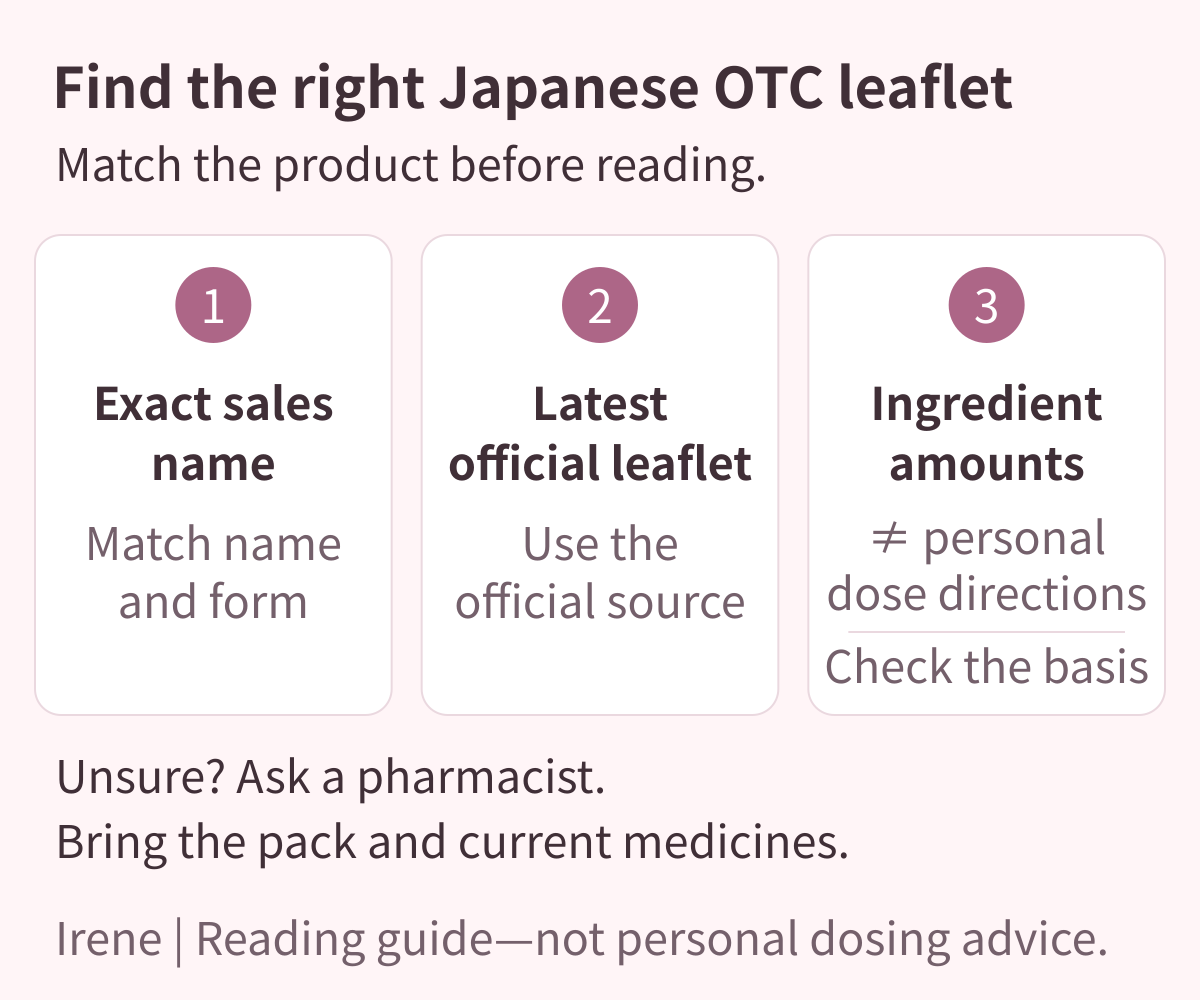
Have a Japanese medicine box, but keep finding translations, old screenshots or another product in the same range? Match the full Japanese name, retrieve the corresponding official leaflet, read the warnings, then separate dosing instructions from the basis used in the ingredient table. A familiar brand name is not enough to work out how much to take.
- 01IdentifyFull name, formulation, manufacturer
- 02RetrieveOfficial search, matching leaflet
- 03Read in contextWarnings, directions, ingredient basis
- 04ConfirmPack, medicine record, questions
- Start with the full product name
- Find the matching leaflet through PMDA
- When a result or version does not match
- Read both the action and its timing
- Separate the dose instructions from the ingredient basis
- Keep the Japanese text when asking for help
- Prepare a focused pharmacist check
- Official sources and scope
Start with the full product name
Keep the complete Japanese name, including letters, numbers and wording such as 錠 or 顆粒. Check the manufacturer and formulation too. A translated nickname, box colour or shop listing can provide a clue, but does not establish identity.
Tablets, patches and gels sharing a brand can appear together in search results. Do not transfer directions from a product sold in Taiwan, Hong Kong or another market to the Japanese version. If the name is unreadable, you have only a loose tablet, or the manufacturer does not match, ask a pharmacist rather than selecting the closest-looking result.
Check packaging changes instead of guessing what they mean. For example, Eisai’s Selbelle Seii Tablets page explicitly says its announced package renewal does not change the ingredients. That statement applies to this particular change, not every redesign.
Find the matching leaflet through PMDA
These steps reflect the desktop flow checked on 22 October 2026. Layout may differ by device. Open PMDA’s 一般用医薬品・要指導医薬品 情報検索 for non-prescription medicines.
- Enter the full Japanese name in 販売名(医薬品の名称), the sales-name field.
- The checked page defaulted to 部分一致, a partial match. Names containing your search text may appear too. Check that 添付文書 is selected, then choose 検索.
- Compare 販売名 and 製造販売業者等: the product name and manufacturer information. Do not simply choose the first result or newest date.
- Open the PDF in the matching row’s 添付文書 column. Check the name inside the document again.
Our partial-match search for ロキソニンS returned 14 results, including oral and topical products. The example opened was the exact ロキソニンS row from Daiichi Sankyo Healthcare. This demonstrates identification, not a medicine recommendation; result counts may change.
If a revision date, 改訂年月, is shown, check it. PMDA explains that updated leaflets can differ from the paper in your box. Confirm the exact product before using the current information. A leaflet revision date is not a medicine expiry date and says nothing about how your pack was stored. PMDA source-use guidance
When a result or version does not match
- No PMDA result: recheck the full name, then look at that manufacturer’s official product page or leaflet directory. PMDA confirms that some OTC leaflets are not listed. Absence alone establishes neither authenticity, safety nor suitability.
- An old PDF link fails: return to the search entry point. PMDA says leaflet URLs change with updates. A saved download, cached copy or screenshot is not confirmed current just because it still opens.
- An older pack differs from today’s page: keep both and ask the manufacturer or pharmacist to establish the version. Do not replace its information with that of a different current product in the range. Official directories can also retain discontinued products; a live page does not prove ongoing manufacture.
See the PMDA FAQ and, as one manufacturer example, Daiichi Sankyo Healthcare’s leaflet directory. Resolve an uncertain identity or version before filling the gap with a guess.
Read both the action and its timing
使用上の注意 introduces precautions. The Japanese labels and short phrases below are signposts; the English explanations are not a complete translation of any warning. Read the full condition, who it applies to, the symptoms and which professional the instruction names.
- してはいけないこと
- Prohibited uses or actions. Follow a restriction that applies to you, a combination or an activity. Reducing the amount or trying one dose does not bypass a prohibition.
- 相談すること
- Matters requiring consultation. Read beyond the heading: instructions may concern before use, after use or symptoms that fail to improve.
- 服用前
- Before taking the medicine. A requirement to consult first means before use, not after trying it.
- 直ちに服用を中止
- Stop taking it immediately. If the stated condition occurs, also follow the consultation instruction that follows; stopping alone may not be the full action.
- 直ちに医師の診療を受けて下さい
- Obtain medical attention from a doctor immediately. Do not soften this into asking a pharmacist when convenient.
For example, Loxonin S’s official information includes pre-use consultation, stopping and consulting after specified symptoms, and immediate medical attention for serious symptoms within its consultation section. The heading is not permission to try the medicine first. This overview omits the products’ full contraindications and adverse-effect lists, so cannot rule out risk.
Separate the dose instructions from the ingredient basis
Read 用法・用量 first
Find the product’s age row, amount per administration, frequency, interval, timing or method, and adjacent restrictions. 1回量 means the amount for one administration; 1日 refers to a day. Do not assign one universal age threshold to “adult” on Japanese medicines, or treat a daily maximum as a target.
When a medicine has no pediatric directions, do not create a child’s dose by halving the adult amount. SSP’s official FAQ specifically addresses this mistake.
Then ask what quantity the ingredient table describes
Sections such as 成分・分量 or 成分と働き describe ingredients and amounts. Read the basis above the numbers: it may be one tablet, a stated number of tablets or sachets, a volume, or an adult daily quantity. That basis is not your personal dosing instruction.
Example 1: ロキソニンS
1錠中This leaflet reports the ingredient amount per tablet. That phrase alone cannot tell you how much to take at one time.
Example 2: セルベール整胃錠
成人1日量3錠中This leaflet uses a total of three tablets, described as the adult daily quantity, as its ingredient-table basis. Do not read those three tablets as one administration.
For a pharmacist’s ingredient check, keep the ingredient name, unit and quantity basis together. Do not crop out just the milligrams to rank products as “stronger,” or calculate a new dose yourself.
Keep the Japanese text when asking for help
Some manufacturers offer other languages as comprehension aids. Check that the version corresponds to the same Japanese product. This guide does not treat an unchecked translation as the current leaflet or substitute an overseas formula for the Japanese one.
PMDA warns that machine translation may be inaccurate and does not translate PDF files. Browser translation, OCR and search snippets cannot replace the full Japanese leaflet and professional confirmation. If a negative instruction, number, unit, heading or product name is unreadable, do not use a tool to guess it back into place. Show the original and the uncertain passage to a pharmacist. PMDA’s translation notice
Prepare a focused pharmacist check
Bring the box, container, leaflet and medicine where practical. If you only have photos, show the complete name, manufacturer, directions, ingredients and expiry clearly, rather than just a logo or loose tablet. This is a practical preparation suggestion, not a guarantee of identification from a photo.
- Your situation: age, symptoms and duration, allergies or past adverse reactions, relevant conditions, and pregnancy or breastfeeding where applicable.
- Other products used now or recently: prescriptions, OTC medicines, Kampo and supplements, with amounts and last-use times. Say when something is uncertain.
- The question: is this the same product, which warning might apply, and what quantity does the ingredient table describe? If already used, record what, when and how much.
A medicine record supports checks for duplication and interactions. The Pharmaceutical Society of Japan’s explanation of お薬手帳 includes OTC medicines, supplements and allergy/adverse-reaction history. Share personal health information with the professional helping you; there is no need to post it in public comments.
Finding a document begins the check. Ask a pharmacist when identity, essential wording or conditions of use remain uncertain. If the leaflet calls for immediate medical attention, follow that instruction rather than delaying care to continue searching.
Official sources and scope
- PMDA non-prescription medicine search, source-use and revision guidance, and FAQ
- Daiichi Sankyo Healthcare: Loxonin S and leaflet entry point; leaflet directory
- Eisai: Selbelle Seii Tablets and Japanese leaflet entry point
- SSP: no improvised pediatric dose when no pediatric directions exist
- Pharmaceutical Society of Japan: medicine records
This is a retrieval and reading guide, not a complete leaflet for any product. Official information was checked on 22 October 2026; return to official entry points for later updates. The diagram is original. No official webpage screenshots, leaflet images or package photos are reproduced.