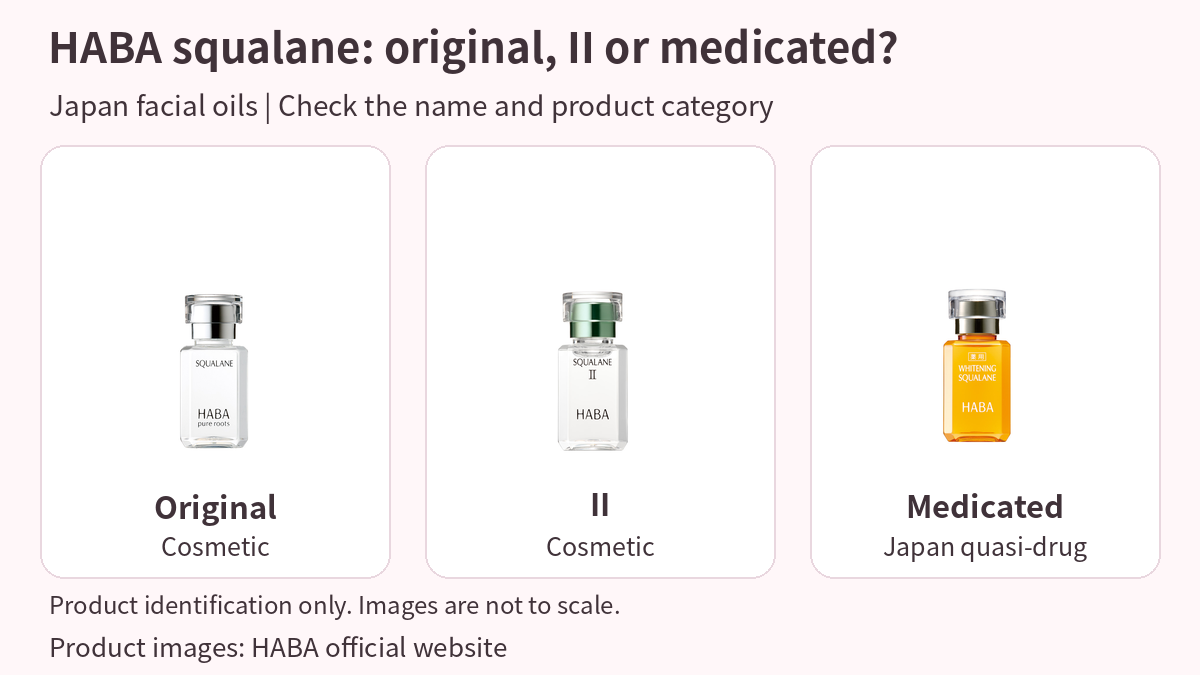
The II on a HABA bottle identifies a version, not a strength level. The original and II are cosmetics; Medicated Whitening Squalane is a Japanese quasi-drug. First match the bottle’s full name and category, then choose a size. The basic application sequence is lotion first, spread the oil across your palms, then press gently onto the face.

I’m Irene, a Taiwan-born pharmacist qualified in Japan.
- Match the full Japanese name before choosing a size
- Original and II share an ingredient listing; the medicated oil differs
- Read “medicated whitening” with its stated limits
- The basic order: cleanse, apply lotion, then squalane
- Read your pack, and do not push through a skin problem
- Image credits and official sources
Match the full Japanese name before choosing a size
The Japanese names below help you check the shelf label or official listing. “Original” here means 高品位「スクワラン」. This comparison excludes Q10, limited sets and the differently named 薬用ホワイトレディ.
| Japanese product name | Classification in Japan | Listed sizes |
|---|---|---|
| 高品位「スクワラン」 | Cosmetic skincare oil | 15, 30, 60 and 120 mL |
| 高品位「スクワラン」II | Cosmetic skincare oil | 15, 30 and 60 mL |
| 薬用ホワイトニングスクワラン | Skincare oil classified as a Japanese quasi-drug | 15 and 30 mL |
For example, the 30 mL manufacturer item codes are 010110 for the original, 010070 for II and 010141 for the medicated version. These are HABA item codes, not JAN barcodes. Matching the bottle size alone does not establish that two products are the same.
Original and II share an ingredient listing; the medicated oil differs
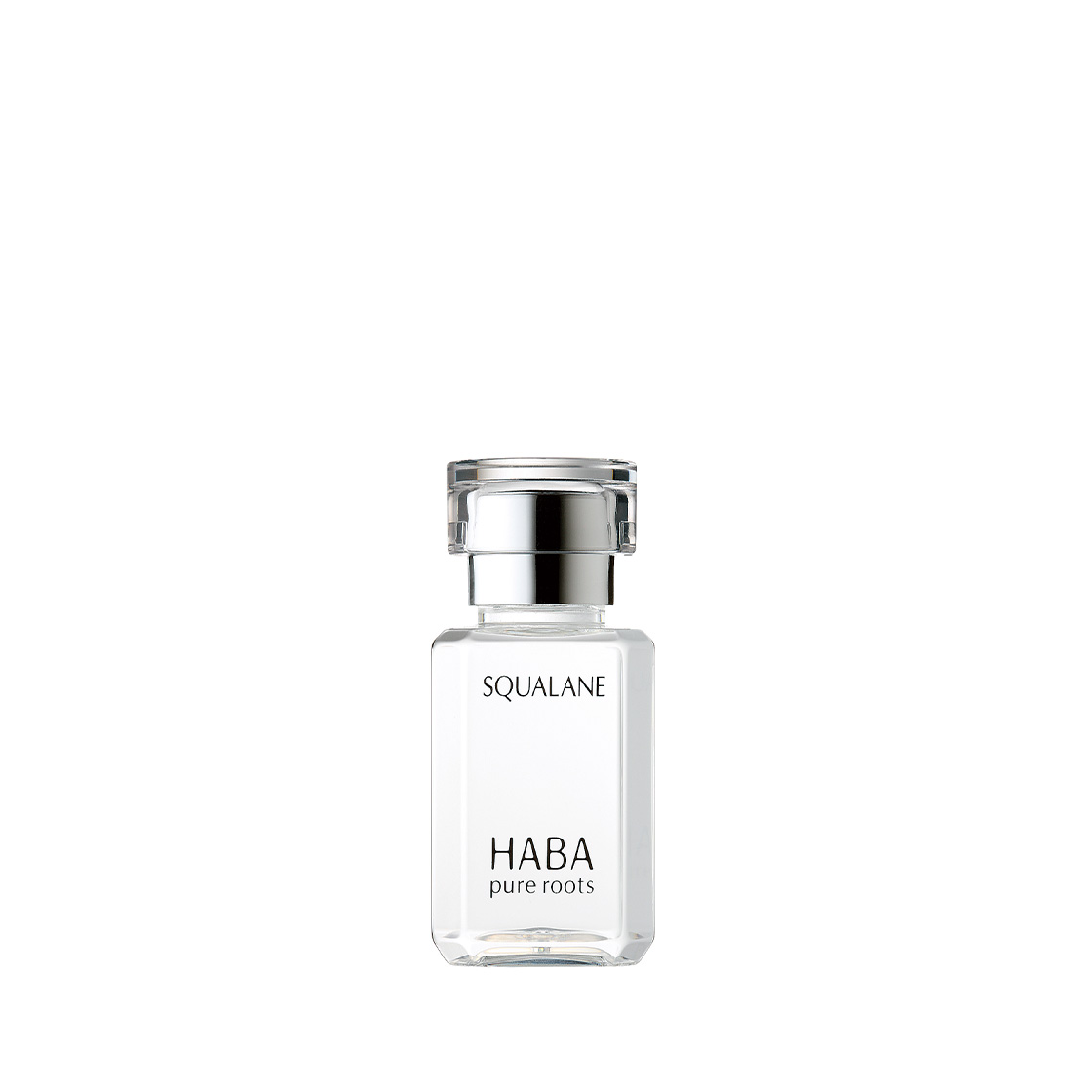
Original: 高品位「スクワラン」
Plant-derived: 高品位「スクワラン」II
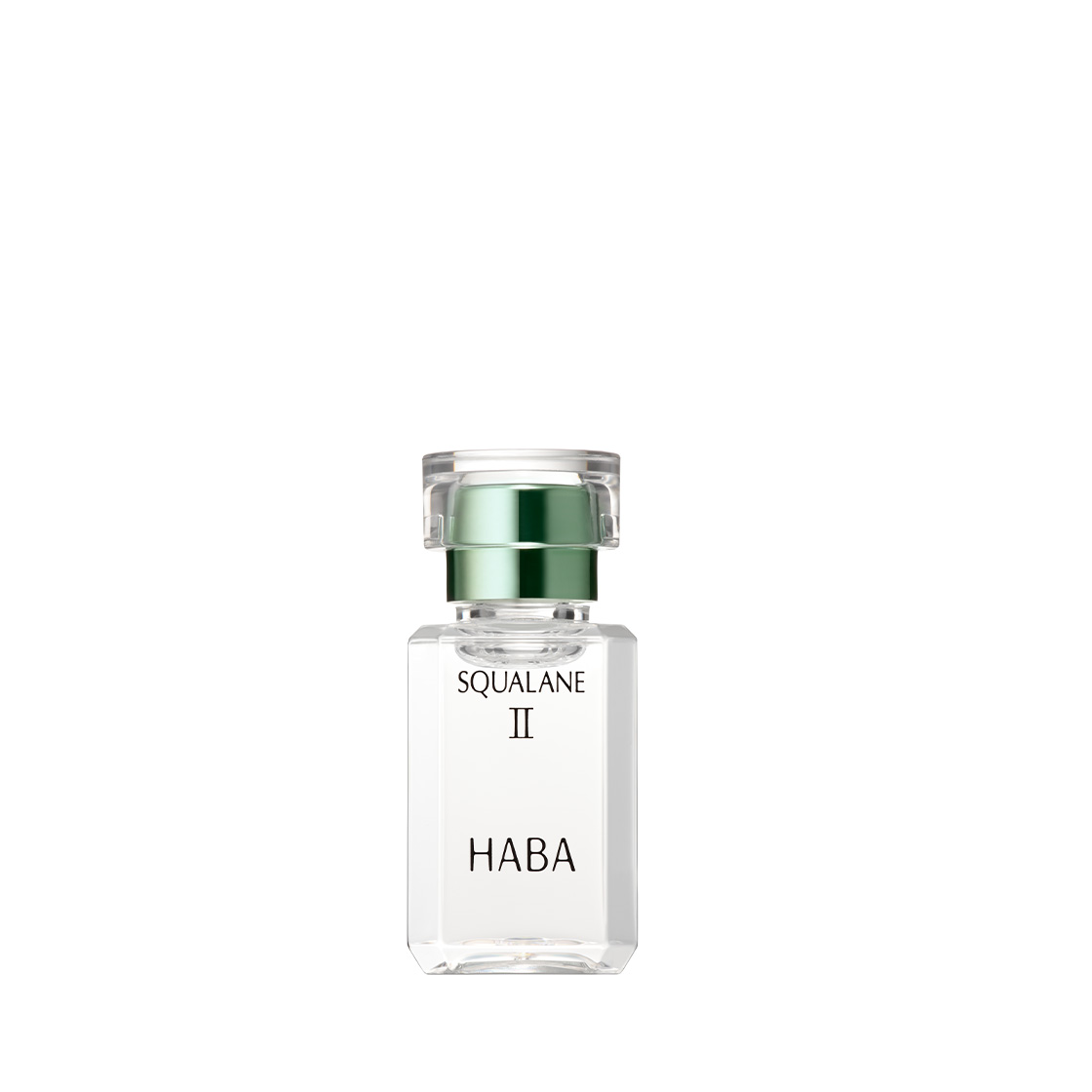
The original and II both list only スクワラン (squalane) as their ingredient. HABA describes II as plant-derived. Its FAQ says that, despite the raw-material difference, the original and II do not differ in their effects on the skin, method of use or feel. That is the manufacturer’s description, not a guarantee of identical suitability for every person.
The plant-derived label can help identify II; it does not establish that it is safer, less irritating or more effective. Also distinguish スクワラン (squalane) from スクワレン (squalene). They are not interchangeable ingredient names.
Read “medicated whitening” with its stated limits
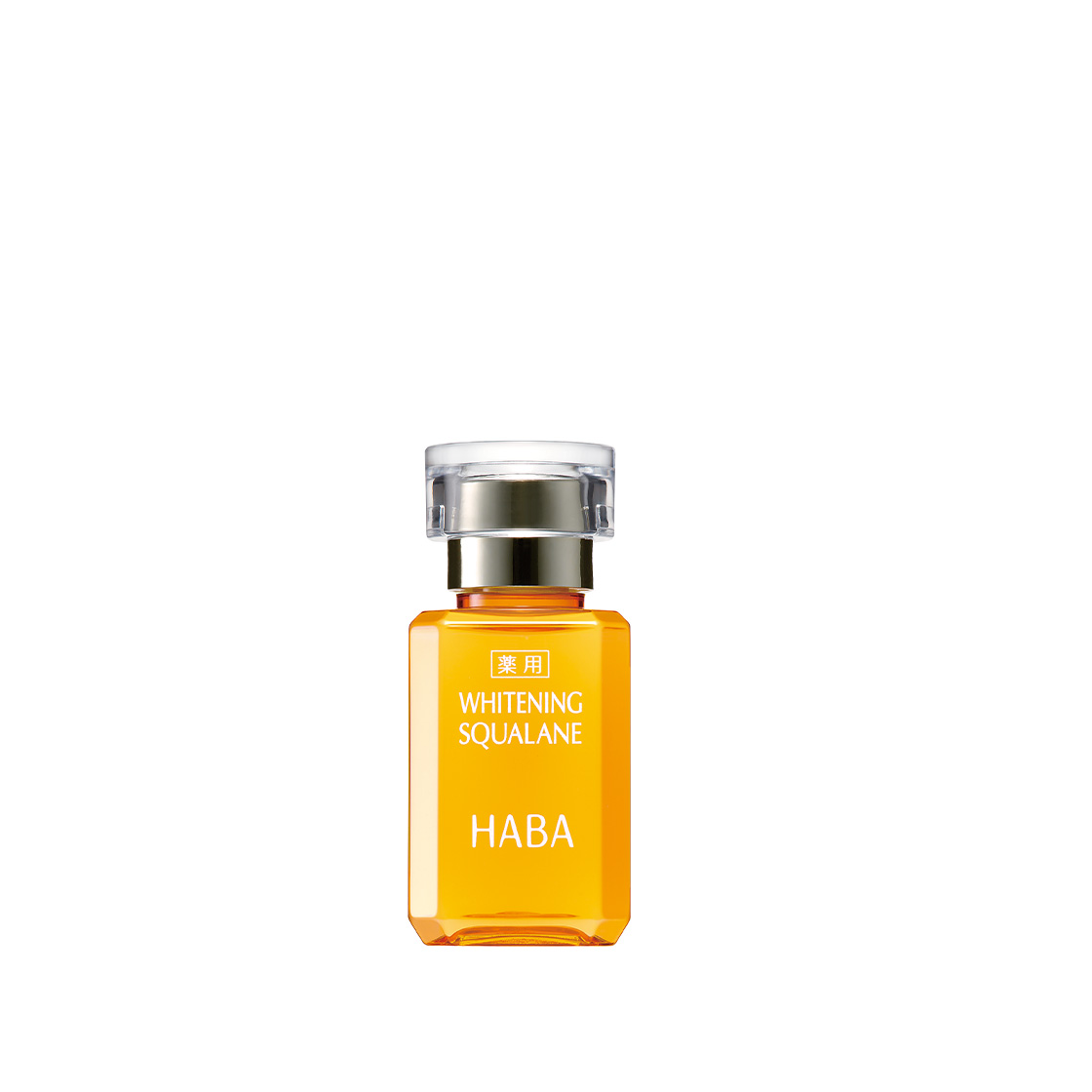
The medicated oil’s registered Japanese name is 薬用 ホワイトニングCオイル. Its active ingredient is listed as テトラ2-ヘキシルデカン酸アスコルビルEX. The other ingredients are スクワラン (squalane) and 天然ビタミンE (natural vitamin E). Natural vitamin E is not listed as the active ingredient in this product.
The medicated version is a Japanese quasi-drug, not a medicine for treating disease. The maker defines its whitening purpose as suppressing melanin formation to help prevent spots and freckles caused by sun exposure. This does not mean removing existing spots, changing your natural skin colour or providing sunscreen protection.
For 薬用ホワイトニングスクワラン, the official product page advises first-time users and people with sensitive skin to start with a sample. That note applies to the medicated version. An uneventful sample trial does not guarantee that a reaction will never occur.
The basic order: cleanse, apply lotion, then squalane
All three product pages show the basic sequence of makeup removal/face washing, lotion, then squalane. Here, “lotion” means the hydrating 化粧水 step. Their application guide is:
- While drops of lotion remain on your palms, take one drop of squalane.
- Spread it well across both palms so that it can be applied over the face.
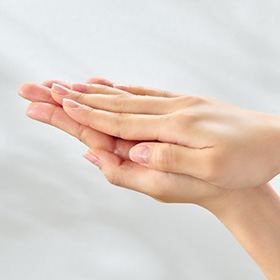
Spread it across both palms before moving to the face. Use step 1 for the maker’s basic amount guide. - Gently cup your face with your hands and press lightly.
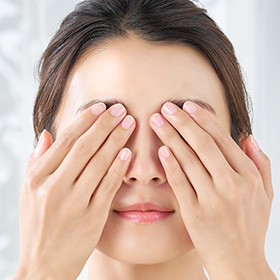
Then gently cup the face with both hands and press lightly.
One drop is the product pages’ basic amount guide, not a fixed amount for every person. HABA’s general skincare advice says to adjust to the skin’s condition, while the original product page cautions against applying too much. This basic sequence is not a complete compatibility guide for every serum or specialist skincare product.
Read your pack, and do not push through a skin problem
The original and II also qualify their testing information: testing does not guarantee that irritation, allergy or comedones will never occur. A plant-derived label or a short ingredient list cannot guarantee your skin’s response.
As general cosmetic-safety advice, stop using a cosmetic immediately if a skin problem develops, and seek dermatological care depending on the symptoms. This is general advice from Japan’s Consumer Affairs Agency.
Read the complete directions on your own container and box before use. This product-identification and basic-order guide does not replace those precautions.
Scope of the information
Sources checked on 24 October 2026, Japan time. This guide compares three current Japanese product listings and their basic skincare order. Follow the directions and precautions on the product you buy.
Image credits and official sources
Image source and rights holder: HABA Laboratories. The cover and article’s original, II and medicated product photos come from the first, second and third official product pages below respectively. The two palm/face application photos are STEP2 and STEP3 shared by all three pages, shown beside the matching steps in their original sequence. The official images are retained unchanged. Product photos are not to scale; check sizes and product codes against the table and your actual pack.
- HABA 高品位「スクワラン」: product, sizes, ingredients and directions
- HABA 高品位「スクワラン」II: product, sizes, ingredients and directions
- HABA 薬用ホワイトニングスクワラン: quasi-drug label, ingredients and directions
- HABA skincare advice: order and adjusting the amount
- HABA squalane FAQ: original and II
- HABA ingredient dictionary: スクワラン
- Japan Consumer Affairs Agency: general advice on buying cosmetics online