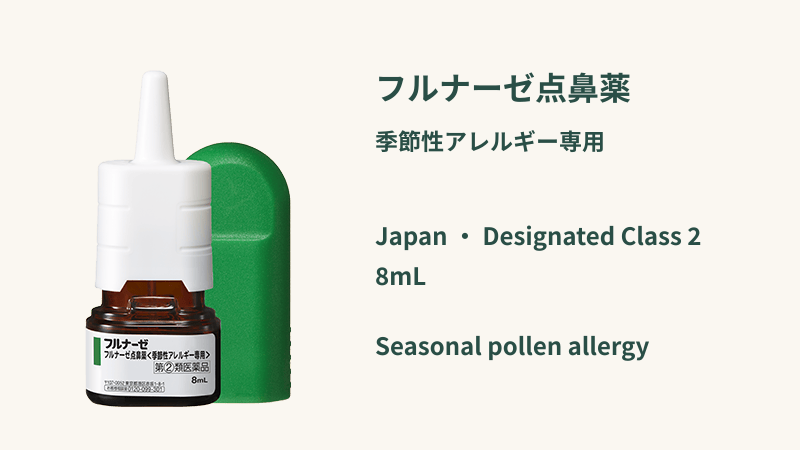
Found a familiar-looking green-capped “Flunase” bottle in a Japanese drugstore? Recognizing the name is not the same as checking the Japanese product’s purpose, age limit and directions. This guide covers only フルナーゼ点鼻薬<季節性アレルギー専用> sold as a Japanese OTC medicine. It does not establish that it can replace your overseas product or prescription.
Japanese product and official leaflet checked: November 1, 2026. This buying and consultation guide cannot diagnose your symptoms. Read the complete leaflet supplied with your own product before use.
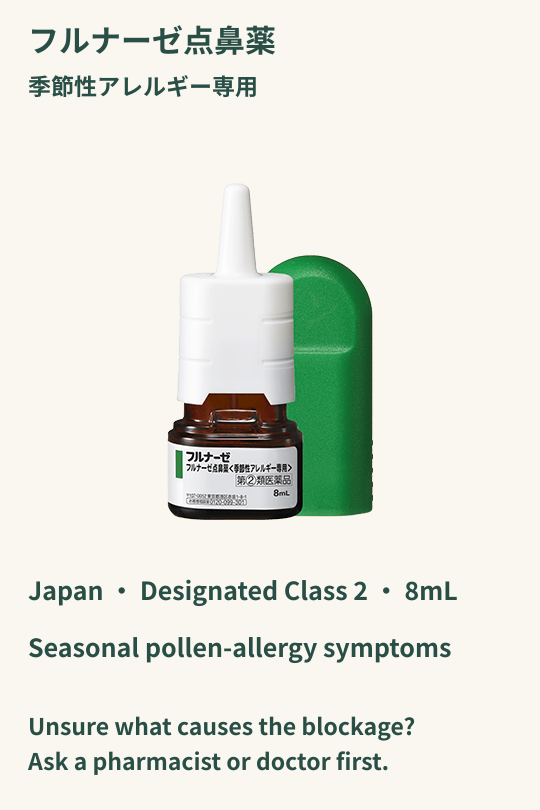
If you are unsure whether pollen is the cause, ask a pharmacist or doctor before choosing it. This product is for seasonal pollen-allergy symptoms, not a general spray for colds or every year-round nasal allergy. Head, forehead or cheek pain with yellow or green mucus also needs assessment first.
Identify the Japanese bottle—not just a familiar overseas name
The full name is フルナーゼ点鼻薬<季節性アレルギー専用>. It is a designated Class 2 OTC medicine in Japan. The official bottle pictured here contains 8mL. Its nasal corticosteroid ingredient is fluticasone propionate; the Japanese leaflet lists 51mg per 100mL. That is a concentration statement, not the amount to spray at once.
The labelled purpose is relief of nasal blockage, excessive runny nose and sneezing caused by seasonal pollen allergy. “Blocked nose” on a label does not identify the cause of your symptoms. A similar overseas name or bottle does not establish the same age limit, dose or permitted duration.
For example, if you use a spray regularly at home and want to buy a Japanese bottle to continue it, show the pharmacist your original pack, ingredient list and directions. Translating the brand name alone is not a substitution check. This guide does not tell you to stop prescribed treatment or switch medicines yourself.
Being 15 or older is only one condition
This Japanese product must not be used under age 15. Older users still need to check all contraindications and consultation conditions. Other Japanese sprays have different rules: if the product in your hand is NAZAL, use the separate NAZAL pump and αAR guide, not these directions.
- Do not use: if pregnant or possibly pregnant; previously allergic to this product or another fluticasone propionate product; diagnosed with systemic fungal disease, a tuberculosis-related disease, recurrent nosebleeds or an infection; affected by a pus-forming infection at the nostril; or if you have already used steroid nasal sprays for three months or more during the past year. The under-15 restriction also applies.
- Consult before use: if receiving medical or allergy treatment, breastfeeding, older, previously allergic to medicines or similar substances, affected by hypertrophic rhinitis or nasal polyps, or receiving long-term or high-dose systemic steroid treatment. Uncertainty about the cause, or the pain and discoloured mucus described above, also calls for advice first.
- Disclose other treatment: include oral allergy medicines, eye drops, other nasal sprays and prescriptions. Acting locally in the nose does not mean every combination is suitable. Do not combine this with other steroid nasal sprays yourself; where a doctor has prescribed treatment, follow that doctor’s directions.
Separate sprays per application from applications per day
These are the Japanese product’s directions for people whose suitability has been checked—not a decision that you personally can use it:
- Usual dose: from age 15, one spray into each nostril per application, twice daily, morning and evening.
- A ceiling, not a target: no more than four applications a day, eight sprays in total across both nostrils, with at least three hours between applications. Eight daily sprays does not mean eight sprays into each nostril at once. Do not add doses just to reach the maximum.
- Reduce frequency as symptoms improve: it may be increased within the leaflet’s limits if symptoms worsen again. Do not exceed those limits. Overuse or incorrect use can make side effects more likely.
- No more than three months in a year: include time using other steroid nasal sprays. Switching brands does not restart the count. If longer treatment is needed, consult an ear, nose and throat specialist.
This is not a complete administration tutorial. Follow page 2 of this product’s leaflet for first-use preparation, shaking, bottle position, avoiding the nasal septum and nozzle care; do not borrow another spray’s technique. It is for nasal use only. Do not share it, transfer it to another container or pierce the nozzle with a needle. Keep it capped and out of children’s reach. Do not use an expired product; even within its expiry date, use it promptly after opening.
New problems do not have to wait for the one-week review point
Seek immediate medical treatment for serious allergic symptoms after use, such as breathing difficulty, hoarseness, hives or confusion. Do not wait through an observation period.
Stop immediately and take the leaflet for professional advice if you develop nasal irritation, pain, dryness, bleeding, an unpleasant smell or crusting; throat irritation, dryness or an unpleasant taste; rash, swelling, headache, sleep disturbance or tremor; or eye pain or difficulty seeing. Recurrent nosebleeds or nasal crusting require stopping and medical treatment, not more sprays.
New or unusual head, forehead or cheek pain, or yellow or green mucus after use, also calls for stopping immediately and seeking advice. If there is no improvement after about one week of use, stop and take the leaflet to a doctor, pharmacist or registered medicine seller. That is not an instruction to continue through side effects for a week or to increase the dose yourself first.
What to show the pharmacist
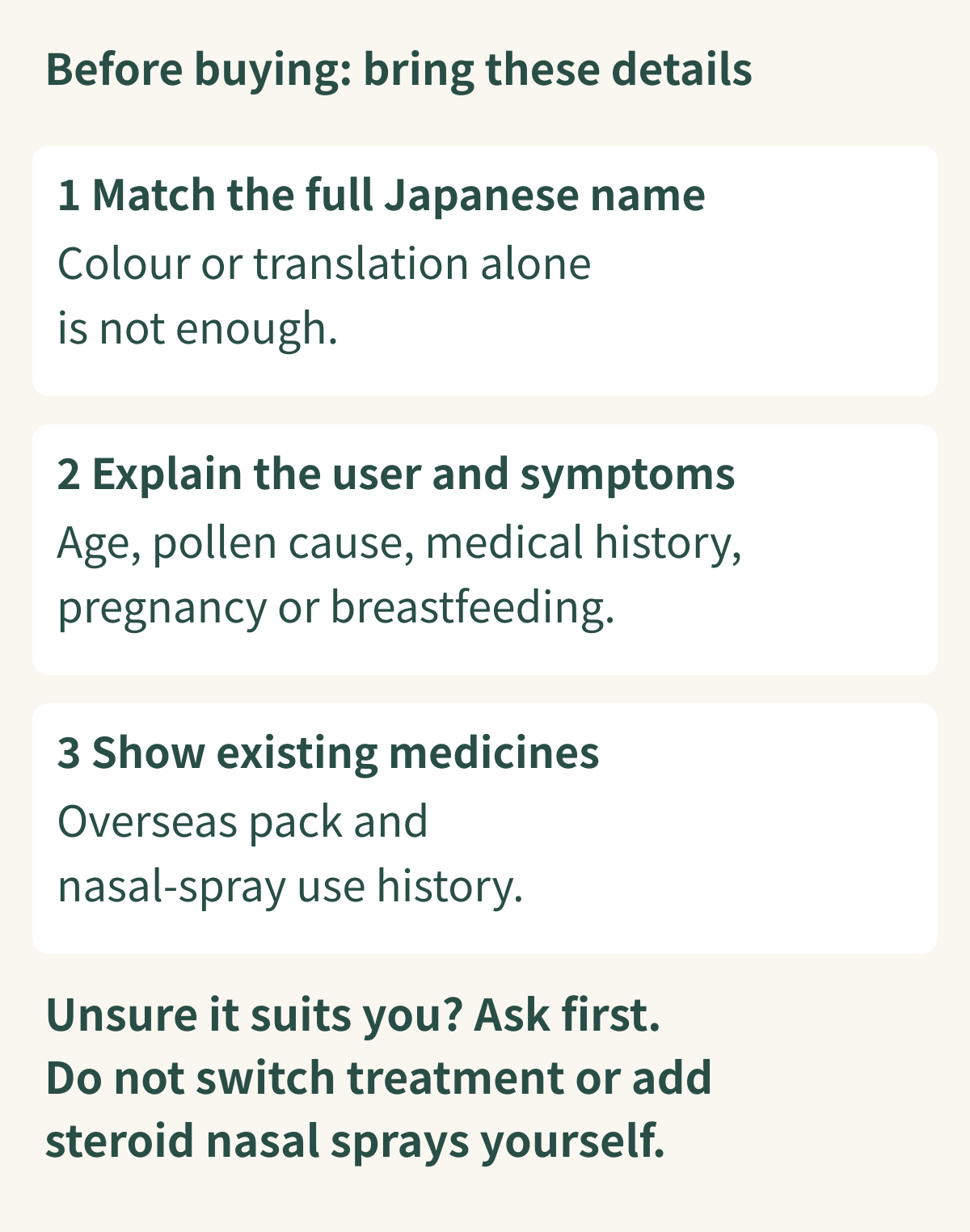
Recognizing the Japanese product is the first step. Whether it suits you, and whether it can follow your existing treatment, is the next check. Individual shop stock has not been checked, and the photograph does not guarantee identical packaging for every batch on sale.