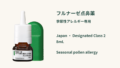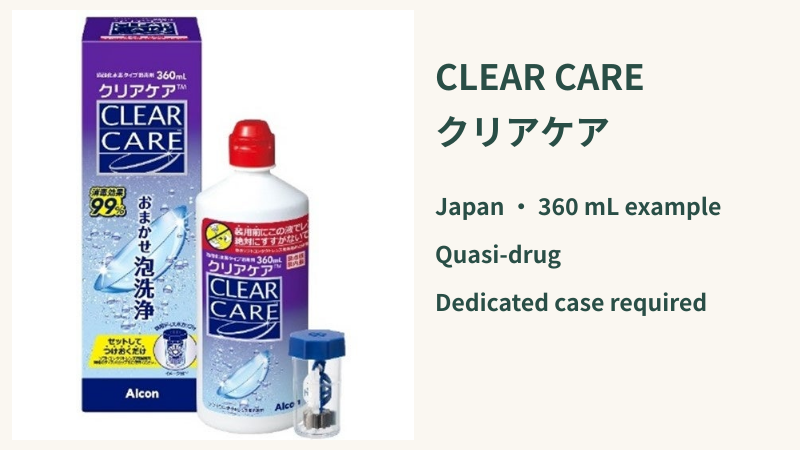
You forgot your contact-lens solution while travelling. Can you buy CLEAR CARE, pour it into your flat travel case and soak your lenses briefly before bed? This Japanese product, クリアケア, is a hydrogen-peroxide disinfection system that requires its dedicated case and complete neutralization. It is not a liquid to put in your eyes or use for rinsing lenses immediately before wear. Check whether you can use the complete system before buying it.
Checked: November 1, 2026. This guide concerns the current Japanese クリアケア, a quasi-drug, illustrated with the manufacturer’s 360mL product photograph. It does not transfer directions from overseas namesakes, Plus or other versions.
- Identify the purpose: bottles on the same shelf are not interchangeable
- Before buying, check your lenses, the case and the time available
- Two travel-related details that are easy to miss
- Symptoms are not a reason to change solution and keep wearing lenses
- Ask a more useful question than “Where is the lens solution?”
- Official sources
Identify the purpose: bottles on the same shelf are not interchangeable
This product disinfects soft contact lenses in groups I–IV. Some coloured lenses are incompatible: check the lens manufacturer’s instructions as well. This is not an assurance of suitability for hard lenses, nor permission to disinfect and reuse daily disposable lenses.
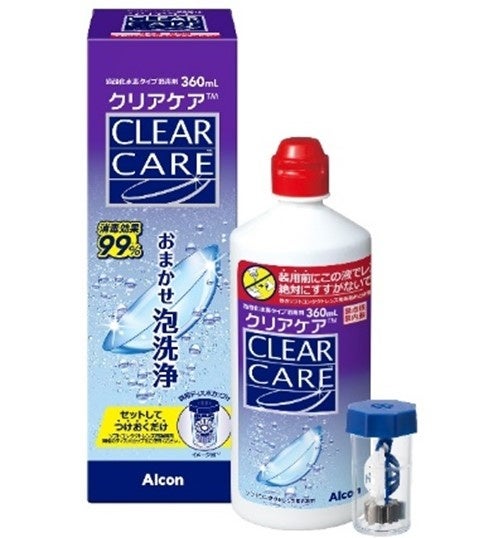
It is not eye drops, a lens-insertion lubricant or storage solution for an ordinary travel case. The disinfectant contains hydrogen peroxide and must be used with the supplied dedicated “ディスポカップ” containing a neutralizing disc. A familiar-looking package does not make another brand’s case or directions suitable.
If you need a liquid to help insert your lenses, see the separate C3 lens-insertion solution guide. Insertion lubricants and disinfection systems serve different purposes.
Before buying, check your lenses, the case and the time available
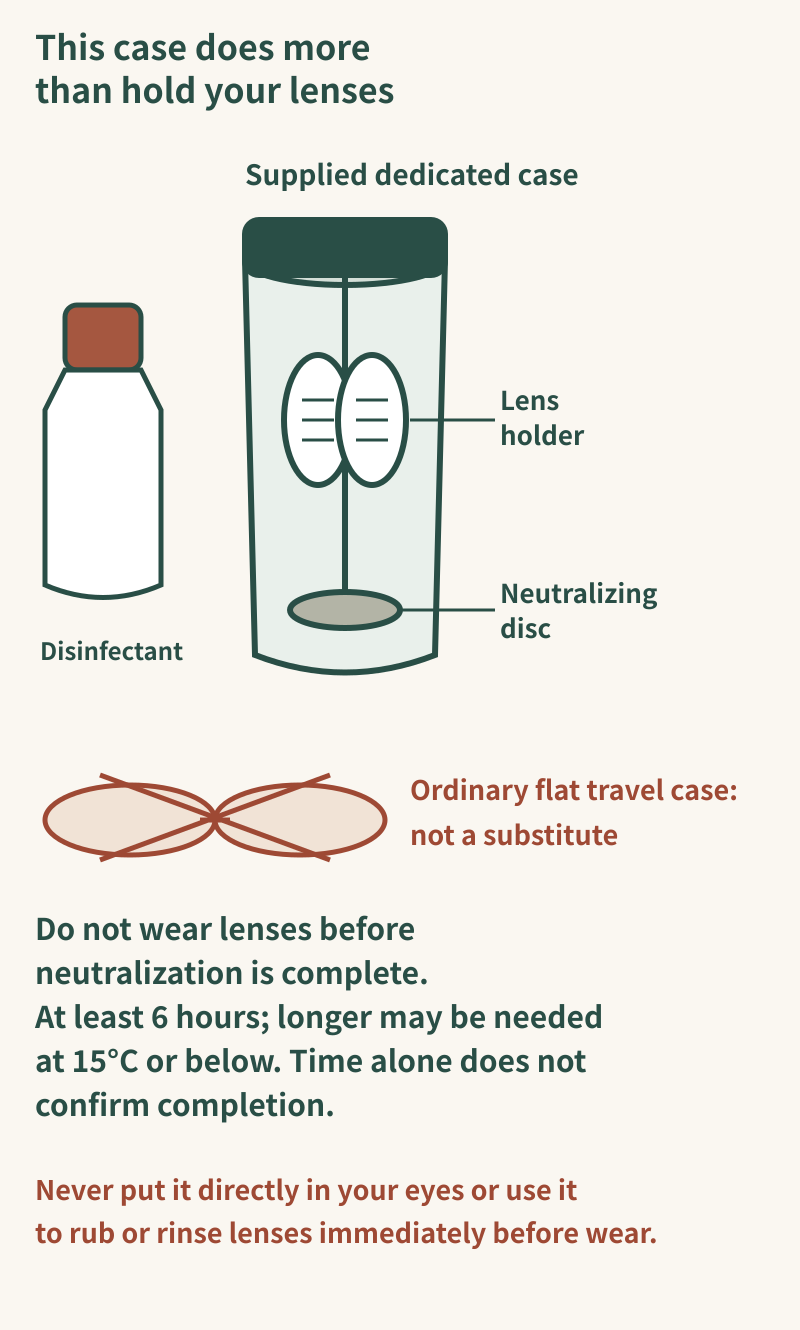
- Are my lenses compatible? Check their exact name, type and instructions, especially for coloured lenses. If uncertain, ask an eye-care professional, the retailer or manufacturer rather than assuming that all soft lenses are suitable.
- Do I have the dedicated case supplied with this product? You must use its case with the neutralizing disc, not a flat travel case or a case from another peroxide system. The current instructions say to replace it with the new case supplied in each box. Do not use a damaged case.
- Can neutralization finish under the required conditions? Leave the system for at least six hours after starting disinfection and neutralization, and do not wear the lenses until neutralization is complete. At temperatures of 15°C or below, it can take longer than six hours. A timer finishing is not, by itself, a safety guarantee. Follow the instructions for room-temperature use; in winter, use a warmer room where possible.
For example, if you buy solution late at night and need to leave a few hours later, the important question is not which bottle is biggest or cheapest: it is whether you can meet every condition of this system. If the time, case or lens compatibility is uncertain, do not improvise with this product. Ask a professional about a suitable alternative arrangement; use your glasses meanwhile if you can. Do not shorten neutralization or try to replace it with extra rinsing.
Two travel-related details that are easy to miss
The dedicated cup is not a travel case during neutralization
The official instructions prohibit carrying the cup during neutralization because it may leak; do not shake it either. Do not plan to put it in your bag and let the process finish while travelling. Follow the complete instructions for the fill level, lid, any leakage and subsequent cleaning. This guide is not a shortened procedure with conditions omitted.
Rinsing at the start of disinfection is different from rinsing before wear
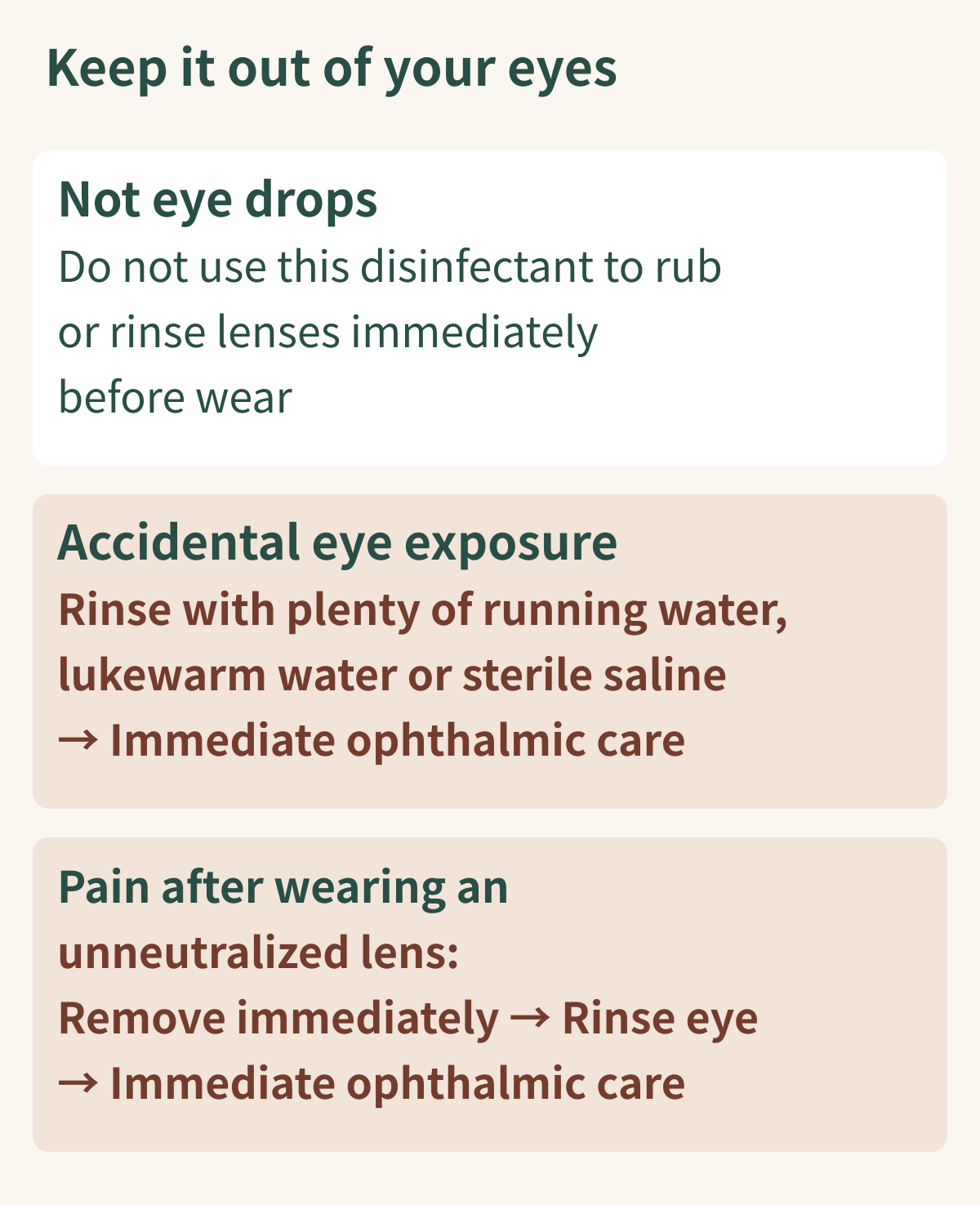
The complete official disinfection procedure includes a specific initial rinsing step. However, do not use this disinfectant to rub or rinse lenses immediately before wearing them. Unneutralized liquid contacting the eye can cause pain and eye injury. If rinsing is needed after disinfection and neutralization are complete, the instructions specify a separately sold soft-lens storage solution, such as クリアケア リンス&ゴー. That is a different product, not this bottle of disinfectant.
Symptoms are not a reason to change solution and keep wearing lenses
Consult an eye-care doctor before use if you have had eye-allergy symptoms or are receiving medical treatment. If redness, inflammation, pain, itching, watering, blurred vision or other abnormalities occur during or after lens wear, stop using the lenses immediately and seek ophthalmic care. If hives or other abnormalities occur while using the product, stop and consult a doctor or pharmacist.
Do not put it directly in your eyes or swallow it. Do not mix it with other disinfectants, substitute household hydrogen peroxide or reuse spent solution. Do not use an expired product; use within three months of opening. Keep it out of children’s reach; children must use it under a guardian’s guidance and supervision. Choosing the correct product does not replace complete care instructions or regular eye examinations.
Ask a more useful question than “Where is the lens solution?”
Bring the lens packaging or a clear photograph, plus details of your current solution and case. Explain when you need to wear your lenses again and whether you have any eye symptoms. Ask: “Is this suitable for my lenses? Which dedicated case does it need? Can I meet all the neutralization conditions?” With eye symptoms, prioritize eye care rather than delaying treatment to finish shopping.
Official sources
- Alcon Japan: current クリアケア product information
- Complete instructions linked from the current product page (document code CC24.10-1-2; the 201610 in the URL is not treated here as its revision date)
- Alcon Japan: April 1, 2025 product-renewal announcement
- Product announcement and photograph published by Alcon Japan