Japanese official information checked: November 2, 2026. This guide covers the 2026 reformulation, トラフルBBチャージc. The former a is included only for ingredient comparison.
If you spot a Traful BB Charge box with a small “c” at the end of its name, here is the change worth knowing: nicotinamide and biotin have increased; the amounts of vitamins B2 and B6 have not. The current active-ingredient list also no longer includes coix seed extract. Those details tell you more than a general claim about “increased vitamins.”
Below, we compare the former a and current c using the same two-tablet quantity, then explain c’s directions and stopping rules. An increase in ingredient amounts cannot be translated into faster relief from mouth ulcers.
Check the full name and the age note behind “30 days”
The product here is トラフルBBチャージc (Traful BB Charge c), a Japanese Class 3 OTC medicine with vitamins B2 and B6 as its main ingredients, rather than a general food supplement. The official Japanese launch date for the reformulated version was April 15, 2026. That date does not confirm which version an individual shop has in stock.
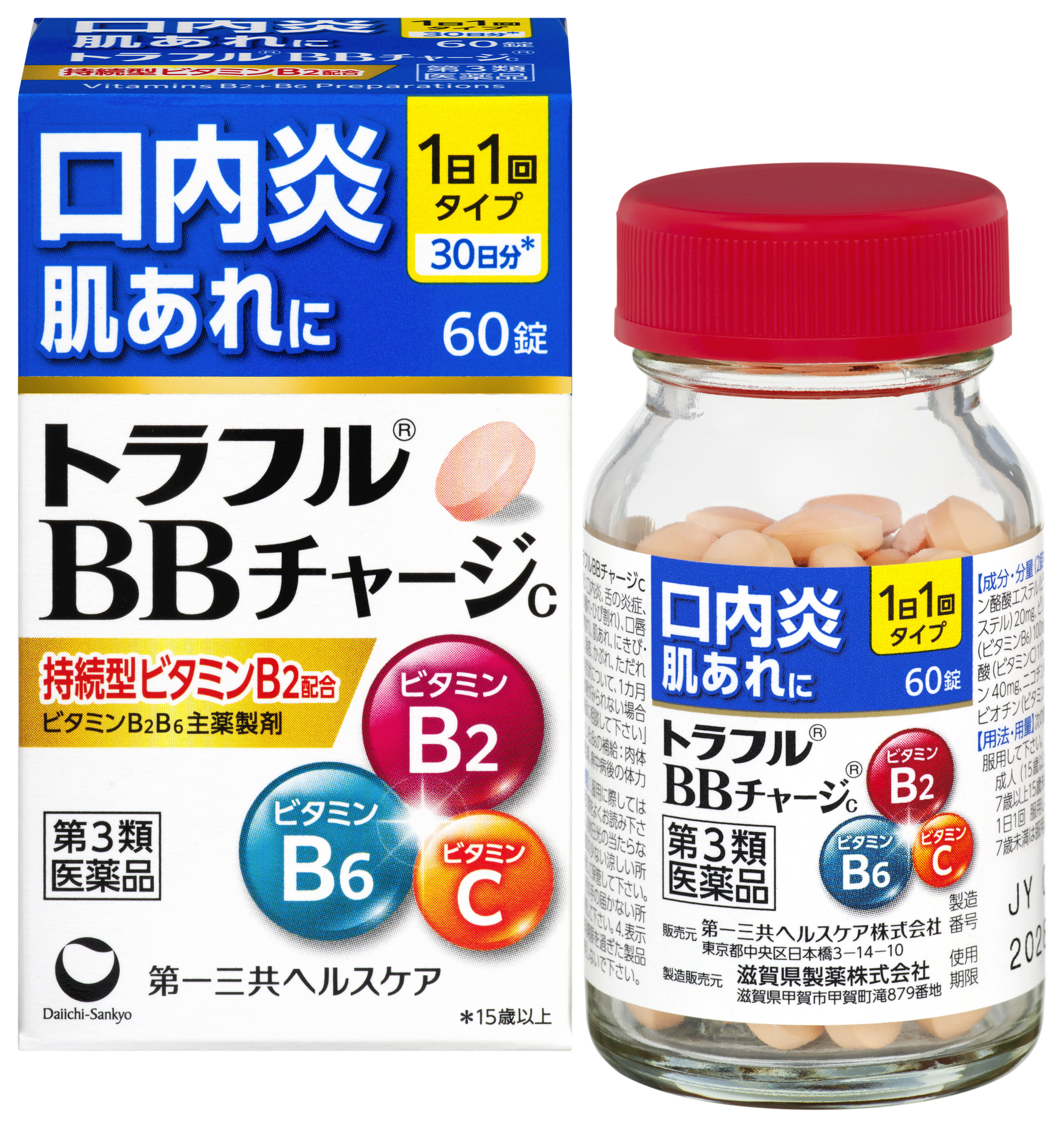
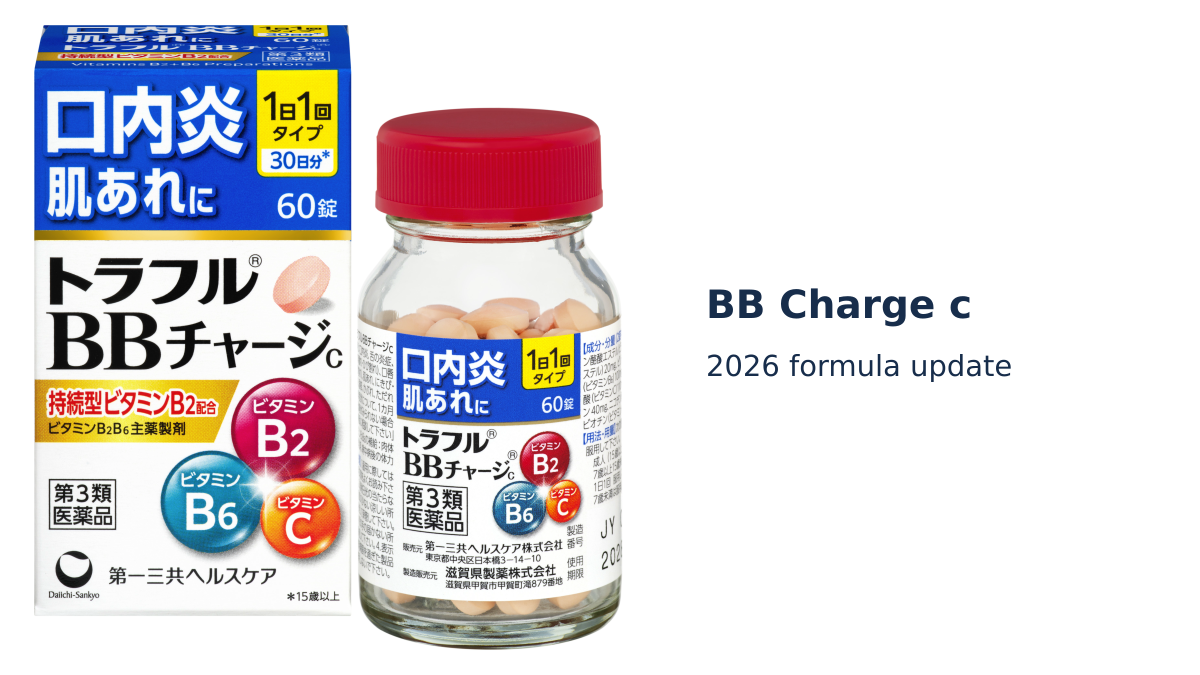
Look for both “BBチャージ” and the final “c.” The former BB Charge a and トラフル錠a (Traful Tablets a) are different product names. Neither the letter a nor the Traful brand alone identifies a formula. Use the photo to recognise the product, then read the box and leaflet supplied with your own medicine.
Two ingredients increased and four stayed the same
Every amount below is per two tablets, the labelled daily quantity for ages 15 and over. These are not amounts per tablet or the daily quantity for children aged 7–14.
| Ingredient | Former a | Current c |
|---|---|---|
| Nicotinamide (niacinamide) | 30 mg | 60 mg, increased |
| Biotin (vitamin H) | 0.05 mg | 0.2 mg, increased |
| Riboflavin butyrate (vitamin B2 butyrate) | 20 mg | 20 mg, unchanged |
| Pyridoxine hydrochloride (vitamin B6) | 100 mg | 100 mg, unchanged |
| Ascorbic acid (vitamin C) | 110 mg | 110 mg, unchanged |
| L-cysteine | 40 mg | 40 mg, unchanged |
| Coix seed extract (ヨクイニンエキス) | 107.7 mg Equivalent to 1.4 g of the raw herb | Not listed as an active ingredient |
Nicotinamide is therefore present at twice the former amount and biotin at four times the former amount, while the number of active ingredients has changed from seven to six. Those ratios describe quantities, not multiples of effectiveness. The B2 figure is the amount of the butyrate ingredient, not a separately calculated amount of free riboflavin.
The coix seed change is also worth reading carefully. Although the extract is absent from c’s active-ingredient list, rough skin remains among c’s labelled indications. Removing an ingredient does not, by itself, tell you that an indication has been removed.
A vitamin label does not diagnose the cause of a mouth ulcer
The Japanese indications include relief of mouth inflammation or ulcers, an inflamed tongue, swollen or cracked mouth corners or lips, rough skin and acne. These are examples, not the complete indication list; the full current leaflet is linked at the end. A separate indication is vitamin B2 and B6 supplementation during physical fatigue, pregnancy or breastfeeding, and reduced physical strength during or after illness. These are labelled uses, not a recommendation that everyone in those circumstances needs this medicine.
The leaflet itself describes several possible contributors to mouth ulcers, including biting the mouth, an unbalanced diet, fatigue, lack of sleep and stress. Seeing “mouth ulcers” and “vitamins” on one box does not establish that your symptoms come from a vitamin deficiency. Nor does this ingredient comparison demonstrate that c works faster, works better or is safer than a. A discussion about whether it suits you needs your symptoms and current medicines, not just a comparison of the largest numbers on the labels.
How the current c is taken
- Ages 15 and over: two tablets per dose, once daily.
- Ages 7–14: one tablet per dose, once daily, under a parent’s or guardian’s guidance and supervision.
- Under 7: do not take.
Take with water or warm water at any time, regardless of meals, and follow the stated directions and amounts. “Once daily” does not mean once with each meal. The pack’s 30-day quantity is not a treatment course you must finish. This guide does not determine whether you can take it with another medicine.
When to stop taking it
Stop immediately if you develop a rash, skin redness, itching, nausea, vomiting, loss of appetite, stomach discomfort or a feeling of stomach fullness after taking it. These may be adverse effects. Take the leaflet to a doctor, pharmacist or Japanese registered OTC medicine seller for advice.
If diarrhoea occurs and persists or worsens, stop and consult one of those professionals with the leaflet. If symptoms have not improved after about one month of use, stop and seek advice with the leaflet as well. This is the medicine’s stopping rule for lack of improvement, not an assurance that every mouth problem can wait a month. Do not wait a month to act on the adverse effects described above.
Read the new leaflet as well as the new formula
The vitamin B2 butyrate in this product may turn urine yellow, but that does not explain every urine colour change. The medicine may also affect urine and stool test results. If you have tests, tell the doctor that you are taking a preparation containing vitamin C.
Keep the bottle tightly closed in a cool, dry place away from direct sunlight and out of children’s reach. Do not transfer the tablets to another container, handle them with wet hands or put wet tablets back in the bottle. Discard the protective packing material after opening, but keep the desiccant in the bottle until the medicine is used up, and do not swallow it. Do not use the product after its stated expiry date.
The useful takeaway for your next look at the shelf is simple: the increases are nicotinamide and biotin, not B2 and B6. Identify c first and read its own instructions, rather than relying on what you remember from an older box.
Official sources and image attribution
Directions and precautions here follow the current Japanese c leaflet. This guide does not replace the full leaflet or an individual medicine assessment. The former a is included only for active-ingredient comparison, not as a complete guide to taking the old product. The launch date does not establish stock in individual shops.
- Daiichi Sankyo Healthcare: current Traful BB Charge c product information
- Complete current c instructions in Japanese (two pages)
- Former a instructions in Japanese (two pages; ingredient comparison source)
- Daiichi Sankyo Healthcare: renewal announcement dated March 16, 2026
Product identification photo: Daiichi Sankyo Healthcare Co., Ltd., from its official release on Digital PR Platform. Used as a limited quotation to identify and discuss the current c carton and bottle. Rights remain with the original rights holder; this is not a freely licensed image.