 I’m Irene, a Taiwanese pharmacist working in Japanese drugstores. This guide uses the official product information and currently linked Japanese leaflet to explain the pack, dosing and situations that need professional advice.
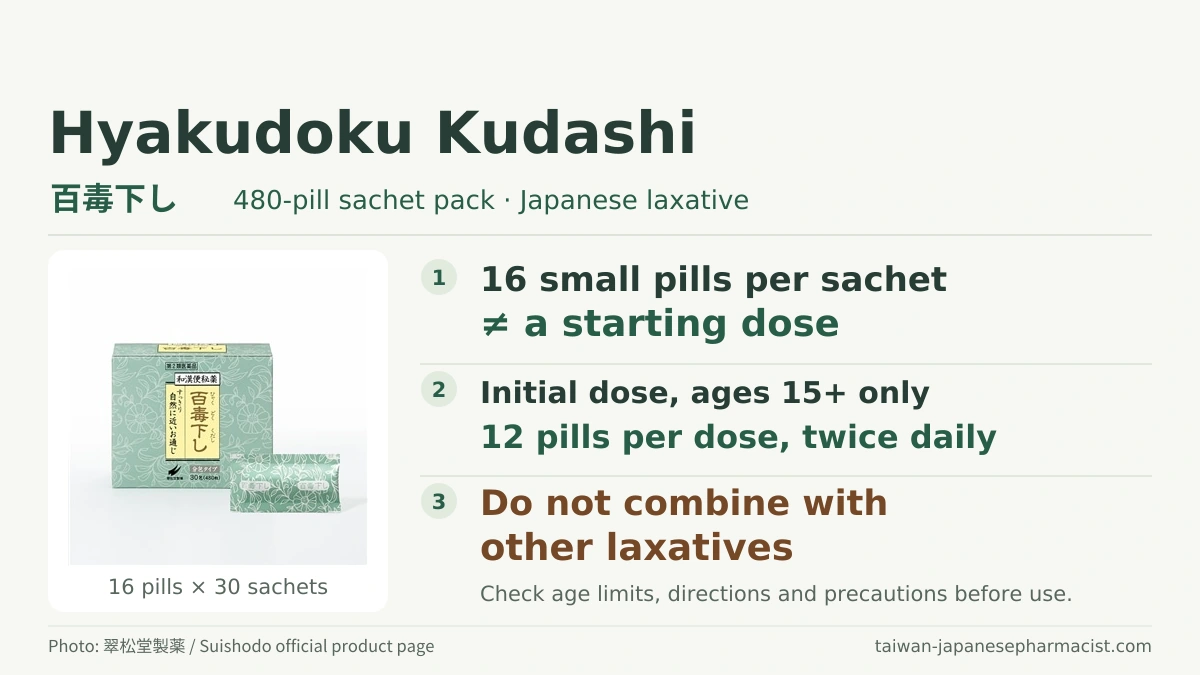
- Sixteen pills is the sachet size. The first dose is the minimum for the user’s age. Children under 3 must not take it.
- Check suitability before counting pills. Do not combine it with another laxative. Breastfeeding, pregnancy or possible pregnancy, and ongoing medical treatment need the checks below.
- This is a constipation medicine. Its name does not establish a detox, weight-loss or daily wellness use.
Check these points before opening a sachet
Restrictions that matter
- Do not give it to children under 3.
- Do not take another laxative while using it. If you have already taken a different constipation medicine, show the pharmacist its name or pack before adding anything.
- Breastfeeding: the leaflet says not to take this medicine, or to avoid breastfeeding while taking it. Ask a doctor or pharmacist about a breastfeeding-compatible approach. Do not interrupt breastfeeding just to use this product or invent a waiting interval before nursing again.
- Do not take excessive amounts. More pills are not a shortcut to resolving constipation.
The leaflet requires advice from a doctor, pharmacist or Japanese registered medicine seller before use if you are receiving medical treatment, are pregnant or may be pregnant, have previously had an allergic reaction to medicines or similar substances, or have severe abdominal pain, nausea or vomiting. Bring a list of medicines and supplements for review.
Warning signs call for medical care before trying a laxative. Seek prompt medical assessment for constipation with constant abdominal pain, rectal bleeding or blood in the stool, inability to pass gas, vomiting, fever or unintended weight loss. Seek emergency care for sudden severe abdominal pain, or abdominal pain with vomiting blood, heavy rectal bleeding, black sticky stools, or inability to pass either stool or gas. These are general constipation and abdominal-pain warnings, not a list of side effects unique to this product.
Identify the Japanese 480-pill sachet pack
- Japanese name
- 百毒下し(ヒャクドククダシ)
- Pack covered here
- 480 pills: 16 pills × 30 sachets
- Form and category
- Small round pills; Japanese Class 2 over-the-counter laxative
- JAN barcode
- 4987314010580
- Seller
- 翠松堂製薬株式会社 (SuiShoDo Pharmaceutical)
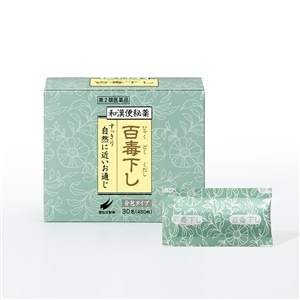
Show staff the full Japanese name, 480-pill sachet format and JAN rather than relying on the green box alone. This guide covers that specific pack. Bottles with other counts should not be described as containing 16-pill sachets. A current official listing does not guarantee stock at every shop.
The approved uses are constipation and relief of specified symptoms associated with constipation, including abdominal bloating and reduced appetite. The association with constipation matters: the label does not establish a general beauty, acne or unrelated disease treatment.
Count pills per dose, then check the first-dose minimum
Every number below means small round pills per dose, not sachets or the daily total. The Japanese leaflet specifies twice daily, morning and evening, on an empty stomach. Start at the age-appropriate minimum, then adjust gradually within that age group’s labelled range according to bowel movements and condition.
Ages 15 and over
Per dose: 12–16 pills
First dose: 12 pills
Ages 11–14
Per dose: 8–12 pills
First dose: 8 pills
Ages 7–10
Per dose: 6–8 pills
First dose: 6 pills
Ages 3–6
Per dose: 4–6 pills
First dose: 4 pills
Children must take it under parental or guardian supervision. For young children aged 3 or older, the leaflet also warns about pills lodging in the throat. Do not use this age card alone to choose treatment for a child; ask a doctor or pharmacist if unsure.
“Between meals” means 2–3 hours after eating
The leaflet gives morning and evening empty-stomach dosing, before or between meals. Its term 食間 means 2–3 hours after a meal, not during one. This guide follows the medicine leaflet. If your pack or other instructions leave the timing unclear, show them to a pharmacist rather than combining different schedules.
A practical example: 16 in the sachet, 12 for the first dose
For a first-time user aged 15 or over, the sachet holds four pills more than the initial 12-pill dose. Opening the sachet is not a reason to take those extra pills or add another dose to use them up. The reviewed official information gives no specific storage period or resealing method for a partly used sachet. Ask a pharmacist or the manufacturer how to handle the remainder.
-
1. Check age, restrictions and symptoms
No use under 3 and no combination with another laxative. Follow the breastfeeding restriction, pre-use consultation rules and medical warning signs above.
-
2. If suitable, count individual pills
Check the age-specific starting minimum, frequency and timing. A full sachet is not a universal first dose.
-
3. Watch for reasons to stop
Do not increase the dose in response to adverse symptoms. Stop and seek advice if there is no improvement after about a week; warning signs should never wait that long.
When should you stop and get advice?
Stopping rules in this product’s leaflet
- Stop immediately and seek advice if a rash, redness, itching, severe abdominal pain, nausea or vomiting develops after use. These may be adverse effects.
- Stop and seek advice if diarrhea persists or worsens. More diarrhea does not mean a better result.
- Stop and seek advice if symptoms have not improved after about one week of use. Do not keep extending use or increasing the dose yourself.
Bring the leaflet when consulting a doctor, pharmacist or Japanese registered medicine seller. Seek immediate medical care for the emergency warning signs described earlier.
About one week is a no-improvement stopping threshold, not a recommended daily one-week course. The maker’s FAQ also advises avoiding daily use. Repeated constipation or an ongoing need for laxatives deserves professional advice about the cause and a suitable approach.
Leftover pills, herbal ingredients and travel questions
Can I put the remaining pills in a travel pillbox?
The leaflet says not to transfer the medicine to another container. Keep it cool, dry, away from direct sunlight and out of children’s reach, and do not use it after its expiry date. Ask a pharmacist or the manufacturer about a partly used sachet. Do not borrow another product’s instructions to fold a packet closed or finish it within a certain number of days.
Does the name mean it is a detox or weight-loss product?
百毒下し is the product’s name. Its constipation indication, dose and restrictions should guide any decision to use it. The name does not support detoxification, routine cleansing or weight-loss claims. Do not take it in advance without constipation simply to keep a trip on schedule.
Do herbal ingredients mean it is safer or will not cause pain?
The medicine contains six herbal ingredients, including rhubarb and aloe. It still has restrictions, precautions and potential adverse effects. Plant origin does not mean it is suitable for everyone or guarantee that abdominal pain or diarrhea will not occur. Check the full ingredient list with a pharmacist if allergy or ingredient suitability is a concern.
What should I ask at a Japanese pharmacy?
Explain the user’s age, how long the constipation has lasted, any pain or vomiting, medicines being taken, and pregnancy or breastfeeding status. When checking the sachet instructions, you can show this question:
この薬を初めて使います。私の場合の1回量と、開封した分包に残った薬の扱い方を確認したいです。
“This is my first time using this medicine. I would like to confirm the dose for me and how to handle pills left in an opened sachet.” This question does not replace the restrictions or medical-care checks above.
If you are an adult still deciding whether medicine is needed during your trip, read the travel-constipation guide to daily routines, pharmacy advice and medical help. Do not transfer doses between products or combine laxatives yourself.
Sources and product image
Checked 11 November 2026. This is a label-reading guide for the Japanese-market product, not a personal trial or an effectiveness test. It does not replace individualized medical or pharmacy advice. Read the full leaflet supplied with your medicine; packaging and official information may change.
Official primary sources
- PMDA: current Hyakudoku Kudashi product record and linked medicine leaflet (PDF): doses, timing, indications, restrictions, stopping rules and storage. This guide uses the leaflet currently linked on the check date; it is not a 2026 launch or revision announcement.
- SuiShoDo: Hyakudoku Kudashi 480-pill sachet pack: pack identity, JAN, ingredients and the product photograph.
- SuiShoDo: frequently asked questions: supplementary advice, including avoiding daily use. Dosing frequency and timing in this guide follow the medicine leaflet.
- NIDDK: Symptoms & Causes of Constipation: general warning signs needing medical attention. Page last reviewed May 2018.
- NHS: Stomach ache: urgent and emergency warning signs. Page last reviewed 20 October 2026.
Editorial discovery, separate from medical evidence
The Hyakudoku Kudashi section in Japaholic’s 2026 SUGI drugstore shopping article (1 August 2026) prompted this topic. That article is marked PR; it is not treated here as independent evidence of effectiveness, sales or demand. The JAPANKURU autumn 2026 household-medicine feature is explicitly a paid feature, with no verified standalone publication date. It shows the 1,152-pill version, a different pack from this guide’s 480-pill sachets.