Does a clear bottle of Isodine simply offer a different flavour from the brown gargle? No: the active ingredients and product categories differ. Both ranges covered here need dilution, but the amounts are different. Check the complete name and personal precautions before choosing by colour, size or taste.
I’m Irene, a Taiwan-born, Japan-licensed pharmacist working in a Japanese drugstore. This guide uses official Japanese packs and instructions to answer three buying questions: which product is it, what should you ask first, and how does that particular product need diluting? It is not a personal product test or an effectiveness ranking.
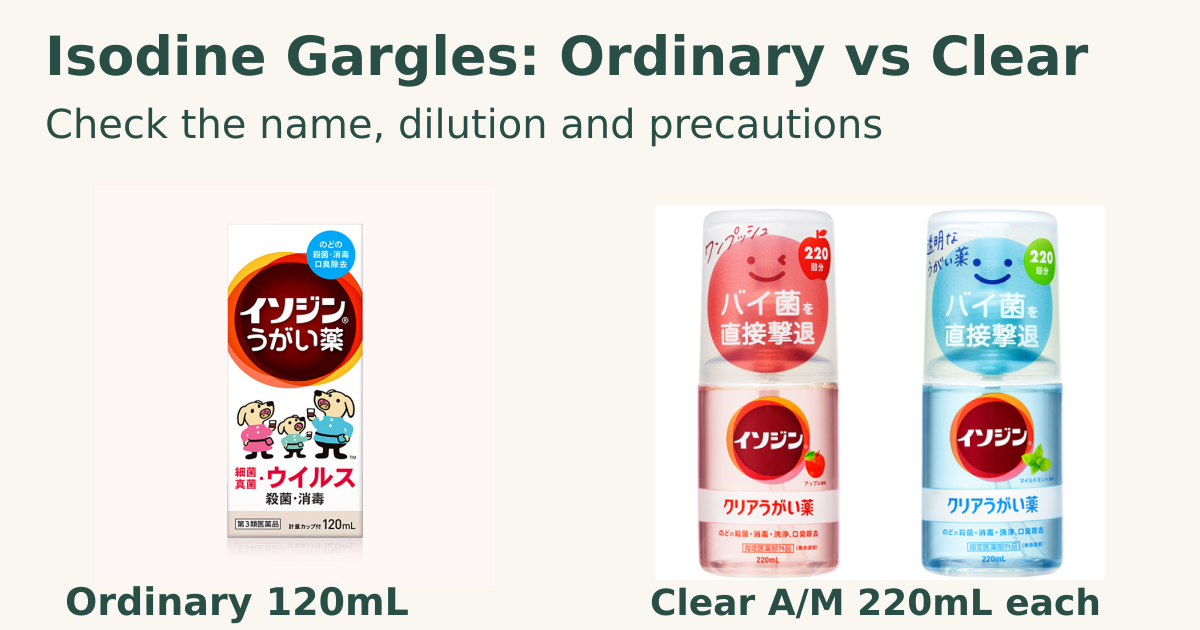
Official information checked: 31 October 2026. Scope: イソジンうがい薬 and イソジンクリアうがい薬A / M. Photos show the ordinary 120mL pack and both Clear 220mL bottles. Individual shop stock and every physical batch have not been checked. P, C, throat sprays, wound products and overseas versions are outside this guide’s directions.
Read the name: Clear is more than a flavour change
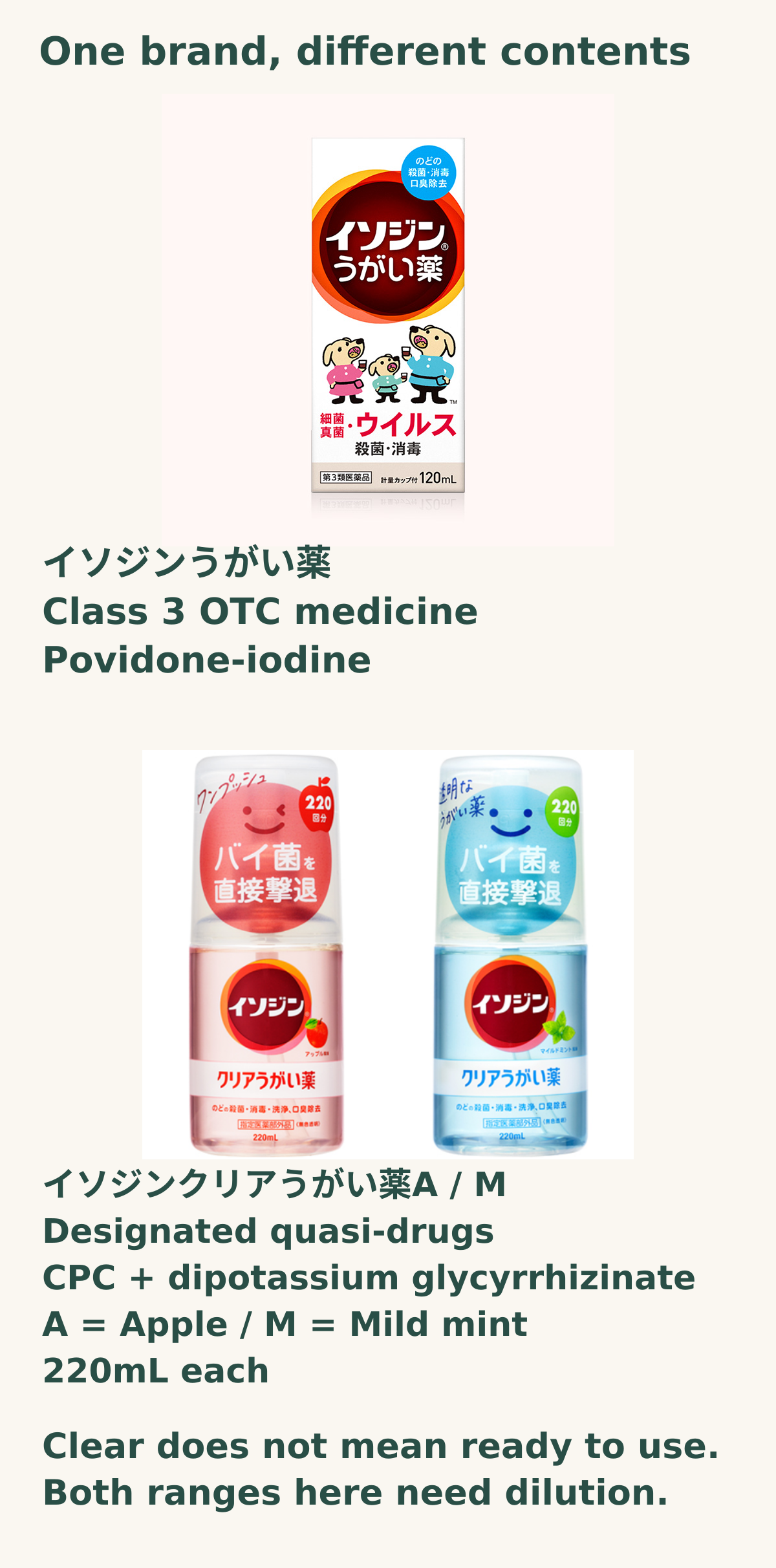
- イソジンうがい薬: a Class 3 OTC medicine. Each 1mL of concentrate contains 70mg povidone-iodine, equivalent to 7mg available iodine.
- イソジンクリアうがい薬A (apple) / M (mild mint): designated quasi-drugs. Each contains 250mg cetylpyridinium chloride hydrate (CPC) and 250mg dipotassium glycyrrhizinate per 100mL of concentrate, without povidone-iodine.
These are ingredient amounts in the bottled concentrate, not a dose. Both ranges are labelled for disinfecting and cleansing the mouth and throat and removing bad breath. Their classifications are not a ranking of which bottle is stronger. Do not extend those uses into a guarantee against colds, COVID-19 or flu, or a substitute for medical care when ill.
For example, someone might see a transparent Clear bottle and pour it straight into their mouth like their usual mouthwash. That is the mix-up this comparison aims to prevent: Clear A and M also require dilution. Transparent does not mean alcohol-free, allergy-free or suitable for everyone. Both contain ethanol; check each product’s complete additive list too.
Check personal precautions before choosing a flavour
Ordinary Isodine: allergy history and thyroid conditions matter
Do not use the ordinary product if you have previously had allergic symptoms from this product or its ingredients. Consult a doctor, dentist, pharmacist or registered medicine seller before use if you have had allergic reactions to medicines or similar substances, have severe erosion inside the mouth, or have been diagnosed with thyroid dysfunction. Trying a smaller amount first is not a substitute for that check.
Clear A / M: treatment or severe oral erosion requires advice first
Both Clear instructions require consultation with a doctor, pharmacist or registered medicine seller before use if you are receiving medical treatment or have severe erosion inside the mouth. The absence of povidone-iodine does not establish Clear as a safe substitute for someone with thyroid disease or an allergy. Explain your conditions, allergies and current medicines to the pharmacist and identify the complete product name.
Both ranges require parental guidance and supervision when used by children. Do not invent a universal minimum age; if someone cannot reliably gargle and spit, do not force use—ask the pharmacist first. Nor should these directions be transferred to Isodine P, C or another product.
Both need water, but not the same recipe
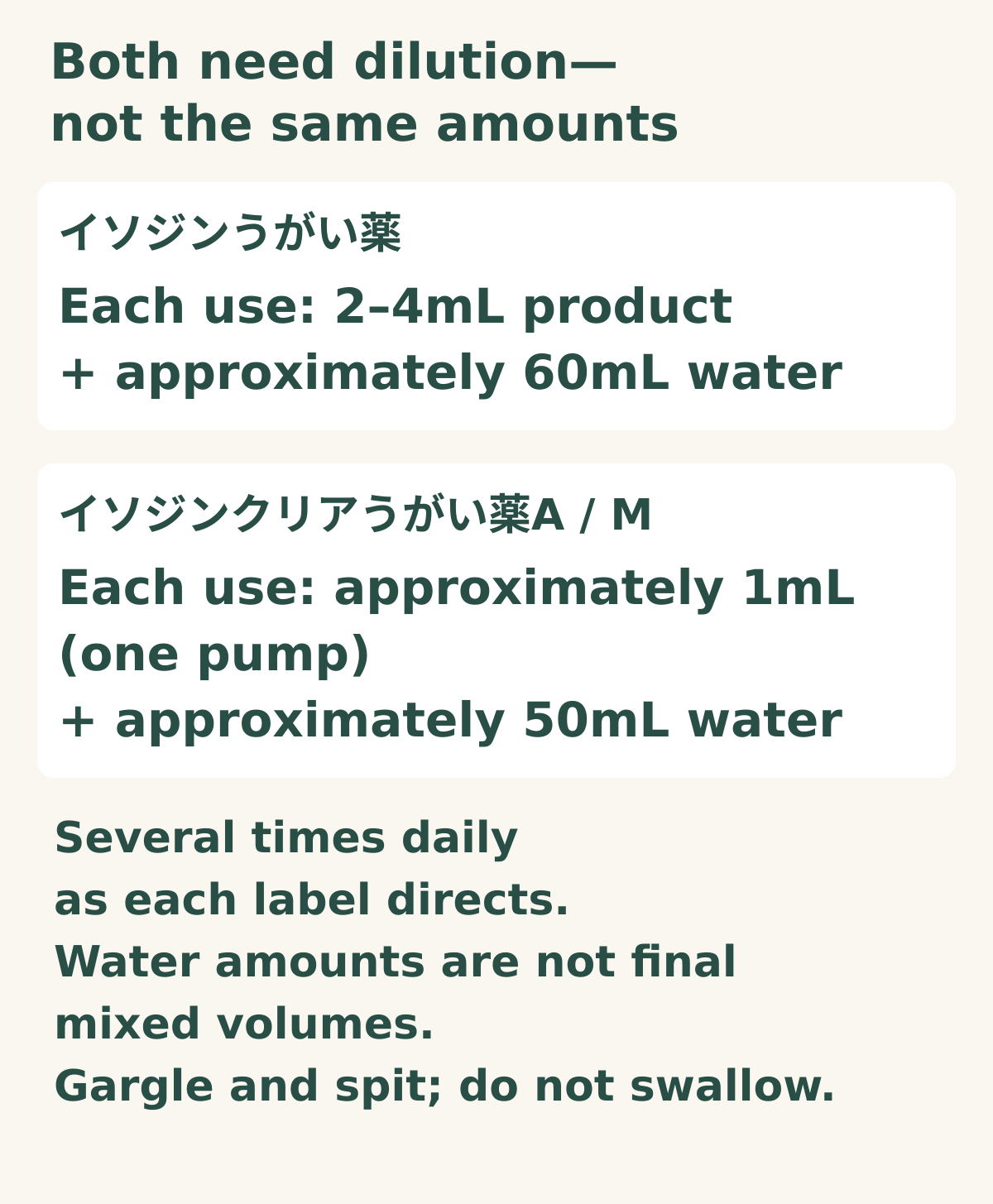
Ordinary イソジンうがい薬: for each use, dilute 2–4mL of the product with approximately 60mL of water, and gargle several times daily.
Clear A / M: dilute approximately 1mL (one pump) with approximately 50mL of water for each use, several times daily. That pump quantity belongs to these products; a pump on another bottle need not deliver the same amount.
Do not treat different measuring cups and pump counts as interchangeable instructions. The figures above specify the water added, not a final combined volume to make up to. Read the full instructions matching the product in your hand.
Stop for reactions: do not wait for day six
- Ordinary Isodine: stop immediately and take the leaflet to a doctor, dentist, pharmacist or registered medicine seller for rash, redness, itching, a rough or stinging mouth, burning, irritation, nausea or discomfort. Soon after use, hives, hoarseness, an itchy throat, breathing difficulty, palpitations or clouded consciousness can signal a serious allergic reaction: obtain medical attention immediately.
- Clear A / M: stop immediately for irritation in the mouth after use and take the container to a doctor, pharmacist or registered medicine seller.
- Both ranges: stop and consult if symptoms have not improved after 5–6 days of use. This is not a direction to keep using an uncomfortable product for 5–6 days; the stop-use and immediate-care conditions above take priority.
For ordinary Isodine in the eyes, rinse immediately with water or lukewarm water and see an ophthalmologist if symptoms are severe. Its leaflet also warns of possible discolouration of silver-containing dental materials such as dentures and staining of clothing. Clear instructions include avoiding contact with plastics and painted surfaces and keeping away from flames. Keep both ranges out of children’s reach, away from sunlight and heat, following their individual storage directions. Do not transfer them to another container or use after expiry.
Ask the pharmacist to check three things
Show the complete name on the pack or bottle. Explain the problem and its duration, allergies, conditions, treatment and other medicines. Then confirm whether this product is appropriate, whether medical care should come first, and its own dilution directions. You can say: “この製品は私に使えますか。薄め方と、使用前の注意を確認したいです。” This means: “Can I use this product? I would like to check how to dilute it and the precautions before use.”
If you were looking at Asadaame AZ Gargle, identify it separately: its ingredient and labelled uses differ. “They are both gargles” is not a basis for transferring quantities. Holding off when suitability remains unclear is more useful than buying a bottle to try on a guess.
Official sources and image credits
- Ordinary Isodine product page and official photo
- Ordinary Isodine complete leaflet
- Clear product page
- Shionogi Clear product information and official 220mL photo
- Clear A complete instructions
- Clear M complete instructions
These sources concern the Japanese products and do not replace individual advice. Read the latest full instructions matching your complete product name; do not transfer directions from overseas or other same-brand products.