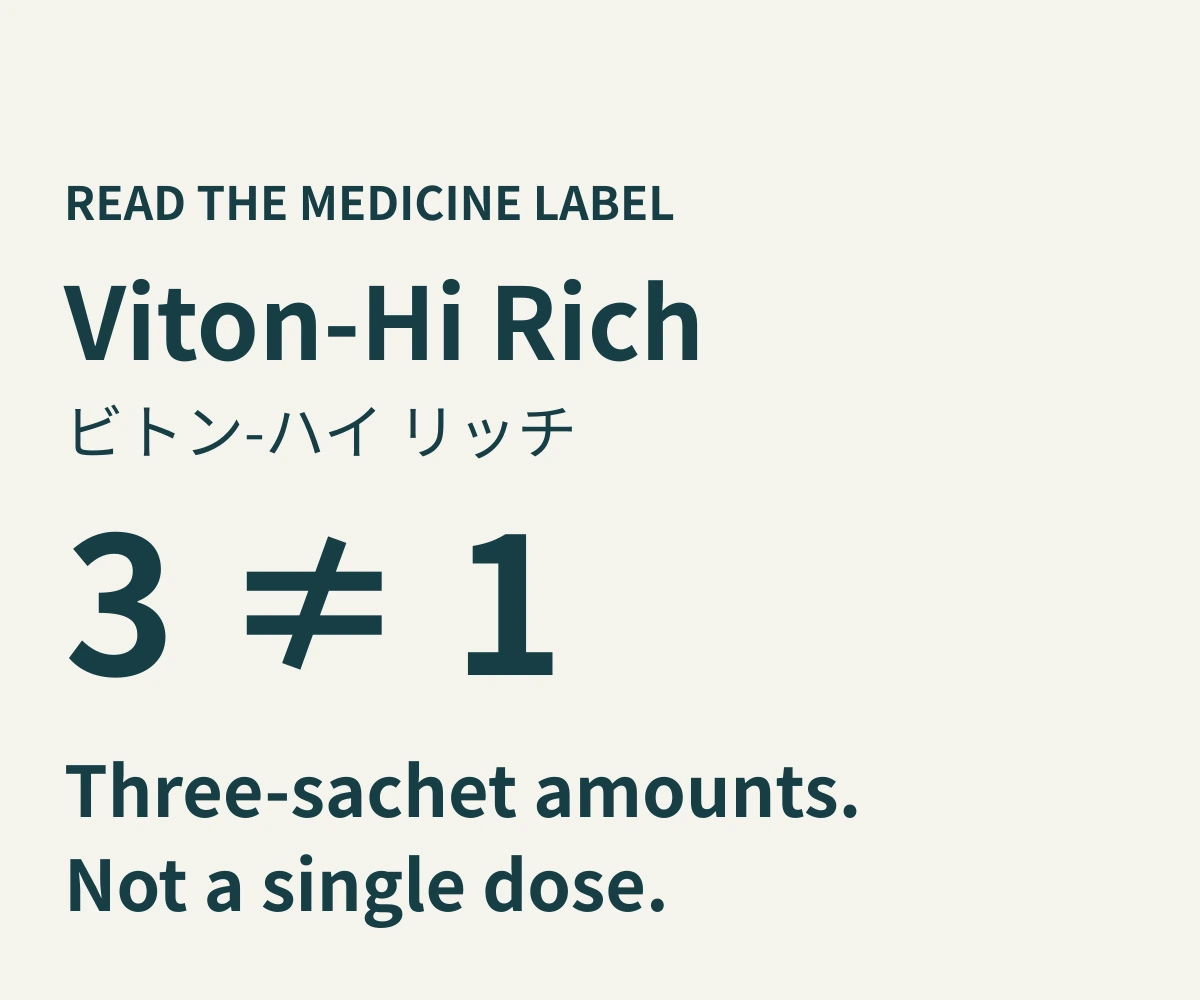
The 2,000 mg of vitamin C on Viton-Hi Rich (ビトン-ハイ リッチ) is the amount in three sachets, not one. One whole sachet contains 2 g of granules; 60 or 90 is the number of sachets in a box. The ingredient table’s three-sachet reference does not mean everyone should take three sachets a day. This guide separates those quantities, explains the Japanese label’s age-specific doses and gives a short comparison with ビトン-ハイECB2.
Sources checked: 12 November 2026, Japan time. This is a check date, not a leaflet revision or reformulation date. This guide explains the label; it cannot determine the cause of your symptoms or whether the medicine is suitable for you.
Numbness or bleeding may need assessment before vitamins
- Sudden one-sided weakness or numbness, a drooping face or difficulty speaking: contact local emergency services immediately, even if symptoms have stopped. Do not wait for vitamins to work.
- Excessive active bleeding, bleeding with weakness/dizziness or breathing difficulty, or very heavy abnormal vaginal bleeding or faintness: seek emergency assessment. A nosebleed lasting more than 10–15 minutes also needs emergency assessment, not a month-long wait.
- Constant, recurrent or long-lasting pins and needles: arrange medical assessment. Recurrent nosebleeds need medical advice, and gums that bleed when brushing or eating need dental assessment. Heavy periods affecting daily life, bleeding between periods or bleeding after sex also need assessment rather than a self-selected vitamin trial.
These early-care boundaries come from NHS and healthdirect guidance, separately from the Japanese medicine label. Sources are listed below.
Three different quantities on the label
The official Japanese product page lists 60- and 90-sachet packs. Box count, the weight of a whole sachet and the ingredient-table reference describe different things:
- 60 or 90 sachets: how many sachets are in the box. This is not a universal treatment duration.
- One sachet = 2 g: the weight of all the granules, not 2 g of vitamin C. The portion taken at one time depends on age.
- 3包中, “in three sachets”: the combined active-ingredient quantities in three whole sachets. It is not an instruction to take three at once.
Section 15 of Cosmopolitan HK’s Japan drugstore shopping feature dated 9 January 2026 assigns C 2,000 mg, E 300 mg, B2 12 mg and B6 15 mg to each sachet and describes one sachet daily. Checking it against the official leaflet changes the quantity reference: those figures are for three sachets combined. One sachet once daily for an adult is itself within the labelled range of one to three doses daily. Correcting the ingredient amounts does not mean telling everyone to take three doses. The feature is beauty and travel-shopping coverage, not clinical evidence.
The photograph below shows the 90-sachet ビトン-ハイ リッチ / Viton-Hi Rich carton and one 2 g sachet. “90包” is the box count; “3包中” above E 300 mg and C 2000 mg is the ingredient reference. Although the carton also says “ECB2 + B6,” that alone does not establish that the formula is simply unchanged ECB2 with B6 added.
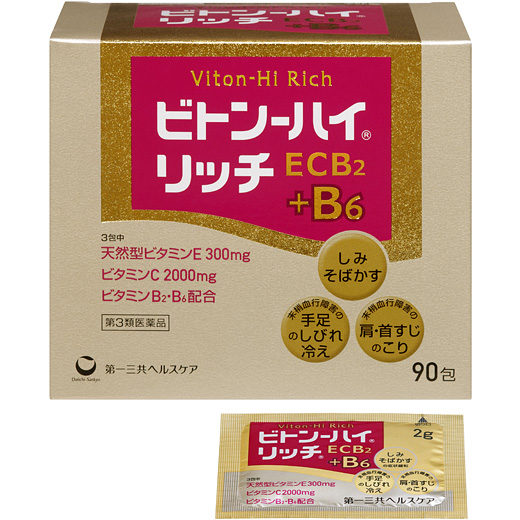
The small print in the photograph may be hard to read on a phone. Use the explanation above and the original diagram below to check the three-sachet reference rather than relying on the large front-panel numbers.
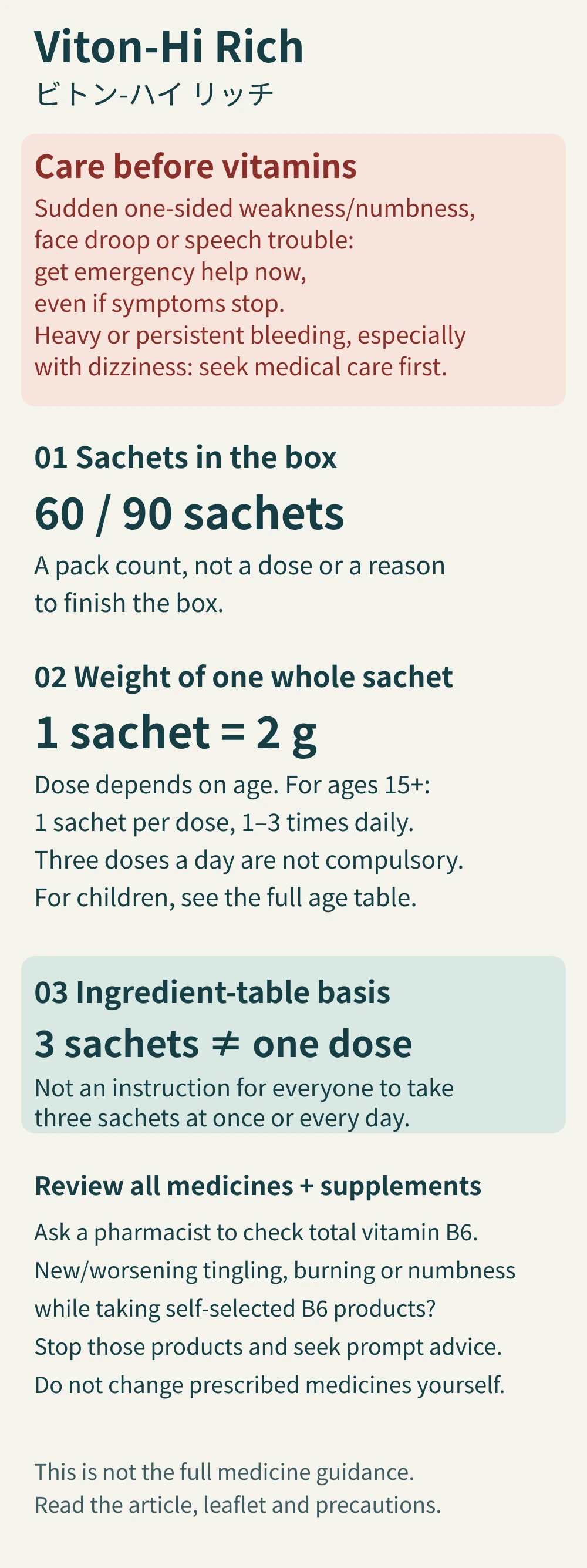
Rich active ingredients, all per three sachets
Rich is a Japanese Class 3 OTC medicine primarily containing vitamins E and C, not an ordinary food supplement. Class 3 status is not a guarantee that every combination or duration of use is safe.
| Labelled ingredient | Per 3 sachets |
|---|---|
| Ascorbic acid (vitamin C)アスコルビン酸 | 2,000 mg |
| d-alpha-tocopheryl acetate (natural-form vitamin E)酢酸d-α-トコフェロール | 300 mg |
| Riboflavin butyrate (vitamin B2 butyrate)リボフラビン酪酸エステル | 12 mg |
| Pyridoxine hydrochloride (vitamin B6)ピリドキシン塩酸塩 | 15 mg |
These are the chemical forms and amounts on the label, not conversions to free vitamins, international units (IU) or rounded per-sachet figures. Ingredient amounts alone do not establish comparative clinical benefit.
Rich additives: hydrogenated maltose syrup (還元麦芽糖水アメ), hydroxypropyl cellulose (ヒドロキシプロピルセルロース), acesulfame potassium (アセスルファムK), thaumatin (タウマチン), lemon oil (レモン油), flavouring (香料) and tocopherol (トコフェロール). The Japanese names help you check your own leaflet. Ask a pharmacist if you have an ingredient concern.
What the leaflet lists it for
- Relief of spots, freckles and pigmentation from sunburn or rash.
- Relief of shoulder/neck stiffness, numb or cold hands and feet, and chilblains due to peripheral circulatory disturbance. That qualifier matters; it does not diagnose the cause of someone’s numbness.
- Prevention of gum bleeding and nosebleeds, not treatment for active major bleeding.
- Vitamin E and C supplementation during physical fatigue, reduced strength during or after illness, and old age.
These labelled uses are not promises of whole-body whitening, guaranteed fading of pigmentation or relief of every cause of numbness. They do not mean that every healthy reader needs this medicine.
Have a pharmacist check B6 and overlapping products first
List all medicines and supplements you use, including multivitamins, B complexes and magnesium or zinc products that may contain B6, for a pharmacist to review together. Rich and ECB2 overlap in C, E and B2. Rich also contains B6; ECB2 does not list B6 as an active ingredient. Do not independently stack the two products or add extra B6.
The Australian TGA’s 2026 safety update warns that B6-containing products can cause peripheral neuropathy and that multiple products can contribute to exposure. If tingling, burning or numbness starts or worsens while using self-selected B6 products, stop those self-selected B6 products and seek medical or pharmacist advice promptly. Do not add more B6 to treat the symptoms. Do not change prescribed medicines on your own. Sudden one-sided symptoms still need the emergency response described above.
This is a general B6 safety warning, not proof that Rich caused an individual’s symptoms or a basis for a universal safe total. Labels may use different chemical forms, which a professional can reconcile. Australian regulatory requirements should not be treated as Japanese medicine rules.
Rich portions by age and when to take them
Before taking Rich: consult a doctor, pharmacist or Japanese registered OTC seller if you are receiving a doctor’s treatment or have previously had allergic symptoms from medicines or other substances. This guide cannot establish suitability during pregnancy or breastfeeding, with a medical condition or alongside other medicines.
| Age | Amount per dose |
|---|---|
| 15 years and older | 1 sachet |
| 11–14 years | 2/3 sachet |
| 7–10 years | 1/2 sachet |
| 3–6 years | 1/3 sachet |
| 1–2 years | 1/4 sachet |
| Under 1 year | Do not take |
For every permitted age group, the frequency is one to three times daily. Follow the directions and doses strictly. Having a child dose on the label is not a recommendation for routine supplementation in young children. Children must take it under a guardian’s guidance and supervision. Ask a pharmacist if you cannot measure the specified portion accurately; do not invent an eyeballing, teaspoon or liquid-dilution method.
- Twice daily: after breakfast and after the evening meal.
- Three times daily: after each meal.
- Once daily: the Rich leaflet does not specify a particular time or relationship to meals for this case. Ask a pharmacist if you need clarification; do not borrow ECB2’s instructions.
The Rich leaflet describes granules that dissolve readily in the mouth, but that is not an explicit instruction to take them without water. This guide does not add a dry-swallowing, mixing or dissolving method. One to three times daily is a labelled range, not a direction for everyone to choose three doses or to take three sachets at once.
Rich versus ECB2: more than the presence of B6
ビトン-ハイECB2 is also a Japanese Class 3 OTC medicine, but its directions are not interchangeable with Rich’s. This short comparison addresses identification, not effectiveness rankings or a recommendation to switch.
- The same three-sachet reference: ECB2 contains ascorbic acid 1,000 mg, d-alpha-tocopheryl acetate 300 mg and riboflavin butyrate 12 mg, with no B6 active ingredient listed. Rich contains C 2,000 mg and adds pyridoxine hydrochloride 15 mg. It is not simply the unchanged ECB2 formula plus B6, and these differences do not establish greater benefit.
- Age: ECB2 must not be taken by children under 7. Its portions are one sachet at 15 years and older, 2/3 sachet at 11–14 and 1/2 sachet at 7–10, one to three times daily, with guardian guidance and supervision for children. Do not transfer Rich’s doses for ages 1–6 to ECB2.
- Timing and method: take ECB2 with water or warm water, before or after meals. Twice daily means morning and evening; three times daily means morning, midday and evening. These ECB2 directions do not fill gaps in Rich’s instructions.
- Reaction wording: ECB2 lists rash/redness, itching, nausea/vomiting and stomach discomfort, and additionally lists stomach fullness and loss of appetite. Stop and consult with the leaflet if these occur. The next section gives Rich’s own precautions. If using ECB2, read its complete leaflet.
When to stop Rich, and what to know about tests and storage
“About one month” is not a required trial period
- Rash/redness, itching, nausea/vomiting or stomach discomfort after taking it: these may be adverse reactions. Stop immediately and take the leaflet to a doctor, pharmacist or Japanese registered OTC seller.
- Constipation or diarrhoea that persists or worsens: stop and consult one of those professionals, bringing the leaflet.
- No improvement after about one month: stop and consult a doctor, dentist, pharmacist or registered OTC seller with the leaflet. Earlier problems need the earlier stop or assessment steps above; do not wait for a month to pass.
- Menstruation: the leaflet says periods may arrive earlier or be somewhat heavier. If bleeding lasts a long time, consult a doctor, pharmacist or registered OTC seller with the leaflet. This does not justify dismissing heavy or abnormal bleeding or faintness.
Tests, urine colour and an opened sachet
Vitamin C may affect urine and stool test results. Tell the doctor that you are using a vitamin-C-containing product when having tests; do not decide on your own when or how long to stop it. Riboflavin butyrate may make urine yellow, but that does not explain away red/brown urine, pain or other symptoms.
- Store in a cool place with low humidity, away from direct sunlight and out of children’s reach.
- Do not transfer to another container, which can lead to misuse or changes in quality. Do not use after the labelled expiry date.
- If keeping the remainder of a divided sachet, fold over the opening, store it and use the remaining portion within two days. This is a storage limit, not a reason to take extra doses to finish it.
Two days concerns an opened sachet’s remainder; about one month concerns stopping and consulting for nonresponse; emergencies need immediate attention. These are different limits, and box size should not be converted into a fixed course.
Official and medical sources
Medicine-specific directions and precautions come from the Japanese leaflets. These sources were checked on 12 November 2026, Japan time; that does not mean they were revised on that date.
Japanese product sources
- Daiichi Sankyo Healthcare: Viton-Hi Rich product page and Rich leaflet (PDF).
- PMDA: Viton-Hi Rich leaflet (PDF).
- Daiichi Sankyo Healthcare: Viton-Hi ECB2 product page and ECB2 leaflet (PDF).
- Daiichi Sankyo Healthcare FAQs: children and divided-sachet remainders, ECB2 frequency and ECB2 administration.
B6 safety and earlier assessment
- TGA: Medicines containing vitamin B6 (pyridoxine, pyridoxal or pyridoxamine), published 19 February 2026 and updated 7 April 2026.
- TGA: Health supplements containing vitamin B6 can cause peripheral neuropathy, published 10 November 2022.
- NHS: Pins and needles and Symptoms of a stroke.
- NHS: Nosebleed, Gum disease and Heavy periods.
- healthdirect: Bleeding between periods.
Media wording checked in this guide
Cosmopolitan HK: Japan drugstore shopping feature, section 15, 9 January 2026. Used to identify the published quantity wording, not as evidence of efficacy or safety.