 I’m Irene, a Taiwanese pharmacist working in a Japanese drugstore. Lipovitan may bring its bottled drinks to mind, but DX PLUS is a tablet product. Before buying it, check the exact version, the daily dose, any overlap with your other vitamins and how long you can keep it after opening.
Identify DX PLUS: 大正ビタミンtt
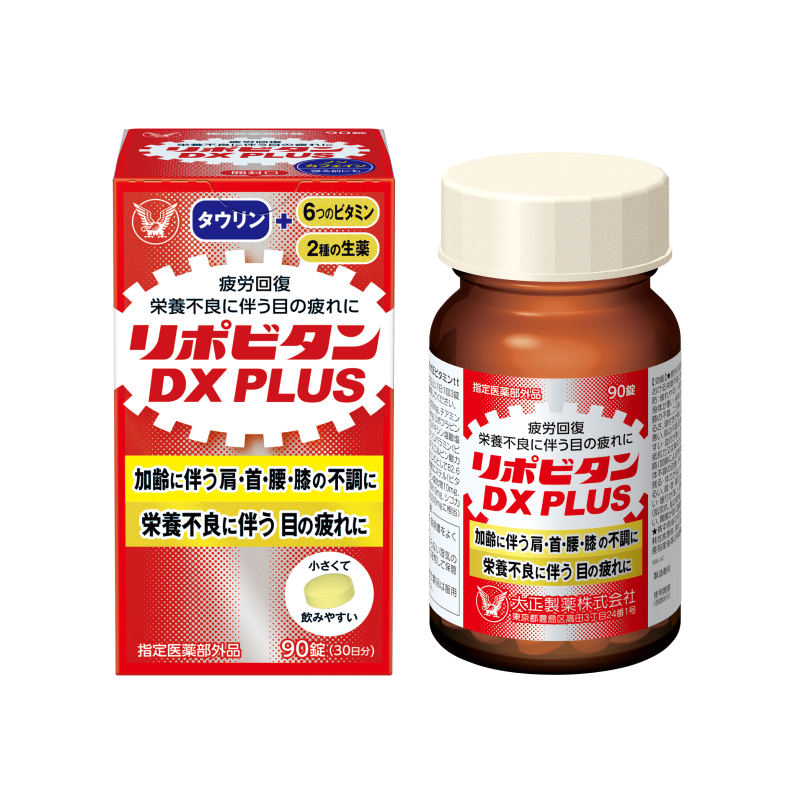
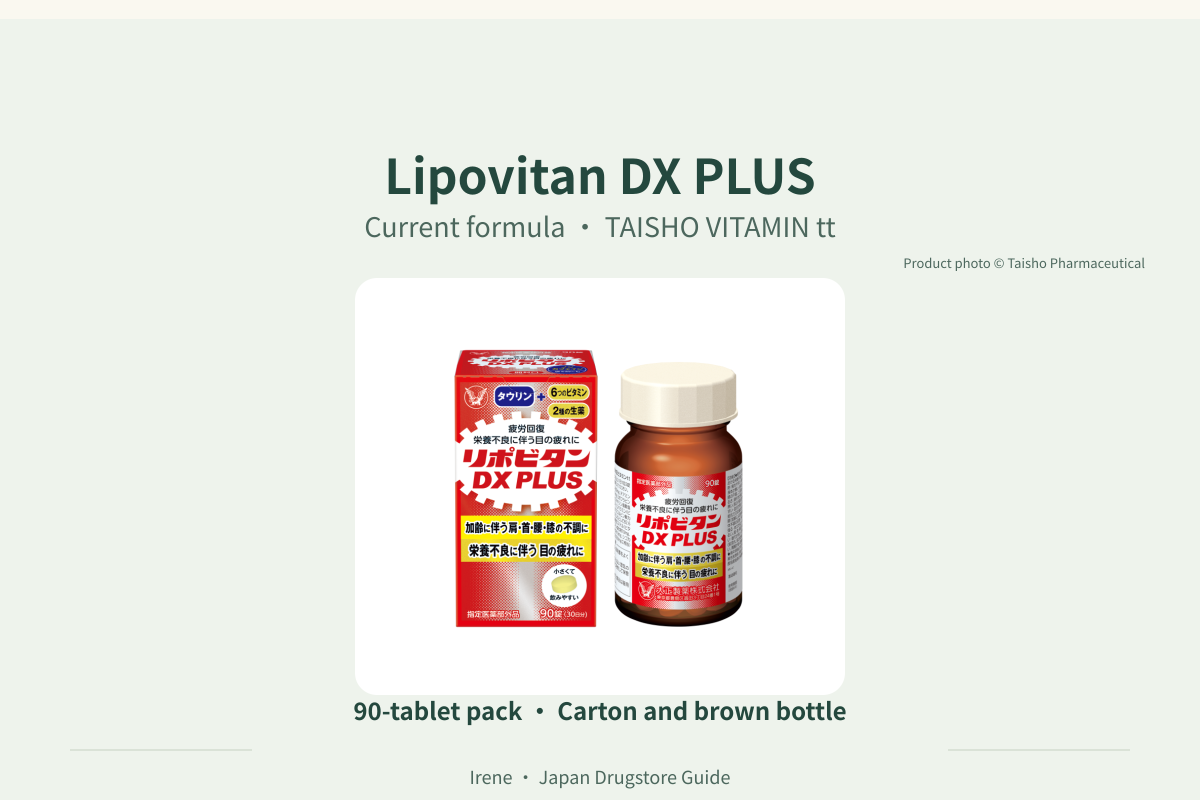
This guide covers the current リポビタンDX PLUS, whose Japanese approved sales name is 大正ビタミンtt (TAISHO VITAMIN tt). Its Japanese classification is a designated quasi-drug. On the pictured carton, check “PLUS,” “6つのビタミン” (six vitamins), “2種の生薬” (two herbal ingredients) and the 90-tablet count. Check the sales name and ingredients on the side too, rather than relying on the red color.
Taisho’s archived catalog marks the older リポビタンDX プラス as discontinued, and its formulation differs. Even current brand copy may spell “plus” in Japanese, so the spelling in a webpage title alone cannot identify the version. Match 大正ビタミンtt and the ingredients on your pack. Do not substitute directions for standard DX or Lipovitan drinks.
Read the conditions attached to the labeled uses
Japanese labeled uses include recovery from and prevention of fatigue, and maintaining or improving stamina, physical resistance or concentration. Two further groups of uses have specific qualifications:
- Symptoms associated with poor nutrition in daily life: examples include fatigue, shoulder/neck/lower-back/knee discomfort, hangover-related poor appetite or sluggishness, sleep difficulties, rough or dry skin, feeling cold, poor circulation and tired eyes.
- Symptoms associated with a weak constitution, including age-related physical frailty: examples include fatigue, shoulder/neck/lower-back/knee discomfort, sleep difficulties, skin problems, feeling cold, poor circulation and a weak digestive system prone to abdominal pain or diarrhea.
The Japanese label also includes nutritional supplementation during or after illness with reduced stamina, during debilitating illnesses with fever, for poor appetite, and during pregnancy, breastfeeding or before and after childbirth. A listed use does not establish that the product is suitable for every pregnant person or anyone receiving treatment.
Keep those qualifications when reading claims about joints or tired eyes. The label does not diagnose the cause of joint pain, vision changes or persistent fatigue. Ask a doctor or pharmacist to assess ongoing symptoms.
Taking and storing it: three practical steps
The packing is separate from the paper-wrapped desiccant inside the bottle. Do not swallow the desiccant. Ask a pharmacist if you cannot tell them apart.
Take with water or lukewarm water. Do not give it to anyone under 15. Do not invent a smaller child’s dose or take extra tablets because you feel particularly tired.
Taisho describes it as caffeine-free and suitable for use before bed. The directions do not require bedtime or after-meal dosing. The bedtime statement does not make it a treatment for every sleep problem.
If you already take B vitamins, a multivitamin or another nutritional product, check for overlapping ingredients to avoid excessive intake. Before buying, ask your doctor or pharmacist to review your medicines and supplements if you are pregnant, breastfeeding, receiving treatment or taking other medicines.
Keep the bottle tightly closed in a cool, dry place away from direct sunlight and children. Do not transfer the tablets to another container or return tablets touched with wet hands.
Both limits apply: use within six months after opening and before the printed expiry date. Follow whichever comes first.
Eleven ingredients per three-tablet dose
These amounts are for the full daily dose of three tablets, not one tablet. The current formulation contains six vitamins.
- Taurine 500 mg
- Thiamine nitrate (vitamin B1) 10 mg
- Riboflavin (vitamin B2) 5 mg
- Pyridoxine hydrochloride (vitamin B6) 5 mg
- Cyanocobalamin (vitamin B12) 0.03 mg, equivalent to 30 micrograms
- Calcium ascorbate 100 mg, providing 82.6 mg of vitamin C
- Tocopherol acetate (vitamin E) 10 mg
- Carnitine chloride 10 mg
- Glycine 5 mg
- Powdered dioscorea rhizome (yam) 10 mg
- Eleuthero dry extract 8 mg, equivalent to 200 mg of the crude herb
Inactive ingredients include sugar and gelatin. Check the complete labeling for allergies or dietary restrictions. Taisho notes that vitamin B2 may turn urine yellow, and the herbal ingredients may cause small color differences between batches. Those explanations should not be used to dismiss every unusual color change or other symptom.
When to stop and seek advice
Diarrhea that persists or worsens: stop and seek advice. The reference to diarrhea associated with a weak constitution among the labeled uses does not make persistent diarrhea after taking the product an expected benefit.
No improvement after taking it for a while: stop and seek advice. This product’s Japanese labeling does not set a fixed number of days or weeks. Do not increase the dose or postpone advice just to finish the bottle.
A useful question at the drugstore
「リポビタンDX PLUSの大正ビタミンttを探しています。このビタミン剤と一緒に飲んでも大丈夫ですか?」
“I’m looking for Lipovitan DX PLUS with the sales name 大正ビタミンtt. Can I take it with this vitamin product?” Add the second sentence if it applies, and show the other product’s pack or ingredient list.
Official sources
Checked November 10, 2026. This guide supports product identification and general understanding, not an individual diagnosis. Follow the complete Japanese labeling supplied with your pack. Translations are supporting references and do not establish approval in other countries.
- Taisho: current DX PLUS product information, ingredients and official packaging photograph
- Taisho: Japanese container/carton labeling and precautions
- Taisho: English product information
- Taisho: archived DXプラス catalog marked discontinued
Translation note: the ingredient list above follows the Japanese “dry extract” wording. The Japanese label also explicitly includes pregnancy in its nutritional-supplementation indication.