
Product information checked: 17 September 2026
Biofermin is on your Japan shopping list. Then you reach the shelf: S, S Plus, tablets, fine granules. Which box were you looking for? Start with the differences in this 3-minute guide, then use the photos to find the right one. It works whether you are choosing for yourself or finding a product your family requested.
This guide compares the four Japanese products called Shin Biofermin S and Shin Biofermin S Plus. We shorten these to S and S Plus below. These are products sold in Japan; similar brand names in another country may refer to different products.

Let’s look at this shelf together
Hi, I’m Irene, a pharmacist from Taiwan working in Japan. You do not need to read every Japanese word on the box. First ask: Which formula am I comparing, and do I want tablets or fine granules? Then match the photo. One less puzzle during your shopping trip!
Choose in 3 minutes: form first, then S or Plus
All four share the same labelled uses: bowel regulation, loose stools, constipation and abdominal bloating. Age and the form you can take are useful first filters.
S tablets / S Plus tablets
For ages 5+. Count the dose for the user’s age. Choosing Plus does not lower the age limit for tablets.
S fine granules / S Plus fine granules
Labelled doses start at 3 months; adults can use them too. Measure with the supplied spoon. Do not give them to babies under 3 months.
S: 3 bacteria types / Plus: 4
Plus adds B. longum and changes some proportions. The uses are the same: S is not the constipation-only choice, nor Plus the loose-stools-only choice. More types do not prove a better fit.
Shopping for family? Match “S / Sプラス” and “錠 / 細粒” to their requested product. Anyone receiving medical treatment should ask a doctor or pharmacist before use. Full age-based doses follow below.
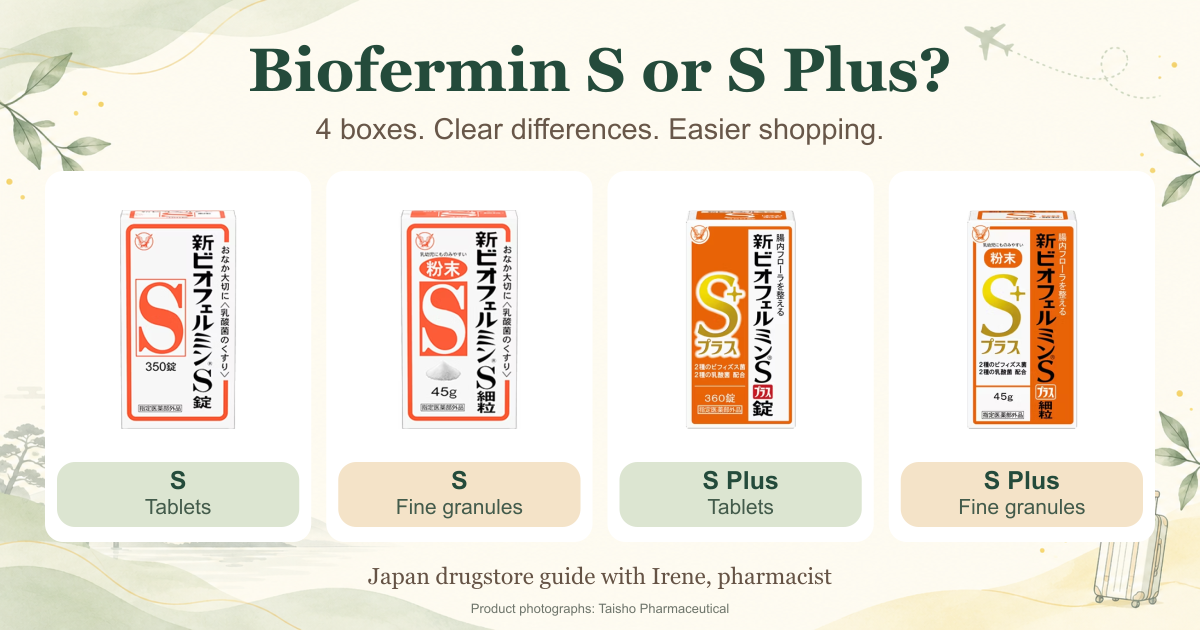
Recognize the four boxes
Save this box comparison before your drugstore visit. At the shelf, match the full Japanese name, then check the form and pack size. Photos are not to scale; image size does not show pack size.
Look for S / Sプラス first. Then check the end of the name: 錠 means tablets; 細粒 means fine granules. Keep this section open on your phone at the store.
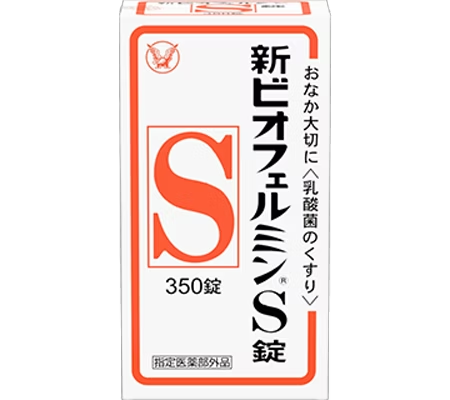
新ビオフェルミンS錠
Look for S + 錠
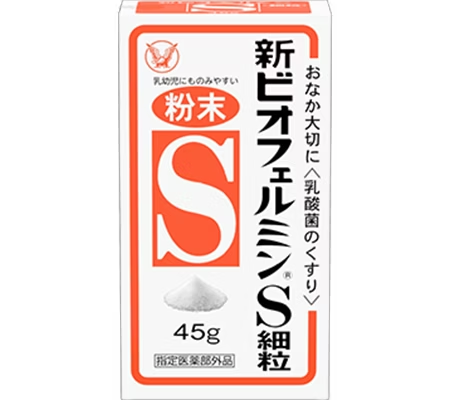
新ビオフェルミンS細粒
Look for S + 細粒
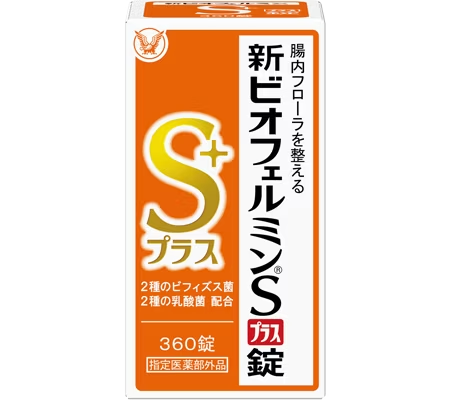
新ビオフェルミンSプラス錠
Look for Sプラス + 錠
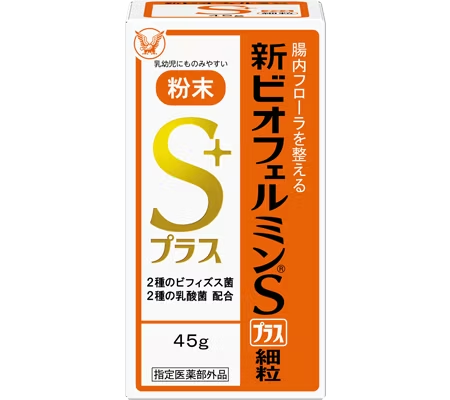
新ビオフェルミンSプラス細粒
Look for Sプラス + 細粒
Box photos: Taisho Pharmaceutical. Shown from left to right: 350 tablets, 45 g, 360 tablets and 45 g. Photos are not shown to scale. Sources are listed at the end.
S vs S Plus: what changes in the formula?
Three types of bacteria
B. bifidum, faecalis bacteria and L. acidophilus.
Four types of bacteria
The three types found in S, plus B. longum. The proportions also differ; it is not simply the same formula with more of everything.
You do not need to memorize the names. Here is how the manufacturer describes their roles, translated into everyday language.
| Bacteria on the Japanese label | In S | In S Plus | The manufacturer’s explanation |
|---|---|---|---|
| ビフィダム菌 B. bifidum | Yes | Yes | Mainly acts in the large intestine. Produces lactic and acetic acids to help improve the intestinal environment. |
| フェーカリス菌 Faecalis bacteria | Yes | Yes | Mainly grows in the small intestine and supports the growth of beneficial bacteria. |
| アシドフィルス菌 L. acidophilus | Yes | Yes | Produces lactic acid, mainly in the small intestine, helping suppress harmful bacteria. |
| ロンガム菌 B. longum | No | Yes | The type selected for S Plus is described as good at producing acetic acid, which helps suppress harmful bacteria. |
- Want the three-bacteria formula, or replacing the S product you already use? Start with S, then choose tablets or fine granules.
- Want to compare the formula with B. longum? Look at S Plus. Both its tablets and fine granules contain this four-bacteria combination.
- No particular formula in mind? Both series list the same uses. Age, preferred form and store availability can help you narrow the choice.
Four types of bacteria do not prove that Plus will work better for everyone. Eating out, stress or a “sensitive stomach” alone does not tell us which formula is better for a particular person.
Match the formula to the way you want to take it
S tablets: count the dose
For the three-bacteria formula in tablet form, look for 新ビオフェルミンS錠. No measuring spoon is needed. The person must be at least 5 and able to take tablets.
S fine granules: an option for adults too
Look for 新ビオフェルミンS細粒 if you want S but prefer fine granules. They are not only for children. Use the supplied spoon each time, not a household teaspoon.
S Plus tablets: the four-bacteria formula
Look for 新ビオフェルミンSプラス錠 if you want to compare the formula containing B. longum and prefer tablets. Age-based tablet counts are the same as for S tablets.
S Plus fine granules: the same four types in another form
Look for 新ビオフェルミンSプラス細粒. This also has doses for adults and children aged 3 months or older. Measure it with the spoon supplied with the product.
Taisho notes that S Plus is sold at a limited selection of pharmacies and drugstores. If you cannot see it, show the full name or box photo to a staff member and ask whether they stock it before spending time searching another aisle.
How to take it: find the right age row
Every amount below is for one dose. Take it three times a day, after meals. On a phone, swipe the tables sideways if needed.
S tablets and S Plus tablets
| Age | Amount per dose | When |
|---|---|---|
| 15 years and older | 3 tablets | 3 times a day, after meals |
| 5–14 years | 2 tablets | 3 times a day, after meals |
| Under 5 years | Do not take | — |
Turning 5 means the child dose starts; it does not mean the adult dose. The leaflet warns that tablets may get stuck in the throat in younger children. Do not invent a dose for a younger child by splitting or crushing tablets.
S fine granules and S Plus fine granules
| Age | Amount per dose | When |
|---|---|---|
| 15 years and older | 1 g = 3 level spoonfuls | 3 times a day, after meals |
| 5–14 years | 2/3 g = 2 level spoonfuls | 3 times a day, after meals |
| 3 months–4 years | 1/3 g = 1 level spoonful | 3 times a day, after meals |
| Under 3 months | Do not take | — |
Use only the spoon supplied with the product. One level spoonful is about 1/3 g, so an adult dose is three level spoonfuls. Slide the spoon open until it locks, as shown in the leaflet. An adult should check the amount and supervise children.
A few things to remember before using it
These four products are classified in Japan as designated quasi-drugs (指定医薬部外品). They are not the same as other Biofermin products labeled 下痢止め, meaning antidiarrheal medicine. Sudden diarrhea or stomach pain while traveling needs its own assessment.
- Receiving medical treatment? Consult a doctor or pharmacist before use, as the leaflets instruct.
- No improvement after about one month? Stop taking it and consult a doctor or pharmacist, bringing the leaflet. Worsening or persistent symptoms do not need to wait a month.
- Choosing a large bottle? Plan to use it within six months of opening and before the printed expiry date. Mark the opening date, keep it in its original container and close it tightly. Keep it away from heat, damp, sunlight and children.
General urgent-care advice: get medical help for severe or persistent abdominal pain, bloody stools or black, tar-like stools. A child who keeps vomiting or cannot drink and becomes less alert also needs urgent help. In a medical emergency in Japan, call 119.
At the drugstore: three small checks
- Before leaving: save the box photo. If buying for family, ask for the exact product name.
- At the shelf: match S or Sプラス, then 錠 or 細粒. Show the photo to staff if you cannot find it.
- Before paying: check the formula, the person’s age and the pack size. Keep the dose table with the photo for later.
Save your time for the places you want to visit
When shopping for someone else, their requested product matters more than whether the label says Plus. You can show the picture and ask 「この商品はありますか?」 — “Do you have this product?” Find the right box, then get back to enjoying Japan.
Questions before you buy or use it
Is S Plus always a better choice than S?
No. S Plus includes B. longum, but both series have the same labeled uses. Compare the formula, age limit and form. The number of bacteria types alone does not show which will work better for you.
Are fine granules only for children?
No. Both fine-granule products have adult doses. They are an option for people who prefer granules and are happy to measure each dose with the supplied spoon.
My child has just turned 5. Which dose applies?
For either tablet product, the dose for ages 5–14 is 2 tablets. For either fine-granule product, it is 2/3 g, or 2 level spoonfuls using the included spoon. Take each dose three times daily after meals, with adult supervision.
Does 1 g mean one spoonful?
No. One level spoonful using the supplied spoon is about 1/3 g. For ages 15 and older, one dose is 1 g, or three level spoonfuls. Do not measure with a household teaspoon or take the whole day’s amount at once.
Can it be taken every day?
The manufacturer says daily use for intestinal regulation may continue when the stomach and bowel condition is good. This does not mean everyone needs long-term use. If symptoms have not improved after about one month, stop and consult a doctor or pharmacist. Seek advice sooner if symptoms worsen.
Can I take it with another medicine?
This product comparison does not confirm that a combination is suitable. If you are receiving medical treatment, consult a doctor or pharmacist before use, as the leaflets instruct.
Sources and photo credits
Product information is based on Japanese manufacturer materials. The English names help you read this guide; match the full Japanese name on the box when shopping. Official product photographs are shown without changing the packaging artwork.
- Taisho: S tablets, photo and leaflet (Japanese)
- Taisho: S fine granules, photo and leaflet (Japanese)
- Taisho: S Plus tablets (Japanese)
- Taisho: S Plus fine granules (Japanese)
- Taisho: S formula and box photo (Japanese)
- Taisho: S fine granules box photo (Japanese)
- Taisho: S Plus formula and box photos (Japanese)
- Taisho: daily use FAQ (Japanese)
- Japan Ministry of Health: urgent symptoms and 119 (Japanese)