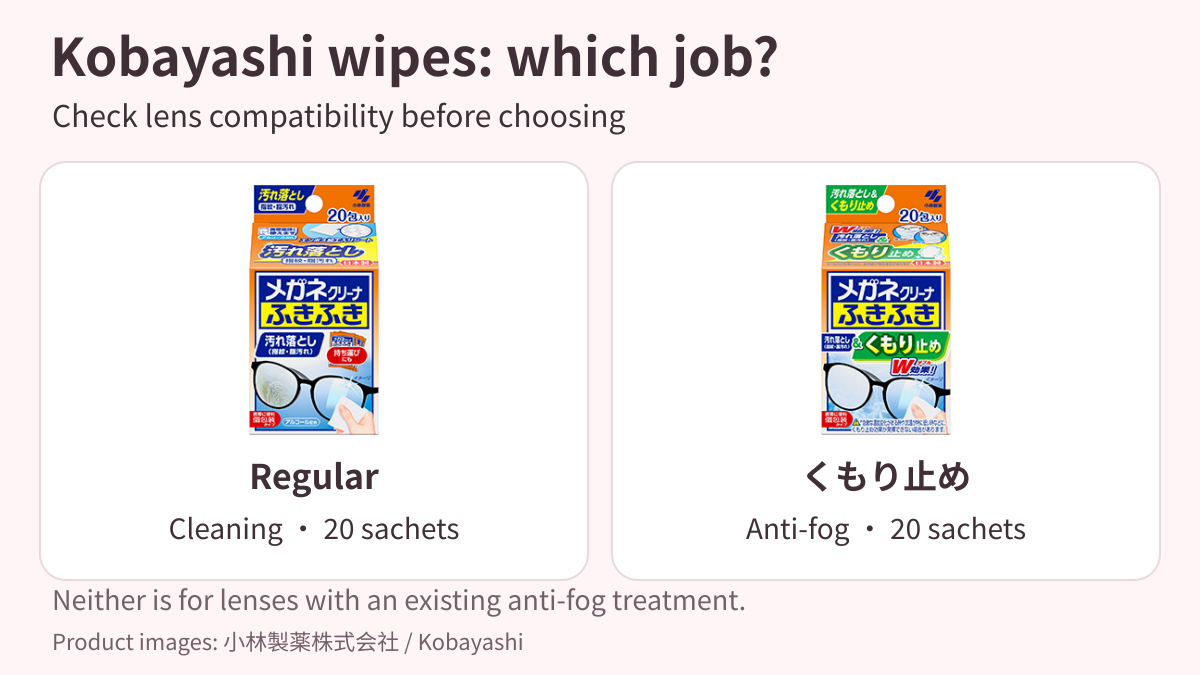
For fingerprints, look at the regular wipe. For fogging, look for くもり止め, but check the lens restrictions first. Neither version may be used on lenses that already have an anti-fog treatment.

I’m Irene, a Taiwan-born pharmacist licensed in Japan. These similar-looking sachets need different handling. Let’s separate the job you want done from the surfaces you may wipe.
Japanese official information checked: 23 October 2026 (Japan time). Scope: the two Kobayashi products named below, not all glasses wipes.
Identify the job before the pack count
メガネクリーナふきふき — regular, 20 sachets
For fingerprints and oily marks. The official listing does not give this version an anti-fog function.
メガネクリーナふきふき くもり止め — anti-fog, 20 sachets
For cleaning and an anti-fog application on compatible lenses. The extra words くもり止め are the key.
Both products are listed in 20- and 40-sachet boxes. Each single-use sheet is approximately 100 × 133mm, with the contents listed as 0.7g per sachet. A 40-sachet box contains more individually wrapped sheets, not a larger sheet.
The regular version lists isopropyl alcohol; the anti-fog version lists isopropyl alcohol and surfactant. Alcohol content is not permission to use either as a hand wipe or contact-lens cleaner. This guide does not make a disinfection claim.
Check your lenses before opening a sachet
| What you want to wipe | Regular | Anti-fog |
|---|---|---|
| Glasses lenses and sunglasses | Check material, coating and condition first. | Check material, coating and condition first. |
| Lenses with an existing anti-fog treatment | Do not use. | Do not use, despite the product name. |
| Lenses with surface scratches | Do not use. | Do not use. |
| Tortoiseshell or gemstone frames | Do not use. | Do not use. |
| Phone, computer or other electronics | Not a blanket yes; see the screen check below. | Do not use on electronic devices. |
| Contact lenses, hands or face | Not an allowed use. | Not an allowed use. |
Kobayashi lists plastic and multi-coated lenses among the usable types for both products. That is not approval for every specialised coating. If you do not know the coating or frame material, take the glasses and product name to the optician before using it.
For materials that are not prohibited, the manufacturer still asks for a test on an inconspicuous area. Sunglasses need a check for colour loss or similar changes. A spot test does not cancel an explicit “do not use” restriction.
The screen check is different for each version
Anti-fog: Kobayashi expressly excludes phones, computers and other electronic devices. Do not use it on a phone because the regular box mentions phones.
Regular: the listed uses include phone screens and the glass surfaces of TVs and computers, with liquid-crystal displays excluded. Do not read this as permission for every modern screen, coating or screen protector. Check your device or protector maker’s cleaning instructions and its alcohol restrictions. If compatibility is unclear, use the method specified for that device instead.
Regular cleaning and anti-fog application use different motions
If sand or metal particles are on the glasses, both product instructions say to rinse them away with water first. If the glasses’ own care instructions do not permit that, stop and ask the optician rather than rubbing the grit with a wipe.
| Regular cleaning | Anti-fog application |
|---|---|
| Gently wipe the lens surface before the sheet dries. The quick-drying regular wipe does not need a separate dry wipe. | Gently move only horizontally across one lens and back, completing five back-and-forth passes. Turn the sheet over and do the same on the other lens. Follow the pack’s direction diagram. |
| Do not save the opened sheet for later. | Do not finish with a dry tissue or rinse afterwards: this can remove the anti-fog ingredients. Do not scrub harder to increase the effect. |
Anti-fog residue may leave wipe marks. Its performance can vary with the wiping method, mask fit, sudden temperature changes or very low temperatures. There is no all-day or all-weather guarantee here. If you need predictable visibility for an activity, do not rely on an untested application.
Keep the safety steps with the sachets
- Use only for the listed purposes. Do not wipe the hands or face, and do not put the sheet or liquid in the eyes or on contact lenses.
- Keep away from flames when using either product.
- If you are sensitive to alcohol or have particularly sensitive skin, the manufacturer’s instructions say to rinse residual liquid from your fingers with water after use.
- Store out of reach of infants and people with dementia.
- Follow local disposal rules. Retain the box or a photo of its full directions when carrying individual sachets.
Three quick buying decisions
- Fingerprints on compatible glasses: regular cleaning is the relevant purpose; you do not need to buy an anti-fog label just because it sounds more advanced.
- Fogging when moving between spaces or wearing a mask: first check that the lenses have no anti-fog treatment, then read the anti-fog application and limitations.
- Unknown coating, scratched lenses or a prohibited material: neither pack is the next step. Ask the optician for the correct care method.
Useful Japanese: 「このレンズに、メガネクリーナふきふきのくもり止めは使えますか?」 — “Can I use the anti-fog version of Megane Cleaner Fukifuki on these lenses?” Show the exact box, not only the brand name.
Official sources
Follow the Japanese pack in your hand. Overseas versions and store availability may differ.
Product pictures are unmodified manufacturer images of the 20-sachet packs, not photographs taken for this blog.