 I’m Irene, a Taiwanese pharmacist working in a Japanese drugstore. If a Pabron box says “1日2回,” check the full name before using it. Sustained-Release Pabron Tablets are taken in the morning and evening and must be swallowed whole. They contain no caffeine, but you still must not drive after taking them. Here is how to identify this version and use its label safely.
- Identify Sustained-Release Pabron Tablets
- What is it for, and who must not take it?
- How to take it: morning and evening
- Six active ingredients, with the daily amounts clearly separated
- No caffeine does not mean safe to drive
- Ask before use if any of these apply
- Side effects and when to stop
- Buying it in Japan: the dose age and purchase rules differ
- Storage and travel
- What to ask at a Japanese drugstore
- Comparing other Pabron products?
- Official sources
Identify Sustained-Release Pabron Tablets
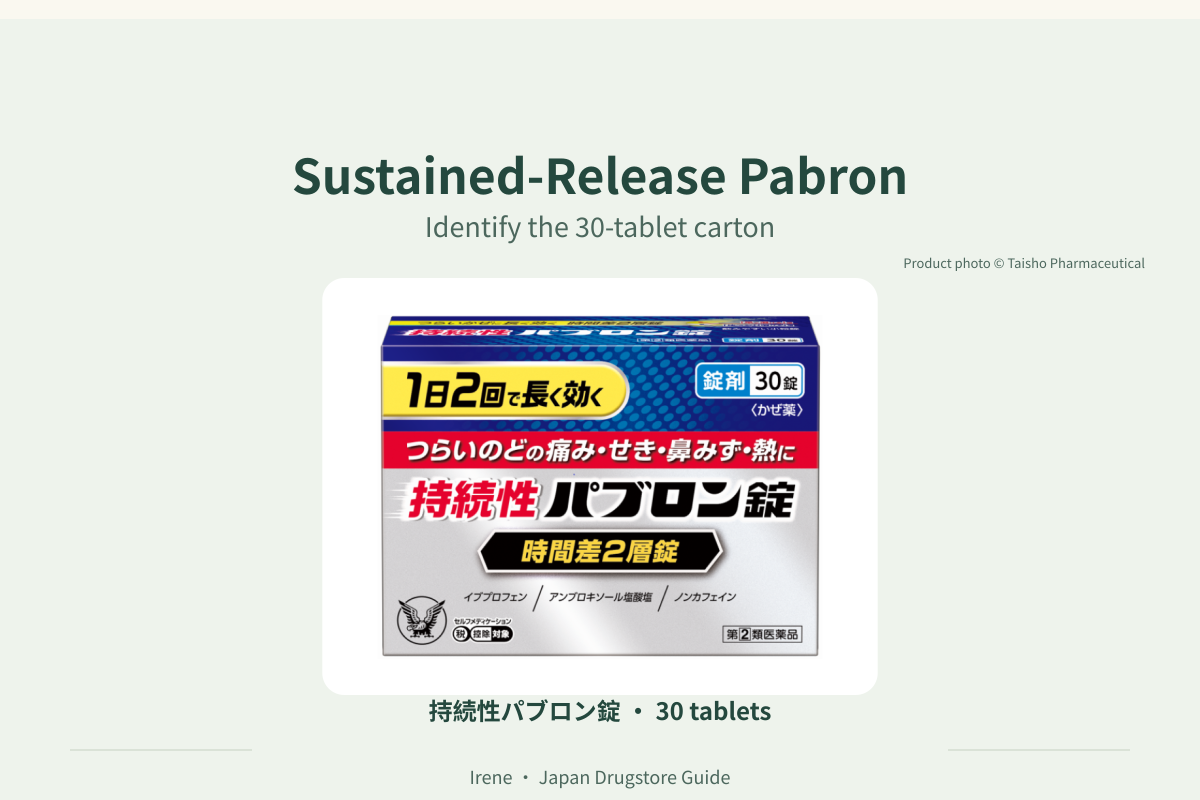
The Japanese name is 持続性パブロン錠. The boxed “2” in the lower-right medicine classification marks a designated Class 2 OTC medicine. Taisho currently lists packs of 18 and 30 tablets.
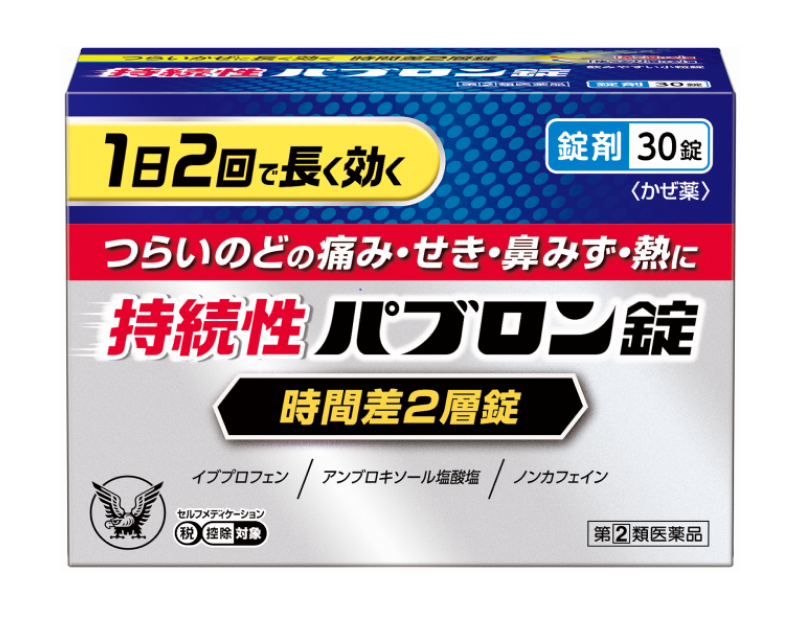
Look for the red 持続性 at the start of the name, 1日2回 in the yellow panel, and 時間差2層錠 in yellow on black. Gold A, S Gold W, Ace Pro-X and Pabron50 are different products. At the labeled daily dose, 18 tablets supply three days and 30 tablets supply five days. That is pack arithmetic, not an instruction to finish the box.
What is it for, and who must not take it?
Its Japanese indication is relief of cold-related sore throat, cough, phlegm, runny or blocked nose, sneezing, fever, fever-related chills, headache, joint pain and muscle pain. A “long-lasting” description does not establish whether your illness is suitable for self-treatment.
- You are under 15.
- You have had an allergic reaction to this product or an ingredient.
- This product, another cold medicine, or a fever/pain medicine has previously triggered asthma.
- You are pregnant and your due date is within 12 weeks.
Breastfeeding: the label says not to take the medicine, or to avoid breastfeeding if taking it. If you want to continue breastfeeding, ask a clinician or pharmacist about a suitable alternative. Do not guess a safe time to restart feeding. Anyone pregnant at an earlier stage, or possibly pregnant, must also seek advice before use.
How to take it: morning and evening
Take with water or lukewarm water after breakfast and the evening meal, preferably within 30 minutes. The daily total is six tablets, not six per dose. Do not add a lunchtime dose or increase the amount because symptoms feel severe.
The tablets have layers that dissolve at different speeds. Keep them intact. Push each tablet out of its PTP blister before swallowing; swallowing the blister packaging can injure the esophagus. If swallowing whole tablets is difficult, ask a pharmacist about another formulation.
This means three to four doses, not three to four days. Stop and consult a doctor, pharmacist or registered OTC seller, taking the leaflet with you. The label particularly highlights fever lasting three days or longer, or fever that returns.
Never take it for more than five days. That maximum does not mean waiting five days before addressing a possible side effect or lack of improvement.
Six active ingredients, with the daily amounts clearly separated
The amounts below are in six tablets, the full daily dose. The leaflet lists amounts per three-tablet dose, which are half of these values.
- Ibuprofen 400 mg: for pain, fever and inflammation.
- d-Chlorpheniramine maleate 3.5 mg: an antihistamine for sneezing and a runny or blocked nose.
- Dihydrocodeine phosphate 16 mg: a cough suppressant acting on the cough center.
- dl-Methylephedrine hydrochloride 60 mg: a bronchodilator used to relieve coughing.
- Ambroxol hydrochloride 45 mg: helps clear phlegm.
- Riboflavin, vitamin B2, 8 mg: vitamin supplementation during a cold.
The inactive ingredients are cellulose, anhydrous silicic acid, calcium hydrogen phosphate, hypromellose, sodium starch glycolate, magnesium stearate and citric acid. Check the full list if you have ingredient allergies. Vitamin B2 can turn urine yellow, but brown urine or yellow skin or eyes should not be dismissed as that harmless color change.
No caffeine does not mean safe to drive
- Do not drive or operate machinery after taking it. Drowsiness can occur despite the caffeine-free label. Plan around this if you have a rental car or other driving commitments.
- Do not drink alcohol before or after taking it. The leaflet does not give a safe number of hours to wait.
- Do not combine it with other cold medicines, fever/pain medicines, sedatives, cough/expectorant medicines, or oral medicines containing antihistamines, including some rhinitis, motion-sickness and allergy products. A different brand name does not prevent ingredient overlap.
Show a pharmacist your regular medicines and ingredient lists. Do not stop prescribed treatment yourself in order to add this product.
Ask before use if any of these apply
The Japanese leaflet requires advice from a doctor, pharmacist or registered OTC seller for:
- Current treatment by a doctor or dentist, pregnancy or possible pregnancy, older age, or previous allergic reactions to medicines or other substances.
- High fever or difficulty urinating.
- A diagnosis of thyroid dysfunction, diabetes, heart disease, high blood pressure, liver disease, kidney disease or glaucoma.
- A diagnosis of systemic lupus erythematosus, mixed connective tissue disease, impaired respiratory function, obstructive sleep apnea or obesity.
- A history of stomach or duodenal ulcer, ulcerative colitis or Crohn’s disease.
The “do not take” restrictions above still apply; they are not a reason to experiment with a smaller dose.
Side effects and when to stop
Stop immediately and consult if these appear after a dose
- Skin: rash, redness, itching, swelling or bruising.
- Digestive symptoms: nausea, vomiting, poor appetite, stomach discomfort or pain, mouth sores, heartburn, an upset or heavy stomach, gastrointestinal bleeding, abdominal pain, diarrhea, bloody stools or bloating.
- Other symptoms: dizziness, numbness, palpitations, shortness of breath, trouble urinating, blurred vision, ringing in the ears, swelling, nosebleeds, bleeding gums, bleeding that is difficult to stop or other bleeding, back pain, an unusually low body temperature or general sluggishness.
Constipation, dry mouth and drowsiness may also occur. Stop and consult if they persist or worsen. The driving restriction applies even if drowsiness is not getting worse.
Rare serious reactions need immediate medical care
The leaflet identifies the following serious reactions. Seek medical care for the warning signs without trying to prove that the medicine caused them:
- Anaphylaxis, asthma or respiratory depression: rapidly developing hives, hoarseness, an itchy throat, palpitations, confusion, wheezing or difficulty breathing.
- Stevens-Johnson syndrome or toxic epidermal necrolysis: high fever, red eyes or eye discharge, lip sores, sore throat, and a widespread rash or redness that persists or rapidly worsens.
- Liver or kidney injury: jaundice or brown urine, or reduced urination and generalized swelling, possibly with fever, rash or marked tiredness.
- Aseptic meningitis: severe headache with a stiff neck, fever, nausea or vomiting.
- Heart attack or cerebrovascular disorder: constricting chest pain, breathlessness and cold sweat, or sudden reduced consciousness, one-sided weakness or difficulty speaking.
- Interstitial pneumonia: breathlessness with mild exertion, a dry cough and fever that appear suddenly or persist.
- Aplastic anemia or agranulocytosis: unusual bruising, bleeding, pallor, blood in the urine or marked fatigue, or sudden high fever, chills and sore throat.
Buying it in Japan: the dose age and purchase rules differ
Because it contains dihydrocodeine and methylephedrine, this product falls within Japan’s 指定濫用防止医薬品 system, introduced on May 1, 2026 to prevent misuse. This purchase system is separate from its designated Class 2 status and its minimum dosing age of 15.
- Purchasers under 18: only one qualifying small pack may be sold, with checks and information from a pharmacist or registered seller in person or by a video call that allows both sides to see and hear each other. A routine text-only online checkout is not a substitute.
- Purchasers aged 18 or over: large packs or multiple packs require in-person or such video-call checks of the reason for purchase and appropriate use. There is no blanket one-box limit for every adult, and being over 18 does not guarantee a sale of any quantity.
Expect questions about age, other medicines and purchases at other shops, plus your name if you are under 18 or when otherwise needed. Answer honestly and follow the seller’s assessment; do not split purchases to bypass checks. A permitted pack size never extends this medicine’s five-day maximum use.
Storage and travel
Keep it in a cool, dry place out of direct sunlight and children’s reach. Do not transfer it to another container. Use within six months of opening and before the printed expiry date, whichever comes first. This storage limit is not a treatment duration. Before crossing a border, check your destination’s rules for medicines containing dihydrocodeine and the other ingredients. Being sold in Japan does not establish permission to import it elsewhere.
What to ask at a Japanese drugstore
「持続性パブロン錠を検討しています。今飲んでいる薬と、運転の予定があります。私に使えますか?」
“I’m considering Sustained-Release Pabron Tablets. I take other medicines and have plans to drive. Is it suitable for me?” Adapt this to your actual situation, and explain your age, symptoms, how long they have lasted and any fever. If you need to drive, say so: this medicine’s label prohibits driving after use.
Comparing other Pabron products?
- Pabron Gold A, S Gold W and Ace Pro-X tablets: compare other combination cold medicines.
- Pabron Gold A tablets versus fine granules: do not carry over this product’s twice-daily schedule.
- Pabron cough medicines: these must not be added to this product on your own.
Official sources
Checked November 10, 2026. Medicine information follows the Japanese leaflet revised in May 2026. This guide supports product identification and general understanding, not individual diagnosis or treatment. Read the complete leaflet supplied with your product and the latest precautions before use.
- Taisho: product details, daily ingredient amounts and official packaging image
- Japanese leaflet, revised May 2026
- Taisho’s English product leaflet, revised May 2026
- Japan’s Ministry of Health: pack-quantity rules effective May 2026
- Hokkaido government: public guidance on the sales system, updated October 16, 2026