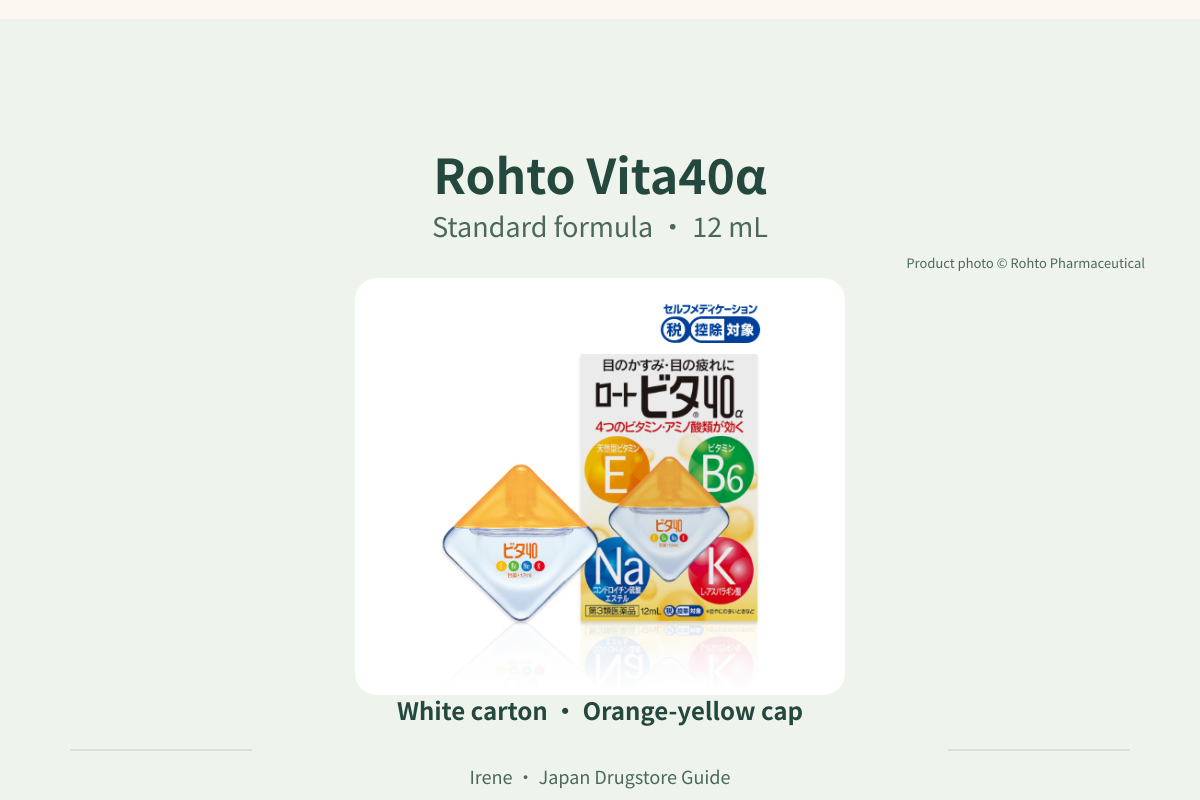
 I’m Irene, a Taiwanese pharmacist working in a Japanese drugstore. Several Japanese eye drops have “40” in their names, but their formulas differ. This guide identifies Rohto Vita40α with the yellow-orange cap and explains its contact-lens restrictions, dose and stop-use rules.
Identify standard Rohto Vita40α, 12 mL
This guide covers the Japanese ロートビタ40α (Rohto Vita40α), a Class 3 OTC medicine supplied in a 12 mL bottle. Its Japanese barcode is 4987241100521. Do not substitute directions for ロートクール40α (Cool40α) or Vロートゴールド40 (V Rohto Gold40).
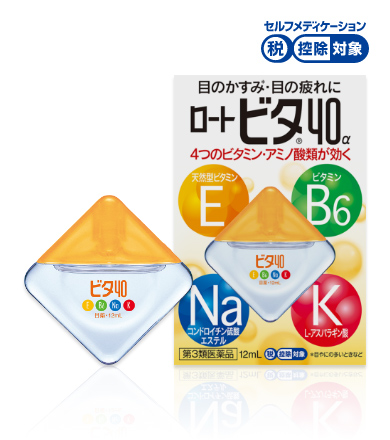
In the photograph, check ビタ40α on the white carton, the yellow-orange cap and the four colored circles marked E, B6, Na and K. The lower carton also says 第3類医薬品 and 12mL. Those details are more reliable than color alone.
“40” is not an age cutoff in the leaflet. It does not restrict use to people aged 40 or older, and it does not give a numerical minimum age for children. It says children must use the drops under a parent or guardian’s supervision. Ask a pharmacist before using them for a child rather than assuming every age is suitable. Rohto rates the cooling sensation 3 out of 5; this is not a rating of effectiveness.
What are its Japanese labeled uses?
- Blurred vision, such as when there is excessive eye discharge.
- Tired eyes and conjunctival redness.
- Prevention of eye disease, for example after swimming or when dust or sweat enters the eyes.
- Blepharitis (inflammation with soreness or erosion of the eyelids) and itchy eyes.
- Eye inflammation caused by ultraviolet or other light, such as snow blindness.
- Discomfort while wearing hard contact lenses.
These labeled uses do not diagnose the cause of redness, blurred vision or pain. Dry eye is not listed among this product’s indications, so do not treat it as an all-purpose artificial tear. Severe eye pain requires advice before use. Seek prompt medical care for a sudden substantial change in vision rather than relying on OTC drops.
Use and storage: three practical steps
If you are unsure of your lens type or when to put lenses back in after removal, show both packs to a pharmacist. This leaflet does not give a universal reinsertion waiting time.
Use only as eye drops; do not swallow. Follow this product’s amount and frequency, rather than copying another Rohto product’s dose or increasing it yourself.
Keep the tip away from the eye, eyelid and lashes to prevent contamination by discharge, dust or other material. Do not use cloudy liquid. Supervise children. If you are receiving medical treatment or use other eye medicines, check with your doctor or pharmacist first.
Store tightly closed in a cool place away from direct sunlight and children. Avoid places reaching 40°C or above, including cars and areas near heaters.
Do not transfer the contents, share the bottle or add anything to it. Do not use it after the expiry date printed on the carton. Even within that date, use it as soon as possible after opening. This leaflet does not specify a fixed number of months after opening.
Droplets or ingredient crystals may form on the tip or inside the cap during storage. The leaflet allows these to be wiped gently with clean gauze before use. This does not make cloudy liquid acceptable.
All six active ingredients, not “four vitamins”
The four nutrients highlighted on the carton are not four vitamins, nor are they the full active-ingredient list. The Japanese label lists these six concentrations:
- d-α-Tocopheryl acetate (natural-type vitamin E) 0.05%
- Vitamin B6 0.1%
- Sodium chondroitin sulfate (コンドロイチン硫酸エステルナトリウム) 0.1%
- Potassium L-aspartate 1%
- Neostigmine methylsulfate 0.005%
- Chlorpheniramine maleate 0.03%
E and B6 are the vitamins; sodium chondroitin sulfate and potassium L-aspartate are the other two highlighted nutrients. The formula also contains the antihistamine chlorpheniramine maleate, so it is more than a vitamin solution.
Complete inactive-ingredient list: boric acid, borax, l-menthol, d-borneol, eucalyptus oil, sodium edetate (エデト酸Na), polyoxyethylene hydrogenated castor oil and a pH adjuster. Check these as well if you have a history of medicine or ingredient allergies.
When to ask first or stop
Ask before use
Consult a doctor, pharmacist or registered OTC medicine seller if you are receiving medical treatment, have had allergic reactions to medicines or other substances, have severe eye pain, or have been diagnosed with glaucoma.
Stop immediately for possible side effects
Skin rash, redness or itching, or eye redness, itching, swelling or painful stinging after use may be side effects. Stop immediately and take the carton’s inside instructions or the leaflet to a doctor, pharmacist or registered OTC medicine seller.
Persistent blurred vision, or no improvement after about two weeks
Stop and seek advice if blurred vision does not improve; you do not need to wait two weeks. A separate stop-use rule applies when symptoms have not improved after about two weeks of use. This is Vita40α’s rule. Do not replace it with another eye drop’s 5–6-day limit or treat it as permission to wait two weeks with every symptom.
A useful question at the drugstore
「ロートビタ40αの12mLについて相談したいです。このコンタクトレンズで使えますか?ほかの目薬も使っています。」
“I’d like advice about the 12 mL Rohto Vita40α. Can I use it with these contact lenses? I also use other eye drops.” Add the last sentence if it applies, and show the lens and medicine packs.
Manufacturer contact details printed on the leaflet: Rohto Customer Support Desk, Tokyo 03-5442-6020 or Osaka 06-6758-1230, 9:00–18:00 Japan time, excluding Saturdays, Sundays and Japanese public holidays. These are Japanese domestic phone numbers for product inquiries, not an emergency service.
Official sources
Checked November 10, 2026, Japan time, against the complete Japanese leaflet currently linked from the official product page. This guide supports product identification and general medicine information, not individual diagnosis or a recommendation to buy. Follow the complete labeling supplied with your pack. Japanese classification does not establish approval or import eligibility elsewhere.