 I’m Irene, a Taiwanese pharmacist working in a Japanese drugstore. If you visit Japan in autumn or winter, a cold-medicine box advertising no drowsiness-causing ingredients can catch your eye. With Pabron 50, check the symptoms it covers, the number of tablets per dose and your other medicines before focusing on that claim.
- Identify Pabron 50: the bottle contains 48 tablets
- Which symptoms does the Japanese label cover?
- Three instructions to keep in mind
- Ingredients in each four-tablet dose
- What the no-drowsiness-ingredients claim does and does not tell you
- Who should avoid it or ask first?
- Side effects: when to stop and when to seek urgent care
- Opening and storing the bottle
- A question you can use at a Japanese drugstore
- Official sources
Identify Pabron 50: the bottle contains 48 tablets
This guide covers Taisho’s Japanese パブロン50錠 (PABRON 50 tablets), a Class 2 OTC medicine. “50” is part of its name, not its tablet count. The current official pack contains 48 tablets. Nor does the name mean the minimum age is 50: the labeled dose is for people aged 15 and over, subject to the other restrictions below.
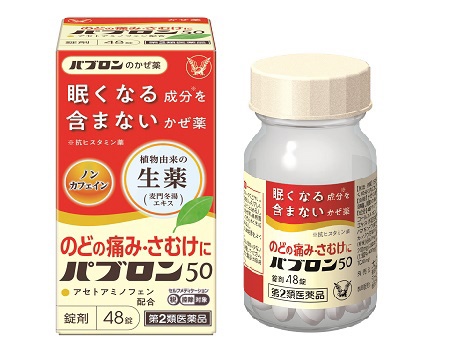
On the pictured red-and-cream carton, look for パブロン50 near the bottom, 48錠 at the lower left and 第2類医薬品 at the lower right. These details are more useful than color alone. The 生薬 wording refers to herbal ingredients, but the product also contains acetaminophen and is not an exclusively herbal medicine.
Do not transfer the directions for Pabron Gold A, S Gold W, Ace Pro-X, rhinitis medicines or children’s products to this pack. Products sharing the Pabron name can have different ingredients, doses and age limits.
Which symptoms does the Japanese label cover?
The labeled use is relief of cold-related sore throat, chills, fever, headache, joint pain, muscle pain and phlegm. Runny nose, blocked nose, sneezing and cough are not on this product’s indication list. A shared brand name does not mean every product treats the same symptoms.
If a runny nose or persistent cough is your main concern, describe it to a pharmacist rather than adding another cold or cough medicine yourself. Pabron 50 is for symptom relief; it does not identify the cause of a fever.
Three instructions to keep in mind
The dose is four tablets, not a two-tablet dose borrowed from another Pabron product. The labeled daily total is 12 tablets, divided into the three doses, never taken all at once.
While taking it, do not use another cold medicine, fever reducer/painkiller, sedative or cough/phlegm medicine. Pabron 50 already contains acetaminophen, also called paracetamol. A different brand name does not make an additional painkiller suitable.
Do not drink alcohol before or after a dose, and do not use it continuously long term. Show all your prescription medicines, OTC products and herbal medicines to a doctor, pharmacist or registered OTC medicine seller for a check.
The leaflet says five to six doses, not five to six days. If symptoms have not improved by then, stop and take the leaflet to a doctor, pharmacist or registered OTC medicine seller. Do not keep taking it just to finish the bottle.
Suspected side effects or severe symptoms need attention sooner. You do not need to complete five or six doses before seeking help.
Ingredients in each four-tablet dose
These amounts are for four tablets, not one:
- Acetaminophen (paracetamol), 150 mg: for fever and pain relief.
- Potassium guaiacolsulfonate, 80 mg: helps loosen phlegm for clearance.
- Dry bakumondoto extract, 600 mg: helps moisten dry throat membranes and clear phlegm.
The 600 mg extract is made from ophiopogon tuber (bakumondo) 533.3 mg, glycyrrhiza 133.3 mg, non-glutinous rice 666.7 mg, jujube 200 mg, ginseng 133.3 mg and pinellia tuber 333.3 mg. Those are the starting herbal quantities for the extract, not extra amounts of extract to add to the 600 mg. Inactive ingredients are anhydrous silicic acid, aluminum silicate, carmellose calcium, magnesium stearate and corn starch.
What the no-drowsiness-ingredients claim does and does not tell you
The Japanese leaflet lists no antihistamine, dihydrocodeine phosphate, dl-methylephedrine hydrochloride or ephedra in the formula. That does not establish that it is suitable for everyone with a chronic illness. The official product page also explicitly says it cannot guarantee the absence of drowsiness, difficulty urinating, constipation or dry mouth.
People receiving medical treatment need advice before taking it. Packaging claims are not an individual assessment of whether you can safely drive or operate machinery.
Who should avoid it or ask first?
Do not take it if:
- You have had an allergic reaction to this medicine or one of its ingredients.
- This or another cold medicine or fever reducer/painkiller has previously triggered asthma.
- You are under 15.
Ask a doctor, pharmacist or registered OTC medicine seller before use if:
- You are receiving medical or dental treatment.
- You are pregnant or might be pregnant.
- You have a history of allergic reactions to medicines or other substances.
- You have a high fever.
- You have been diagnosed with heart, liver or kidney disease, or a stomach or duodenal ulcer.
Side effects: when to stop and when to seek urgent care
Stop immediately and take the leaflet for medical or pharmacy advice if you develop a rash, skin redness or itching, nausea, vomiting, loss of appetite, dizziness or an excessive drop in body temperature.
The leaflet also lists the following rare but serious reactions. Stop and obtain immediate medical care if these occur. Breathing difficulty or altered consciousness needs emergency help:
- Severe allergy/anaphylaxis: soon after a dose, skin itching, hives, hoarseness, sneezing, an itchy throat, difficulty breathing, palpitations or clouded consciousness.
- Severe skin reactions: Stevens–Johnson syndrome, toxic epidermal necrolysis or acute generalized exanthematous pustulosis may involve high fever, red eyes or eye discharge, damaged or eroded lips, sore throat, widespread rash/redness or small pustules on red skin, with malaise or appetite loss that persists or worsens suddenly.
- Drug-induced hypersensitivity syndrome: widespread redness, a generalized rash, fever, malaise or swollen lymph nodes in areas such as the neck, armpits or groin.
- Liver problems: fever, itching, rash, yellow skin or eyes, brown urine, malaise or loss of appetite.
- Kidney problems: fever, rash, reduced urine, swelling throughout the body, malaise, joint pain or diarrhea.
- Interstitial pneumonia: breathlessness with stairs or slight exertion, difficulty breathing, a dry cough or fever that starts suddenly or persists.
- Asthma: wheezing or difficulty breathing.
Opening and storing the bottle
- At first opening, remove and discard the packing material used to protect the tablets during shipping. Do not keep putting it back.
- Do not return tablets touched with wet hands to the bottle; moisture may affect their quality or color.
- Keep the cap tightly closed in a cool, dry place away from direct sunlight and out of children’s reach.
- Do not transfer the tablets to another container. Do not use them after expiry. The leaflet says to use the product promptly after opening but gives no fixed number of months. This is not an instruction to keep taking it until the bottle is empty.
- Herbal ingredients can cause slight color variation between products. This does not excuse improper storage, moisture damage or use after expiry.
A question you can use at a Japanese drugstore
「パブロン50錠について相談したいです。今飲んでいる薬と、症状を確認してもらえますか。」
“I’d like advice about Pabron 50. Could you check my current medicines and symptoms?” Show the other medicine packs and mention pregnancy, chronic conditions or any previous drug allergy.
Official sources
Checked November 10, 2026, Japan time. The current official Japanese leaflet is the primary source; it is marked revised January 2023. This guide provides product identification and general medicine information, not an individual diagnosis or a purchase recommendation. Follow the complete instructions supplied with your pack.
- Taisho: Pabron 50 product information and official packaging photograph
- Japanese leaflet, front: restrictions, consultation and stop-use warnings
- Japanese leaflet, back: indications, dose, ingredients and storage
- Taisho: January 2023 safety-warning revision
- Taisho: English reference translation. Do not rely on this translation alone for medicine-combination precautions. Ask a pharmacist to check your other medicines against the Japanese leaflet.