 I’m Irene, a Taiwanese pharmacist working in a Japanese drugstore. Before picking up Japan’s pink Tofumel A ointment, consider what you need it for: a small wound, cracked skin or everyday skincare. This guide starts with the skin problem, then explains the product’s uses, application frequency and when medical care comes first.
- Tofumel A is a wound medicine, not a routine face cream
- What does the Japanese leaflet list it for?
- When is self-treatment not enough?
- Three practical steps for suitable minor skin problems
- Burns: first aid comes before a medicine choice
- Three active ingredients, measured per 100 g
- Children, eye contact and stained clothing
- Jar and tube storage details
- What to ask at a Japanese drugstore
- Official and clinical sources
Tofumel A is a wound medicine, not a routine face cream
トフメルA (Tofumel A) from Sampo Pharmaceutical is a Japanese Class 2 OTC medicine for wounds and skin antisepsis, among other labeled uses. The manufacturer confirms that it contains no steroid. It still has active medicinal ingredients and precautions. Its pink color does not establish a cosmetic benefit: skin brightening, scar fading and tinted skincare are not among its labeled uses.
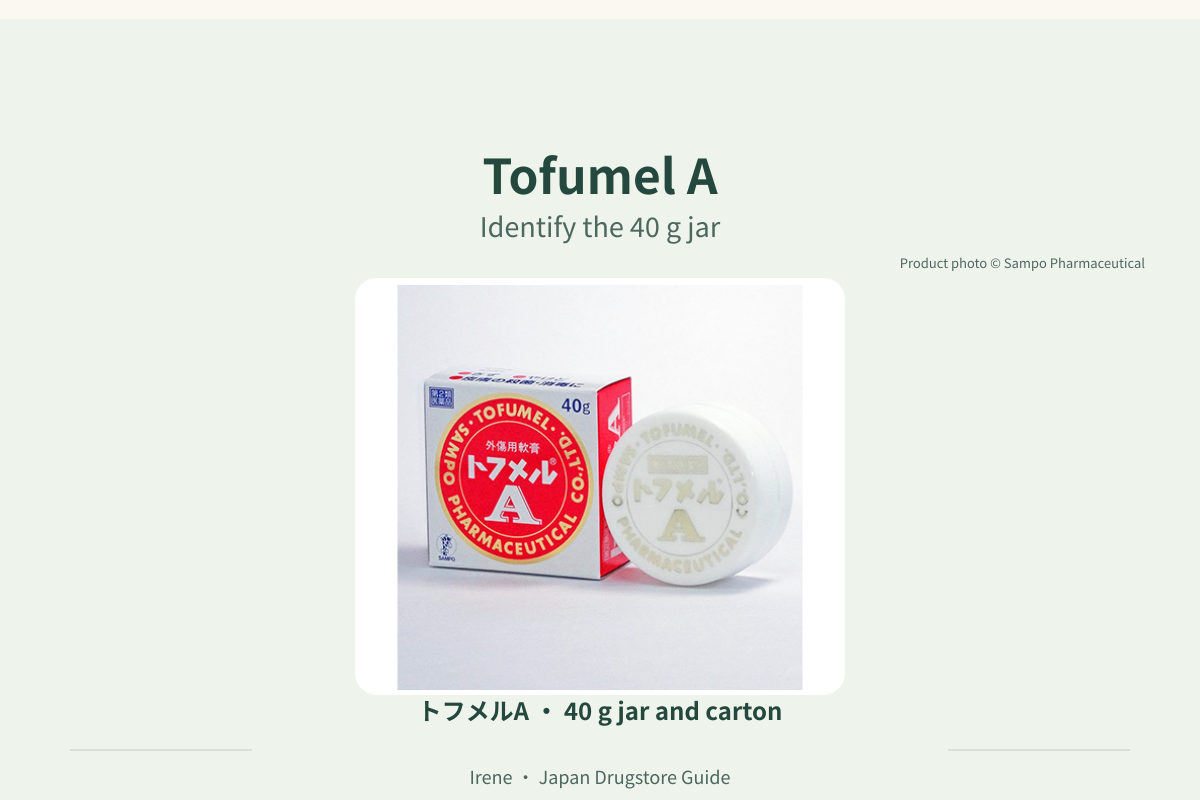
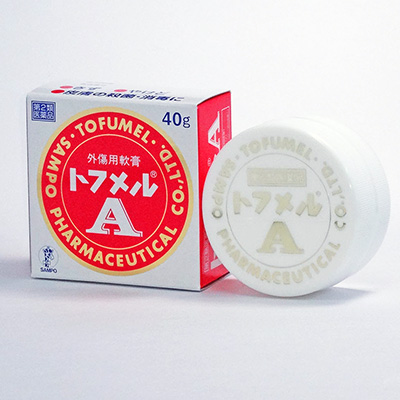
The official range lists a 40 g jar and a 15 g tube. Check the full name トフメルA and the Class 2 medicine marking, 第2類医薬品, before choosing a size. The pack weight is the total contents, not the amount for one application.
What does the Japanese leaflet list it for?
The labeled uses are grazes, cuts, puncture wounds, burns, cracked skin, chapped or fissured skin, chilblains, and skin antisepsis/disinfection. This list does not establish that an injury is suitable for home treatment. For example, “puncture wounds” does not mean that a deep puncture or a wound with something embedded in it needs only ointment.
If your skin has no symptoms and you simply want a moisturizer, an oily ointment base is not a reason to use this medicine as an everyday all-over skincare product. For an injury, first consider depth, size, ongoing bleeding and increasing redness, swelling or pain.
When is self-treatment not enough?
The Japanese leaflet says to ask before use if:
- You are receiving medical treatment.
- You have had allergic reactions to medicines or other substances.
- The affected area is extensive.
- You have a deep wound or a severe burn.
Consult a doctor, pharmacist or registered OTC medicine seller before using the product in these situations.
General wound warning signs: seek immediate care for bleeding that will not stop, a deep wound or an embedded object; do not dig it out. Pus, worsening redness/swelling/pain, fever or persistent dirt need prompt medical attention. These are NHS wound-care warnings, not additional indications for Tofumel A. Do not wait 5–6 days.
Three practical steps for suitable minor skin problems
The Japanese directions are to apply or rub an appropriate amount onto the affected area once or twice a day. The leaflet also describes applying ointment to gauze. Ask a pharmacist about suitable dressing technique when needed. It does not prescribe a fixed number of grams per application.
The 40 g jar and 15 g tube have different pack sizes, not different daily application frequencies. Repeated handwashing is not a reason for unlimited reapplication. For external use only; do not swallow.
If rash, redness or itching develops after use, stop immediately. These may be side effects. Take the leaflet to a doctor, pharmacist or registered OTC medicine seller.
If symptoms have not improved after 5–6 days, stop and take the leaflet with you when seeking advice. This is not an instruction to treat every wound for six days or a promise that healing will finish within that time. Worsening symptoms or the warning signs above need earlier attention.
Burns: first aid comes before a medicine choice
The Japanese leaflet lists burns and describes ointment-on-gauze care after cooling. That application advice is not the immediate first-aid procedure. The NHS guidance reviewed in 2026 advises cooling under cool running water for 20 minutes as soon as possible, not putting creams, oils or butter on burns, and leaving blisters intact.
Large/deep burns, burns on areas such as the face or genitals, and chemical/electrical burns require immediate medical care. Ask a healthcare professional whether this product is appropriate after cooling. Sampo’s own FAQ recommends medical assessment for burns in babies.
Three active ingredients, measured per 100 g
- Zinc oxide 8 g: the manufacturer describes astringent, skin-protective and fluid-absorbing actions.
- dl-Camphor 0.5 g: the manufacturer describes relief of inflammation and itching, among its actions.
- Chlorhexidine hydrochloride 0.2 g: an antiseptic ingredient.
These are the amounts in 100 g of ointment, not a single dose. An antiseptic ingredient does not mean that every wound requires this product, or that ointment alone is enough for a wound producing pus.
Complete inactive ingredients: purified lanolin, petrolatum, glycerin, beeswax, alcohol and ferric oxide. Check these too if you have an allergy history. “Steroid-free” does not remove the need to check ingredients.
Children, eye contact and stained clothing
- Children must use it under a parent or guardian’s supervision. This leaflet does not give a numerical minimum age or a children’s dose in grams. For an infant or young child, tell a pharmacist the age and skin problem and ask whether it is suitable and how much to use. Do not simply halve an adult’s amount.
- Keep it out of the eyes. If it enters an eye, rinse immediately with water or lukewarm water. See an eye doctor if symptoms are severe.
- The pink ointment can stain fabric. The manufacturer warns that marks on clothes and sheets can be difficult to remove. Consider this when packing it for a trip, particularly around hotel bedding or pale clothing.
Jar and tube storage details
Keep tightly closed in a cool place, away from direct sunlight and children. For the tube, wipe away ointment protruding from the opening before replacing the cap. For the jar, wipe the rim, close the lid securely and store it level rather than tilted. Do not transfer the medicine to another container.
Do not use it after its expiry date. The leaflet does not specify a fixed number of months after opening. If you are unsure whether an opened pack is still usable, ask a pharmacist.
What to ask at a Japanese drugstore
This means: “I’m looking for Tofumel A. Is this wound suitable for an OTC medicine?” Explain how and when it happened, the size, any discharge, allergy history and current treatment. Checking the wound before choosing a jar or tube is more useful than asking only which ointment is famous.
Official and clinical sources
Checked November 10, 2026. This guide concerns the Japanese product and the complete leaflet currently linked by its manufacturer. It provides product-identification and general medicine information, not individual diagnosis or treatment. Read the instructions supplied with your own pack. General first-aid guidance is identified separately from Japanese product labeling.
- Sampo Pharmaceutical: Tofumel A product details, pack sizes and photograph
- Sampo Pharmaceutical: complete Tofumel A leaflet, two-page PDF
- Sampo Pharmaceutical: Tofumel A brand page and FAQ
- NHS: Cuts and grazes, first aid and medical warning signs
- NHS: Burns and scalds, first aid and medical warning signs