 I’m Irene, a Taiwanese pharmacist working in a Japanese drugstore. A blue jar of Yuskin I may look like another everyday hand cream, especially with its moisturizing and steroid-free claims. Before choosing it, ask whether you need routine moisture or treatment for existing itching or other labeled symptoms.
- Can blue Yuskin I replace the orange jar as a daily moisturizer?
- Identify the exact product: Yuskin I Cream, 110 g
- What is it labeled for?
- Use it in three steps: symptoms, application, reassessment
- Steroid-free still means checking ingredients and reactions
- Children, the face, pregnancy and breastfeeding
- Do not keep applying it through itching, redness or stinging
- Travel and storage: keep the original jar
- What to ask in a Japanese drugstore
- Official sources
Can blue Yuskin I replace the orange jar as a daily moisturizer?
Do not use Yuskin I simply to moisturize skin without symptoms. The manufacturer’s FAQ specifically says to use this medicine when itching or other symptoms are present, rather than as a moisturizer. A moisturizing texture is not a reason to keep applying it after symptoms have gone.
The orange-lidded Yuskin is a designated quasi-drug in Japan, labeled for cracks, chapped skin and chilblains. Sisora cream and lotion are quasi-drugs focused on moisturizing and preventing dryness. For routine face or body moisture, start with the orange Yuskin and Sisora comparison. You do not need an extra anti-itch medicine merely because you are shopping for a moisturizer. These Japanese regulatory categories are not a ranking of effectiveness.
Identify the exact product: Yuskin I Cream, 110 g
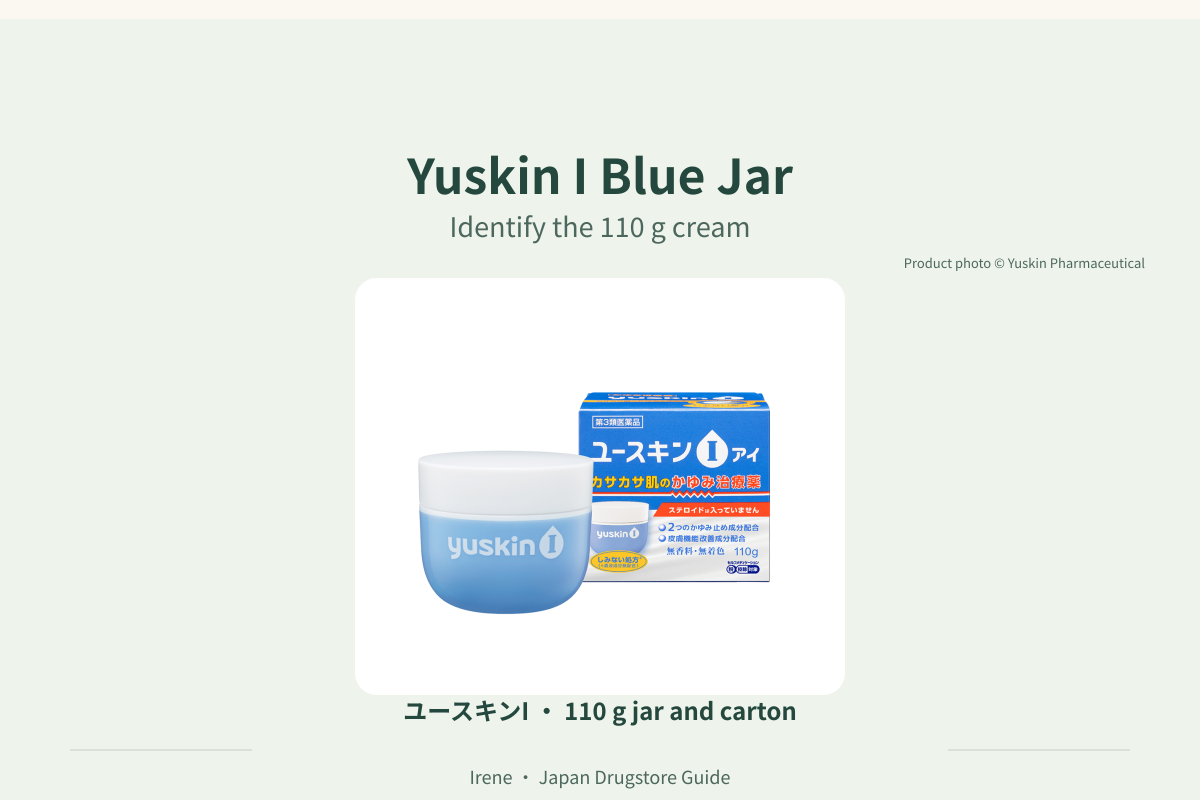
This guide covers Japan’s current ユースキンI(アイ)クリーム110gボトル, sold under the name ユースキンI. It is a Class 3 OTC medicine. Check the letter I(アイ), the word クリーム (cream), and 110g, rather than relying on the brand alone.
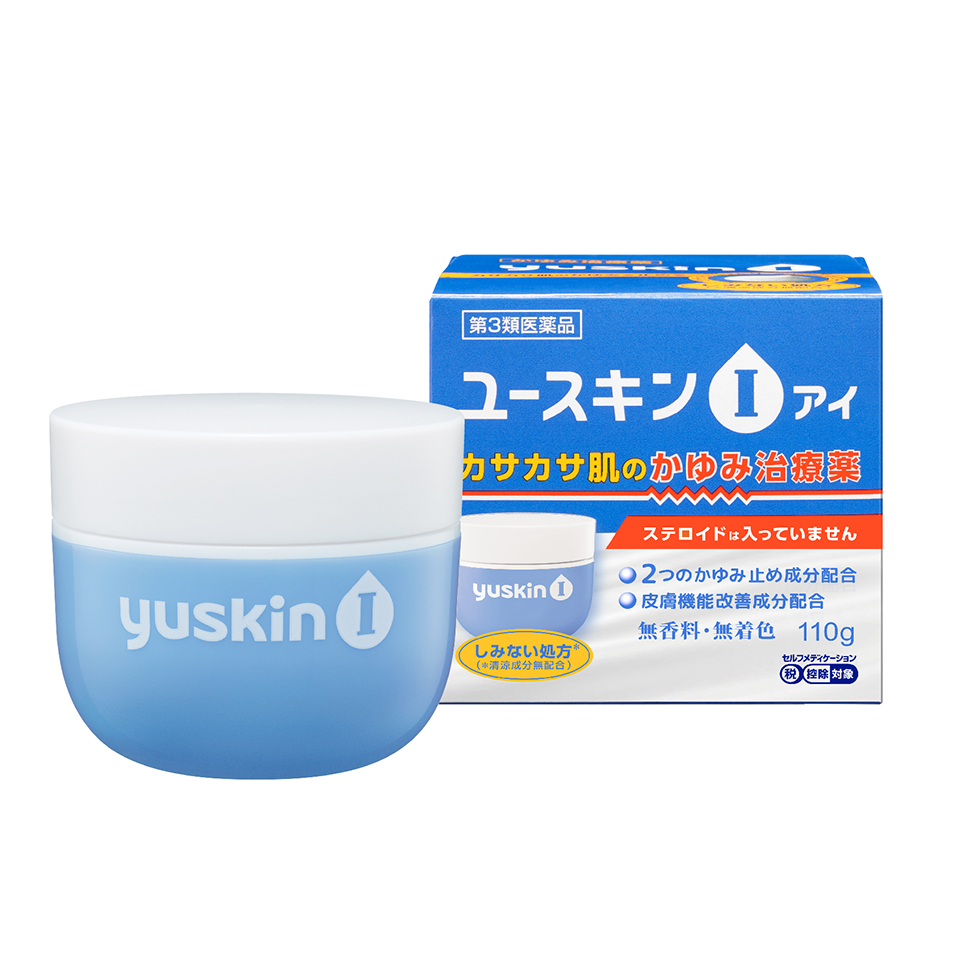
Look for the I inside a white droplet, アイ beside it, and 110g at the lower right of the carton. The front identifies it as a medicine for itching associated with dry skin. Yuskin I also has a lotion version; a package marked ローション is not the jar covered here.
What is it labeled for?
The Japanese leaflet lists itching, dermatitis, eczema, hives, contact dermatitis, heat rash and skin erosions. The manufacturer also describes itching associated with dryness, bathing, tight clothing or underwear, and bedtime. Those examples do not establish the cause of your symptoms.
Severe weeping or erosion requires advice before use. An indication that includes skin erosions is not permission to self-treat badly damaged skin. Also consult a doctor, pharmacist or registered OTC seller in Japan before use if you are receiving medical treatment or have previously had an allergic reaction to medicines or other substances.
Use it in three steps: symptoms, application, reassessment
Those are this product’s directions. The leaflet does not specify exactly three applications a day or a fixed number of grams per application. If you are unsure about the area or amount, show the pharmacist the actual problem rather than borrowing instructions from another cream.
For external use only. Do not swallow it or apply it to mucous membranes such as the lips. Children must use it under adult guidance and supervision, with care to prevent rubbing it into their eyes or putting it in their mouths.
If symptoms have not improved after 5–6 days, stop and take the product and its instructions to a doctor, pharmacist or registered OTC seller. Stop immediately for a suspected adverse reaction; do not wait out that period. The 110 g jar size is not a reason to extend treatment.
Steroid-free still means checking ingredients and reactions
The official page states that the cream contains no steroids, urea, cooling ingredients, added fragrance or coloring. These are formulation features, not a guarantee against irritation or a claim that it suits every skin problem. Fragrance-free products may still have an odor from their ingredients.
The five active ingredients per 1 g of cream are listed below. This describes concentration, not an instruction to apply 1 g:
- Crotamiton 20 mg.
- Diphenhydramine 10 mg.
- Glycyrrhetinic acid 10 mg.
- Isopropylmethylphenol 5 mg.
- Tocopherol acetate 5 mg.
These five ingredients and their concentrations match Yuskin Asemo Cream 32 g. A larger blue jar does not mean stronger anti-itch actives. Matching actives also do not establish an identical overall formulation, texture or clinical performance. This Yuskin I leaflet does not list insect bites, so do not transfer Asemo’s indication list to this jar. If your package is a white tube labeled あせもクリーム, use the separate Yuskin Asemo Cream 32 g guide to identify it.
Check the inactive ingredients too: hydrogenated soybean phospholipids, olive oil, glycerin, 1,3-butylene glycol, dimethylpolysiloxane, xanthan gum, carboxyvinyl polymer, stearic acid, glyceryl triisooctanoate, cetyl palmitate, cetostearyl alcohol, isopropyl myristate, sorbitan stearate, sorbitan sesquioleate, polyoxyethylene hydrogenated castor oil, triethanolamine and parabens. Show the complete label to a pharmacist if you have a known allergy or intolerance.
Children, the face, pregnancy and breastfeeding
- Children: the manufacturer’s FAQ does not set a minimum age, provided the product suits the skin. The leaflet requires adult guidance and supervision. This does not establish that every infant rash is suitable for self-treatment. Have unexplained, recurrent or extensive symptoms assessed rather than inventing a universal age cutoff.
- The face: the FAQ allows use if the skin tolerates it, after a small trial on a soft area such as beneath the chin. Avoid getting it in the eyes. The symptoms-only rule still applies; it does not become an everyday facial moisturizer.
- Pregnancy and breastfeeding: the manufacturer says it may be used if it suits the skin, while noting that skin can be more sensitive during these periods. Stop and wash it off with water or lukewarm water if redness, itching or irritation occurs during or after use, including after sun exposure. Ask your doctor if concerned.
Do not keep applying it through itching, redness or stinging
Stop immediately for possible adverse reactions
These include rash, redness, itching, swelling, contact dermatitis, dryness, irritation, a feeling of heat or stinging after use. Stop and take the product and instructions to a doctor, pharmacist or registered OTC seller. The absence of cooling ingredients does not make stinging something to ignore.
If cream gets into the eyes or mouth
Rinse the eyes immediately with water or lukewarm water; see an eye doctor if symptoms are severe. If a child accidentally puts it in their mouth, first wipe out the remaining cream and seek medical advice if any abnormal symptoms occur. Keep it out of children’s reach. External use does not mean it is harmless to swallow.
Travel and storage: keep the original jar
Close the lid securely and store it away from direct sunlight, preferably somewhere cool, out of children’s reach. Avoid heat and humidity. Do not transfer it into a small travel pot, because this can cause mix-ups or affect quality. Do not use expired cream.
The FAQ advises using an opened product promptly but sets no fixed number of months after opening. Do not use it if its color or smell changes, even before expiry. Storage advice does not override the symptoms-only guidance or the 5–6-day stop rule.
What to ask in a Japanese drugstore
「ユースキンIの110gクリームについて相談したいです。かゆみがあるのはここです。保湿用との使い分けを教えてください。」
“I’d like advice about Yuskin I 110 g cream. This is where it itches. Could you explain how its use differs from a moisturizer?” Add your age, how long it has lasted, any weeping, allergies and current medicines. Those details are more useful than asking which jar is stronger.
Official sources
Checked November 10, 2026, Japan date, against the current 110 g product page, its linked complete Japanese leaflet and product FAQ. This is product-identification and general medicine information for the Japanese-market product, not individual diagnosis or confirmation of approval or import rules elsewhere. Read the complete label supplied with your own package.
- Yuskin Pharmaceutical: Yuskin I Cream 110 g, ingredients, FAQ and package photograph
- Yuskin Pharmaceutical: complete Japanese Yuskin I leaflet
- Yuskin Pharmaceutical: Asemo Cream 32 g ingredients and product information
- Yuskin Pharmaceutical: orange Yuskin 120 g classification and indications
- Yuskin Pharmaceutical: Sisora Cream 110 g classification and uses
- Yuskin Pharmaceutical: Sisora Lotion 170 mL classification and uses