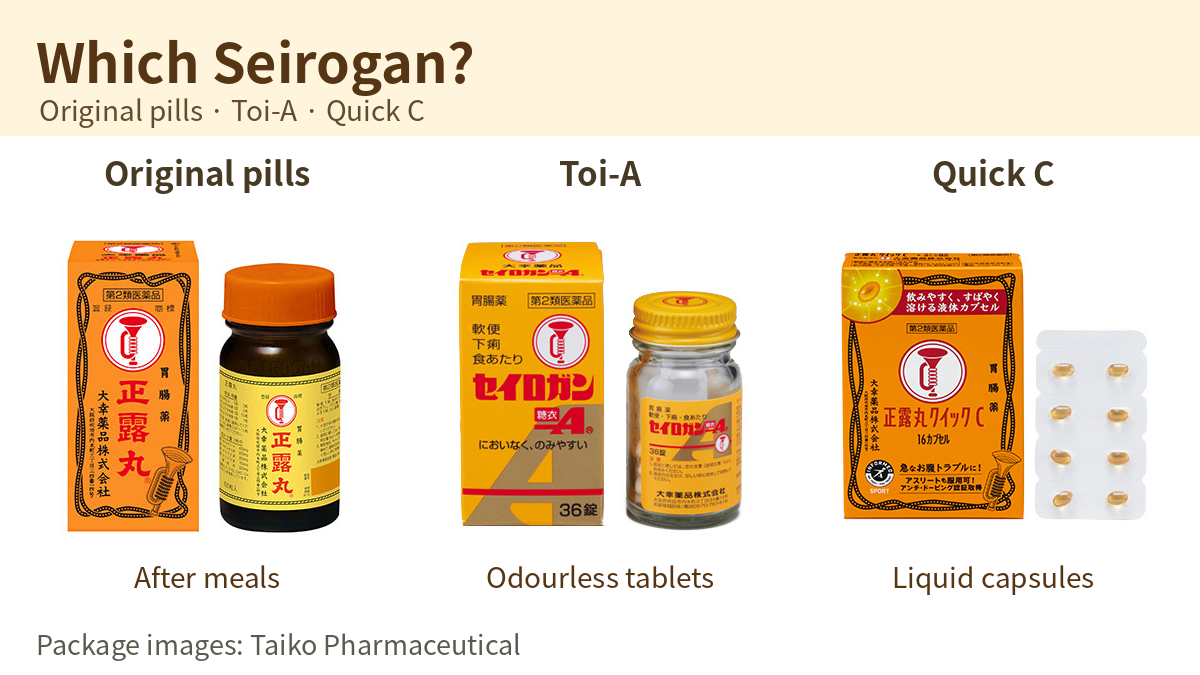
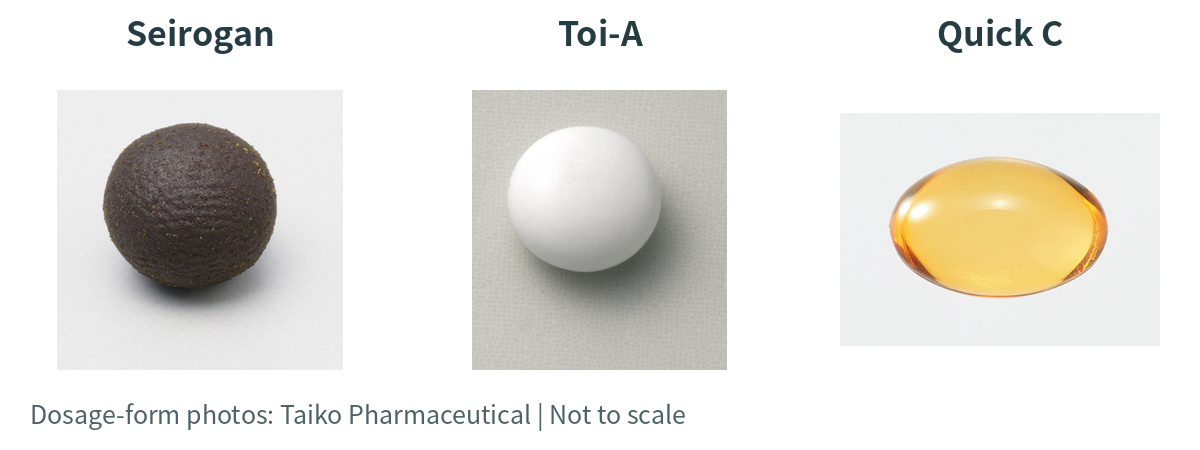
The trumpet logo is familiar, but the products beside it are not interchangeable. Original Seirogan is a soft, dark pill with a distinctive smell; Toi-A is a white sugar-coated tablet; Quick C is a liquid-filled capsule. The practical differences include the ingredients, the number to take and whether doses are tied to meals.
Start with hydration and a safety check. Get medical or pharmacist advice before self-treating diarrhoea with fever, blood, persistent mucus or sudden severe symptoms. Seek prompt care if you cannot keep fluids down, are passing much less urine or feel persistently dizzy. Sudden severe abdominal pain, confusion or difficulty waking someone needs emergency care. None of these three products is for children under 5.

I’m Irene, a Taiwan-born, Japan-licensed pharmacist working in a Japanese drugstore. Let’s work through the things that matter at the shelf: who will take it, which form they can swallow and how the directions fit their day.
Product information checked: 12 October 2026. This guide covers Taiko Pharmaceutical’s Japanese-market products. Other manufacturers and overseas versions have their own labels.
- Have a pack of Toi-A? Check the batch first
- A quick way to narrow down the three
- Match the package to the medicine inside
- Ingredients: check what each number actually refers to
- How many per dose? Use the correct age band
- Who needs advice before taking it?
- Two uses that need extra care
- Official information and image credits
Have a pack of Toi-A? Check the batch first
Taiko announced a recall of certain Toi-A batches on 21 March 2025, including some blister packs and portable packs. It does not cover every Toi-A product. Some listed packs have expiry dates as late as March 2027, so an unexpired date alone does not clear a pack for use.
Before buying or taking it, match the full product name, pack size and batch number on the bottom or side against the official recall list, pages 2–3 of the PDF. At this check, PMDA lists this recall as completed. If a pack you still hold matches the affected list, do not use it; contact Taiko using the details in the notice for instructions. Recall lists for different markets are not interchangeable.
A quick way to narrow down the three
Once an antidiarrhoeal is appropriate for you:
- Original Seirogan: a soft pill with a distinctive smell and taste, containing wood creosote plus four other herbal ingredients. Taken after meals.
- Seirogan Toi-A: an odourless, white sugar-coated tablet with a different herbal formula. Taken after meals. Do not take it if you receive dialysis.
- Seirogan Quick C: liquid-filled capsules with wood creosote as the only active ingredient. Can be taken when symptoms occur regardless of meals, with at least four hours between doses.
All three must be taken with water, either cool or warm. Ask a pharmacist about swallowing difficulties or use in a child. If you have reacted to one of these medicines or its ingredients before, do not simply try another version yourself.
Match the package to the medicine inside
Original Seirogan: the soft, dark pill
Japanese package name: 正露丸.
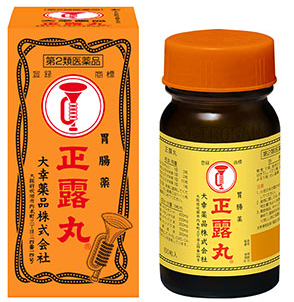
The original is a moist, slightly soft, dark-brown pill with a distinctive smell and taste. The manufacturer currently lists 100-, 200- and 400-pill packs. For ages 15 and over, the dose is three pills, three times daily after meals, preferably within 30 minutes. Children have separate age bands; the dose is not simply half an adult dose.
Seirogan Toi-A: white sugar-coated tablets
Japanese package name: セイロガン糖衣A. “Toi-A” identifies the sugar-coated version.
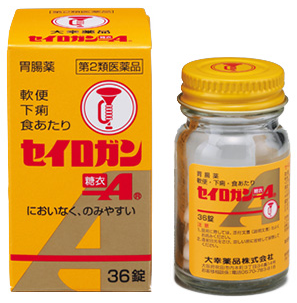
The coating makes these white tablets odourless. Toi-A also has a different formula from original Seirogan; it is not just the original pill with a coating added. For ages 15 and over, take four tablets, three times daily after meals, preferably within 30 minutes.
The current product page lists a 24-tablet portable pack, 36- and 84-tablet bottles, and a 48-tablet blister pack. The portable version, labelled 携帯用, is a packaging option, not a fourth formula. It was relaunched with a redesigned container in 2025. Check batch numbers rather than relying on the pack colour to decide whether a recall applies.
Seirogan Quick C: capsules that are not tied to meals
Japanese package name: 正露丸クイックC.
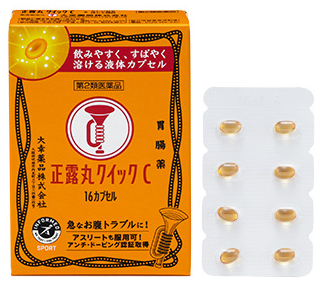
Wood creosote is the only active ingredient. Ages 11 and over take two capsules per dose; ages 5–10 take one. Take no more than three doses a day, at least four hours apart. The manufacturer says it can be taken when symptoms occur, before or after food or on an empty stomach.
“Quick” refers to a liquid-capsule formulation designed to break down and release its ingredient quickly. It is not a promise that everyone’s diarrhoea will stop within a fixed number of minutes, and it does not justify an early extra dose. When carrying it, keep the blister sheet and desiccant in the original foil pouch with the opening folded over, to help prevent moisture absorption and escaping odour.
All three are Class 2 OTC medicines in Japan. Some packs now print the medicine instructions on the back of the box instead of including a separate leaflet: the change began with shipments from late December 2025 for Seirogan 100 pills and Toi-A 36 and 84 tablets, with a QR code linking to the instructions. Keep the box for the directions, warnings, expiry date and batch number. Packaging transitions and shop stock vary.
Ingredients: check what each number actually refers to
All three contain pharmaceutical-grade Japanese Pharmacopoeia wood creosote, labelled 木クレオソート. This is different from industrial coal-tar creosote. The additional ingredients and dose units vary:
- Original Seirogan, per nine pills, an adult day’s dose: wood creosote 400 mg, powdered gambir 200 mg, powdered phellodendron bark 300 mg, powdered glycyrrhiza (liquorice) 150 mg, and powdered citrus unshiu peel 300 mg.
- Toi-A, per 12 tablets, an adult day’s dose: wood creosote 270 mg, powdered geranium herb 300 mg, and dry phellodendron bark extract 300 mg.
- Quick C, per two capsules, one dose for ages 11 and over: wood creosote 90 mg. Its other listed ingredients are excipients. At the maximum of six capsules in a day for this age group, the wood creosote total is 270 mg.
The figures 400, 270 and 90 do not rank the products by strength. They mix daily and single-dose quantities, and the formulas and dosage forms differ. Toi-A contains sugar and gelatin among its excipients; Quick C also contains a gelatin ingredient. Check the complete ingredient list if you have allergies or dietary restrictions.
How many per dose? Use the correct age band
Every number below is for one dose, not the whole day.
| Age | Original pills | Toi-A tablets | Quick C capsules |
|---|---|---|---|
| 15 and over | 3 | 4 | 2 |
| 11–14 | 2 | 3 | 2 |
| 8–10 | 1½ | 2 | 1 |
| 5–7 | 1 | 2 | 1 |
| Under 5 | Do not use | Do not use | Do not use |
- Original and Toi-A: three times daily after meals, preferably within 30 minutes, with water.
- Quick C: when symptoms occur, within the label limits of three doses daily and at least four hours between doses, with water. That four-hour rule belongs to Quick C; it does not replace the after-meal directions for the other two.
- A parent or guardian must supervise children to prevent dosing mistakes or choking. Ask a pharmacist to show you how to measure the original product’s 1½-pill dose if unsure.
- Push medicine out of its blister before taking it. Never swallow the foil packaging, and do not transfer the medicine into another container.
Who needs advice before taking it?
For all three: consult first if you are receiving medical treatment, are older, or have diarrhoea with fever, blood or persistent mucus. These medicines do not replace assessment for infection or dehydration.
Original Seirogan and Toi-A: do not use a product you have previously been allergic to, or one containing an ingredient you are allergic to. Consult first for a history of other medicine or cosmetic allergies, or liver or kidney disease. Original Seirogan also lists people receiving dental treatment. Both products require advice before use during pregnancy, possible pregnancy or breastfeeding. Toi-A additionally says not to use it during dialysis or continuously for a long period.
Quick C: the manufacturer’s FAQ says it can be used during pregnancy and breastfeeding. Still consult a doctor or pharmacist if you are under medical care, take other medicines or have had an allergic reaction to Quick C, original Seirogan or Toi-A. Persistent diarrhoea or warning symptoms during pregnancy or breastfeeding also need attention to the cause and fluid loss.
Can I combine it with Stoppa? What about driving?
Do not combine antidiarrhoeals yourself, including Seirogan with Stoppa or two Seirogan formulas together. Taiko advises against combining these medicines with other antidiarrhoeals, especially those that suppress normal intestinal movement. Check other medicines and supplements with a pharmacist too.
Taiko says the three trumpet-logo products in this guide may be taken before driving or operating machinery and contain no ingredients that cause drowsiness or blurred vision. Do not drive if you feel dizzy, dehydrated or otherwise unwell. Products called Seirogan from other manufacturers may have different ingredients, so this advice cannot be carried across to them.
Stoppa has different ingredients, directions and driving/breastfeeding restrictions; see the Stoppa EX, L EX and children’s version comparison. Quick C is not taken without water like Stoppa.
When should I stop and seek help?
- After original Seirogan or Toi-A: stop immediately and seek advice for a rash, redness, itching, swelling, nausea/vomiting, constipation, loss of appetite, stomach discomfort, dizziness or headache. Take the packaging or leaflet with you.
- Original Seirogan also lists rare liver dysfunction. Seek medical attention immediately for marked general fatigue or yellowing of the skin or whites of the eyes.
- After Quick C: stop immediately and seek advice for loss of appetite or stomach discomfort.
- All three say to stop and consult if symptoms have not improved after about five to six days. This is not a reason to wait that long with worsening, recurring or concerning acute diarrhoea. Seek help sooner for the warning signs at the start of this guide.
Two uses that need extra care
Does “food-related diarrhoea” mean I can treat any food poisoning myself?
No. The labels include diarrhoea, loose stools, diarrhoea from indigestion and food- or water-related diarrhoea, but that does not establish that a particular infection is suitable for self-care. Fever, blood and sudden severe symptoms still need assessment. None of these three is approved to treat anisakiasis, an illness caused by Anisakis parasites. Severe abdominal pain after eating raw fish needs medical assessment rather than repeated Seirogan doses.
Drink small, frequent amounts if you can. A pharmacist can help select an oral rehydration solution if dehydration is a concern; Japanese packs commonly say 経口補水液. This is different from a standard sports drink. Get medical advice first if you have been told to restrict sodium, potassium, sugar or fluids.
Can all three be used for toothache?
Only original Seirogan in this comparison has a labelled use for pain from a dental cavity, むし歯痛. Toi-A and Quick C do not. That original-pill use is temporary local relief, not a general swallowed toothache medicine, and it does not treat the decay. Ask a dentist or pharmacist first; do not put a sugar-coated tablet or capsule into a tooth cavity.
If you have used original Seirogan locally under professional guidance, remove it once the pain eases; never leave it in the cavity. Stop and see a dentist if one or two applications do not relieve the pain, and arrange dental treatment promptly even if it improves. Swelling around the mouth or face that affects breathing or swallowing needs emergency care.
At the pharmacy, explain the person’s age, how long the diarrhoea has lasted, whether they can drink, any fever or blood, and their other medicines. Then check the exact Japanese product name and batch. Those details are more useful than choosing by the orange box alone.
Official information and image credits
This guide helps identify Japanese products and interpret their labels; it is not an individual diagnosis. Follow the pack in your hand and advice from a qualified healthcare professional.
- Taiko: original Seirogan product information and Japanese leaflet
- Taiko: Toi-A product information and Japanese leaflet
- Taiko: Quick C product information and Japanese leaflet
- Original Seirogan and Toi-A FAQ and Quick C FAQ
- Toi-A batch recall notice and list, 21 March 2025
- Portable pack announcement, 22 April 2025 and instructions printed on packaging, 2 February 2026
- Japan Consumer Affairs Agency: oral rehydration solutions
- NHS: dehydration, diarrhoea and vomiting, and toothache warning signs
- Package and dosage-form photographs: Taiko Pharmaceutical’s product pages and professional product information. Images are for identification and are not to scale.
- PMDA: recall register, entry 2-12250, marked completed