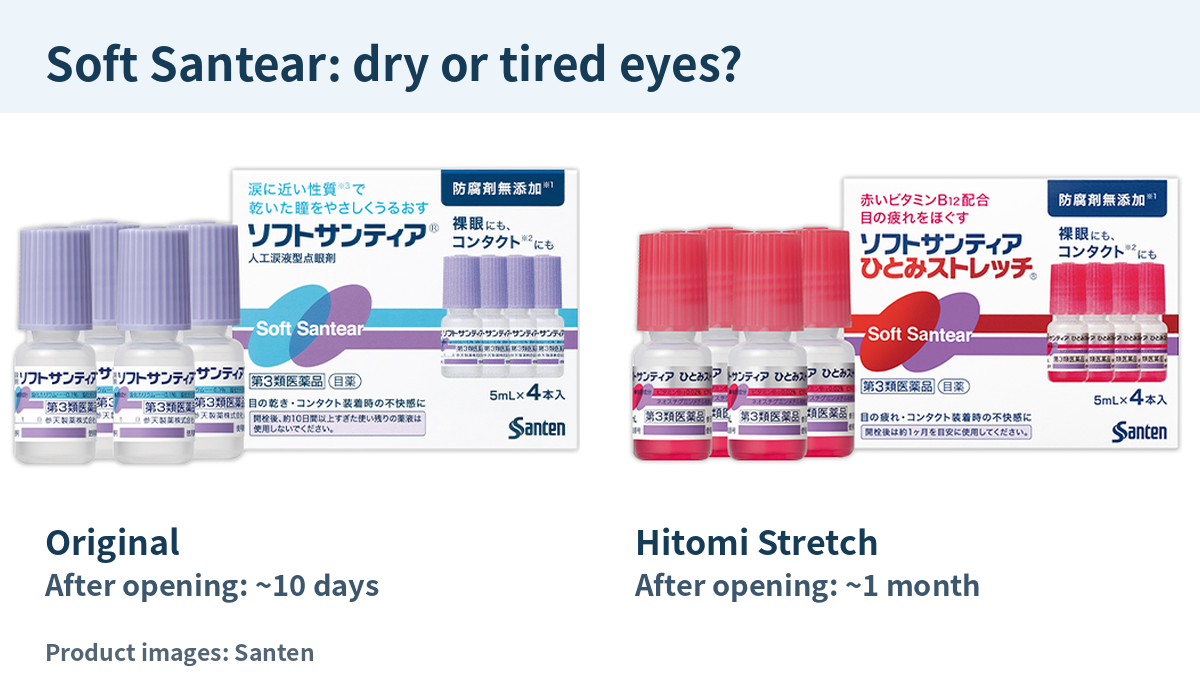
Both come in small 5mL bottles, but which Soft Santear belongs in your basket: the original artificial tears or the red-liquid Hitomi Stretch? Start with what bothers you most: dryness that needs tear supplementation, or tired eyes. Their ingredients, drops per dose and after-opening limits differ.

I’m Irene, a Taiwan-born, Japan-licensed pharmacist working in a Japanese drugstore. Let’s narrow down the choice, then make sure the opening date is as easy to remember as the product name.
Sources checked: October 12, 2026. This guide covers products sold in Japan; directions in other markets may differ.
- First, check whether you need an eye examination
- A quick choice, once those checks are clear
- Original Soft Santear: the tear-supplement option
- Hitomi Stretch: a three-ingredient formula for tired eyes
- Is one cooler? Can you use preservative-free drops more often?
- Open one small bottle at a time
- Check your contact lenses as well as the drops
- When to stop: two weeks is not a waiting period
- Questions to settle before buying
- Sources
First, check whether you need an eye examination
If you suddenly cannot see from one or both eyes, or suddenly develop severe eye pain, seek emergency medical care immediately. Do not wait to try eye drops, and do not drive yourself. Other sudden changes in vision, such as new blurring, flashes or a dark shadow, need urgent medical assessment. Persistent redness, or persistent discomfort while wearing contacts, also calls for an eye examination. Stop wearing the lenses instead of repeatedly adding drops to keep going.
For both products, consult a doctor, pharmacist or registered OTC medicine seller before use if you are receiving medical treatment, have previously had an allergic reaction to medicines or other substances, have severe eye pain, or have been diagnosed with glaucoma. If you have diagnosed dry-eye disease, keep your scheduled eye checks.
A quick choice, once those checks are clear
- Dryness is your main concern: start by looking at original Soft Santear (ソフトサンティア). It is an artificial-tear product with tear supplementation among its labelled uses. Its other indications include contact-lens discomfort, tired eyes and blurred vision associated with excess eye discharge, for example.
- Tired eyes are your main concern: compare Soft Santear Hitomi Stretch (ソフトサンティア ひとみストレッチ), which has three active ingredients including vitamin B12. Its formula differs from the original product’s salts. Red liquid is not a reason to assume it is a stronger artificial tear.
- You wear coloured contacts: do not use Hitomi Stretch while wearing them. For original Soft Santear, ask a pharmacist to check your exact box and lens instructions first; avoid using it over coloured lenses until compatibility is confirmed.
Original Soft Santear: the tear-supplement option
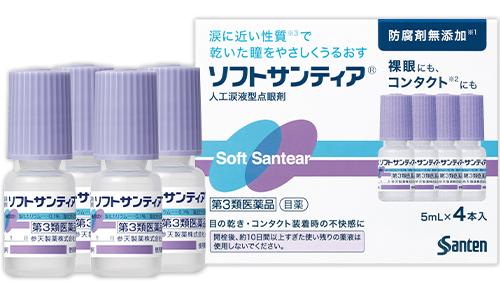
Look for “ソフトサンティア” without the extra “ひとみストレッチ” wording. The current official image has purple-toned caps. Reading the full name is more reliable than shopping for a “blue” or “purple” version.
Its active ingredients are potassium chloride 0.1% and sodium chloride 0.4%. The other ingredients are boric acid and a pH adjuster. Properties including pH and osmotic pressure are close to those of tears. Of these two formulas, it is the direct match when you want tear supplementation for dryness.
- Japanese classification: Class 3 OTC medicine
- Pack: four 5mL bottles
- Directions: 2–3 drops per dose, 5–6 times a day
- After opening: do not use liquid remaining after about 10 days, even if the printed expiry date has not passed
Hitomi Stretch: a three-ingredient formula for tired eyes
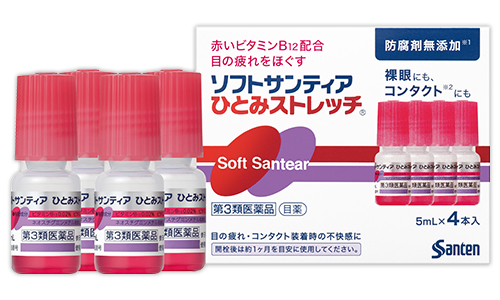
Look for “ひとみストレッチ” on the box. Its active ingredients are vitamin B12 (cyanocobalamin) 0.02%, neostigmine methylsulfate 0.005%, and vitamin B6 (pyridoxine hydrochloride) 0.1%. The first two address focusing-related fatigue; B6 supports tissue metabolism. B12 gives the liquid its red colour.
The Japanese indications are tired eyes, discomfort while wearing soft or hard contacts, prevention of eye disease after swimming or when dust or sweat enters the eyes, and blurred vision associated with excess eye discharge, for example. That prevention wording is not permission to self-treat an infection or ignore persistent blurred vision.
- Japanese classification: Class 3 OTC medicine
- Pack: two or four 5mL bottles
- Directions: 1–3 drops per dose, 5–6 times a day
- After opening: use within about one month, and never beyond the printed expiry date
- Coloured contacts: do not use while wearing them
The same English brand name appears in Taiwan, where the labelled dose differs. Follow the leaflet supplied with the Japanese product rather than mixing instructions from different markets.
Is one cooler? Can you use preservative-free drops more often?
Both have a cooling rating of 0 on Santen’s Japanese product pages. Cooling sensation does not separate these two choices, and red liquid does not mean a stronger cooling effect. Individual sensations vary; a zero rating cannot guarantee that a product will never sting.
Neither contains added preservatives such as benzalkonium chloride. They still have dosing limits and can cause unwanted effects. Do not increase the dose to finish a bottle, or assume that “preservative-free” gives both products the same shelf life after opening.
Open one small bottle at a time
Each 5mL bottle is a multidose bottle, unlike a single-use vial. Only open the bottle you are ready to use. Leave the others sealed; do not screw their caps down in advance and pierce their tips.
- Wash your hands and check that the liquid has no cloudiness or floating material.
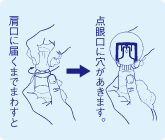
- Before first use, turn the cap clockwise down to the bottle’s shoulder to pierce the sealed tip. Then remove the cap.
- Use the dose for that exact product. Keep the tip away from your eye, eyelid and eyelashes. These are eye drops, not contact-lens cleaning or storage solutions.
- Close the cap firmly and record the opening date: about 10 days for original Soft Santear, about one month for Hitomi Stretch.
- Keep tightly closed in a cool place out of direct sunlight and children’s reach. Do not leave bottles in a hot car or near a heater; do not use a product left in high heat.
Do not share opened bottles or transfer the contents to another container. Discard cloudy liquid or liquid with floating material even if the after-opening period has not ended. If Hitomi Stretch spills on clothing, wash it off with water promptly. Current leaflets say a carrying pouch is not included, so a missing pouch alone is not a sign of an incomplete box.
Check your contact lenses as well as the drops
Original Soft Santear’s Japanese information lists soft, hard, oxygen-permeable and disposable lenses. Hitomi Stretch lists those types too, with an explicit exclusion for coloured lenses. People who do not wear contacts can also select these drops according to their labelled uses.
For original Soft Santear and coloured lenses, the brand page and individual product information are not fully consistent. This guide therefore does not recommend it as universally compatible with coloured contacts. Check the exact drops, your lens instructions and professional advice together. Persistent redness, pain or blurred vision while wearing contacts is a reason to stop wearing them and seek eye care.
When to stop: two weeks is not a waiting period
- With either product, stop immediately and seek advice with the leaflet if you develop a rash, skin redness or itching, or red, itchy or swollen eyes.
- Hitomi Stretch’s leaflet additionally lists stinging pain. Do not continue either product through marked discomfort.
- Stop and seek advice if blurred vision does not improve. You do not need to wait two weeks.
- If symptoms have not improved after about two weeks of use, stop and consult a professional. Worsening symptoms need prompt medical assessment; sudden inability to see or sudden severe eye pain requires emergency care immediately.
Questions to settle before buying
Can children use them?
Santen’s general OTC eye-drop FAQ gives age one and older as a reference, but says children who cannot clearly describe their symptoms should receive an eye doctor’s guidance. Both leaflets require adult supervision when children use the drops. Preservative-free does not mean suitable for self-treatment at every age.
What about pregnancy, breastfeeding or other eye drops?
Neither Japanese leaflet provides a separate pregnancy or breastfeeding dose, or a specific driving prohibition. That absence is not a blanket safety guarantee. Tell your maternity clinician if you use OTC eye drops during pregnancy. If breastfeeding, using other eye drops or receiving treatment, ask a doctor or pharmacist to check the product and directions. Do not drive while your vision is unclear.
Which pack works for occasional use?
Choose the formula for your symptoms first, then think about storage after opening. Hitomi Stretch has a two-bottle option, but a longer opening period is not a reason to substitute it for an artificial tear you actually need. If you prefer a vial discarded after one use, read the Iris CL-I Neo single-use guide. For a different contact-lens drop range, see the Rohto C3 Premium comparison.
Before you leave the shelf, check the full name, drops per dose and opening limit. Dryness and fatigue can overlap. If the choice is unclear, tell the pharmacist your symptoms, lens type and current medicines.
Sources
- Santen: Japanese Soft Santear product information and Japanese leaflet
- Santen: Japanese Hitomi Stretch product information and Japanese leaflet
- Santen: Soft Santear range and OTC FAQ
- PMDA: Soft Santear and Hitomi Stretch
- Santen Taiwan: local Hitomi Stretch information
- Santen: persistent redness and contact-lens symptoms and Okayama Association of Ophthalmologists: urgent eye symptoms
- NHS: vision changes and when to seek emergency care