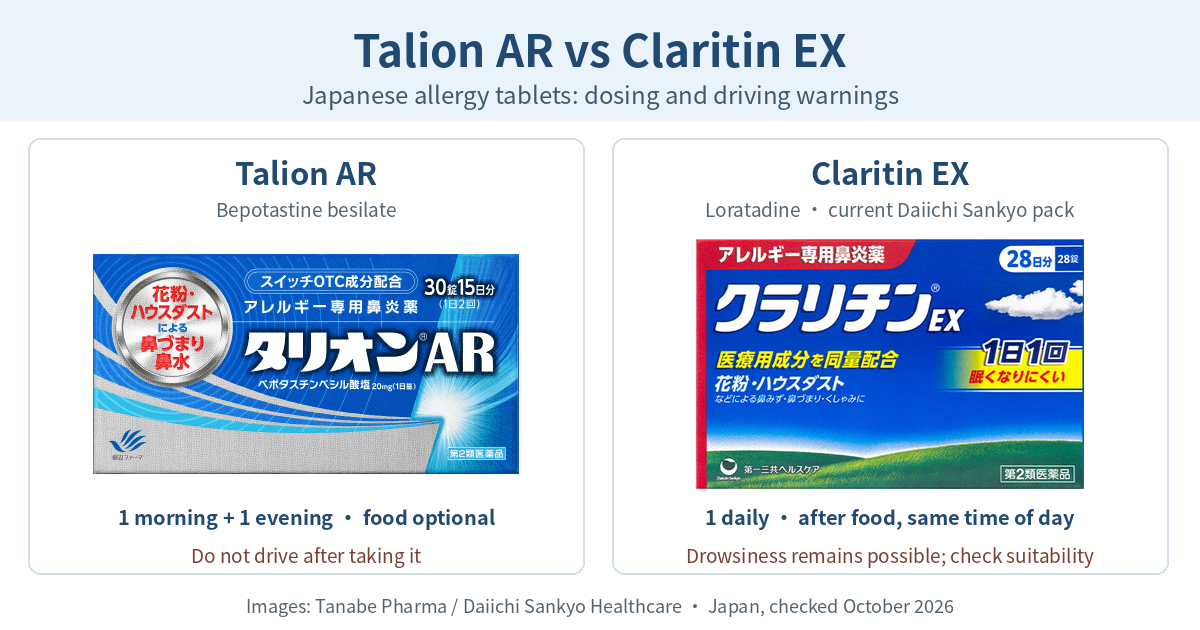
If you need to drive, rule out Talion AR. If you prefer one daily dose, Claritin EX must be taken after food at the same time of day. Both are marketed as less likely to cause drowsiness, but Talion AR explicitly prohibits driving or operating machinery after taking it. Claritin EX can still cause sleepiness and is not a guarantee of safe driving.

I’m Irene, a Taiwan-born, Japan-licensed pharmacist working in a Japanese drugstore. Let’s check the restrictions first, then work out how each dosing schedule fits your day.
Japanese-market information checked on 18 October 2026. This guide covers Talion AR and the regular Claritin EX tablets sold by Daiichi Sankyo Healthcare from 13 October 2026. Do not apply these directions to overseas products, prescription formulations, dissolving tablets or older OTC OD tablets.
Check suitability before choosing a schedule
- Driving or operating machinery? Talion AR’s prohibition takes priority over its less-drowsy advertising. Do not assume a set number of hours after a dose makes driving safe.
- Prefer one daily dose? Claritin EX is one tablet after a meal, at the same time of day each day, provided its health and medicine restrictions do not rule it out.
- Prefer morning and evening doses, with flexible meal times? Talion AR can be taken without food. Its driving and kidney-disease restrictions still come first.
- Unsure whether this is an allergy or a cold? Ask a pharmacist or doctor before choosing either.
Before you buy
Neither product is for anyone under 15 or anyone who has had an allergic reaction to that product or its ingredients. Do not take Talion AR if you have been diagnosed with kidney disease. Claritin EX requires advice before use for diagnosed liver disease, kidney disease or epilepsy; it is not an automatic alternative.
For either product, ask before use if you are pregnant or might be pregnant, an older adult, receiving medical treatment, have a history of medicine or other allergies, or have had another allergic condition such as asthma or atopic dermatitis. Breastfeeding also needs an individual plan, explained below.
The practical differences
Both are Class 2 OTC medicines in Japan for nasal allergy symptoms caused by pollen, house dust and similar allergens: a runny nose, a blocked nose and sneezing. The Japanese OTC category is not an effectiveness ranking.
| What to check | Talion AR | Claritin EX |
|---|---|---|
| Japanese name | タリオンAR | クラリチンEX (regular tablets) |
| Active ingredient | Bepotastine besilate 10 mg per tablet; 20 mg across the two daily doses | Loratadine 10 mg per tablet and per daily dose |
| Age and dose | 15 and older; 1 tablet twice daily | 15 and older; 1 tablet once daily |
| Timing and food | Morning and evening; food is not required | After food, at the same time of day each day |
| Driving / machinery | Prohibited after taking it | No equivalent prohibition in the leaflet; drowsiness is still possible and safe driving is not guaranteed |
| Important disease restriction | Diagnosed kidney disease: do not take | Diagnosed liver disease, kidney disease or epilepsy: consult before use |
The ingredients are different, so 20 mg versus 10 mg does not tell you which medicine is stronger. Nor does taking a medicine once rather than twice daily prove better relief. For two other familiar Japanese brands, see my Allegra FX versus Alesion20 guide. These are alternatives to discuss, not products to combine.
Match the full name and the current distributor
Talion AR: look for AR on the blue-and-silver box
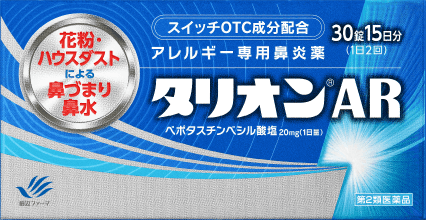
This is the OTC product タリオンAR, not prescription Talion tablets or Talion OD tablets. The pictured box says 30 tablets / 15 days, based on two tablets per day. That pack size does not authorize 15 days of unsupervised use: the consultation requirement beyond two weeks still applies.
Claritin EX: Daiichi Sankyo Healthcare sales began in October 2026
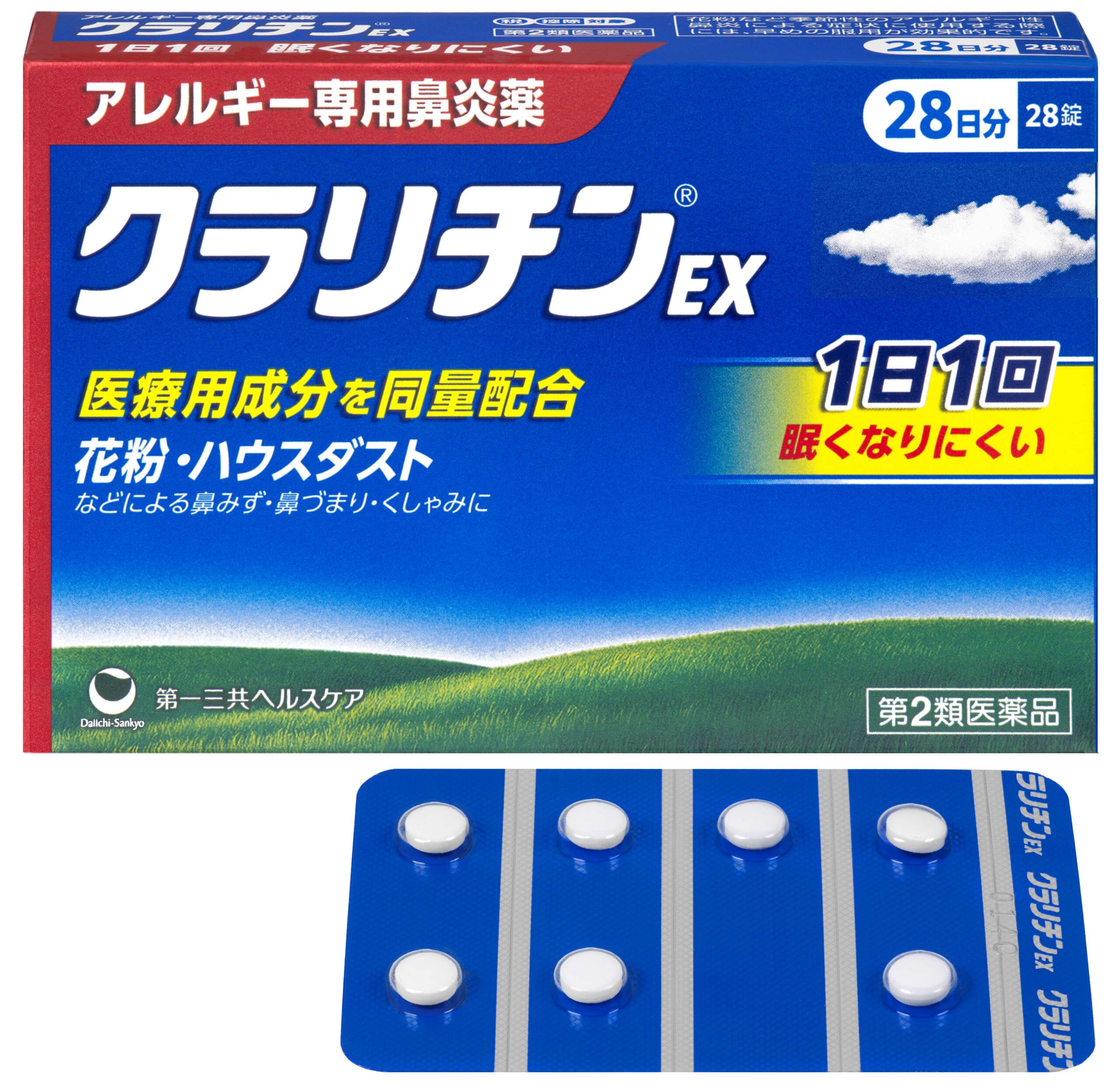
Taisho announced the end of its own Claritin EX sales at the end of September 2026. Daiichi Sankyo Healthcare began selling the product on 13 October 2026. An older article saying “discontinued” needs to be read with that distributor and date in mind.
The current product page lists 7-, 14-, 28- and 56-tablet packs. The pictured 28-tablet box carries the Daiichi Sankyo logo; Bayer Yakuhin is the marketing authorization holder. These are regular tablets taken with water or warm water. Do not substitute directions you remember for RediTabs, dissolving tablets or older OD versions. Follow the local label for any Claritin bought outside Japan.
Two schedules to keep separate
Talion AR
1 morning + 1 evening
For ages 15 and older: one tablet twice daily. Food is not required. This does not mean you can add doses whenever symptoms return or take both daily tablets together.
Claritin EX
1 after food, once daily
For ages 15 and older: one tablet with water or warm water, at the same time of day each day. Do not add a second dose because symptoms return.
For both products, push the tablet out of its blister before taking it. Never swallow a piece of the blister packaging. Keep the original box and leaflet so you can check the name, expiry date and instructions.
Less drowsy does not establish fitness to drive
Talion AR’s leaflet explicitly says not to drive or operate machinery after taking it, even if you do not feel sleepy. Claritin EX has no equivalent prohibition in its current Japanese leaflet, but sleepiness and dizziness are listed adverse effects. Absence of that warning is not a promise that you can drive safely. Do not drive or operate machinery if sleepy, dizzy or otherwise impaired. Tell the pharmacist about any driving plans before you buy.
Check everything else in your travel medicine bag
Do not take Talion AR and Claritin EX together. Both labels prohibit other allergy medicines, including oral rhinitis medicines and medicines for allergic skin conditions, as well as oral medicines containing antihistamines. Some cold remedies, cough and expectorant medicines, motion-sickness tablets and hypnotic or sedative products fall into these groups.
Claritin EX additionally prohibits erythromycin and cimetidine, an antibiotic and an acid-reducing medicine respectively. Do not stop prescribed treatment to take an OTC allergy tablet, or assume that separating doses by a few hours makes a prohibited combination suitable.
Show the pharmacist the exact names of eye drops, nasal sprays and any other medicines too. Talion’s manufacturer has advice about eye drops and nasal sprays, but that answer should not be generalized to every ingredient or another brand.
Both labels say not to drink alcohol before or after a dose. Neither provides a universal safe interval for drinking.
When to get advice, stop or seek urgent care
- Talion AR: consult if symptoms have not improved after one week.
- Claritin EX: consult if symptoms have not improved after about one week.
- Both: consult a doctor, pharmacist or registered medicine seller before continuing beyond two weeks, even if symptoms improve. The number of days printed on a large pack does not remove that requirement.
Both labels require breastfeeding users either to avoid the medicine or to avoid breastfeeding while taking it. Ask a clinician to plan treatment and feeding rather than stopping breastfeeding on the basis of this comparison. Pregnancy or possible pregnancy requires advice before use; halving a tablet is not a substitute.
Stop immediately and seek advice for listed adverse effects such as rash, hives, swelling, palpitations, dizziness or urinary changes. Talion AR specifically lists blood in the urine and reduced urine output, among other symptoms. Claritin EX also lists chest pain or discomfort and urinary retention. For both, stop and consult if dry mouth, constipation, diarrhoea or sleepiness persists or worsens. These are highlights; read the full adverse-effect list.
Breathing difficulty, altered consciousness or a seizure needs immediate medical care. Claritin EX specifically warns about rare anaphylaxis, epileptic seizures in people with a history of epileptic seizures, convulsions and liver injury. Hoarseness with breathing difficulty, yellow skin or eyes, or dark-brown urine are warning signs to act on promptly rather than waiting a week.
Quick questions
Are they interchangeable because both are second-generation antihistamines?
That description alone is not enough. Their ingredients, schedules, food instructions, disease restrictions and prohibited combinations differ. Before switching, tell the pharmacist the exact medicine, dose and time of your last dose so they can advise on the change.
Can a child take half a tablet?
No. Both Japanese OTC products covered here must not be used below age 15. Reducing the dose does not create an approved children’s dose.
Has Claritin EX been discontinued?
Taisho ended its own sales; Daiichi Sankyo Healthcare announced sales of the current regular tablets from 13 October 2026. Ask the retailer about actual stock rather than relying on an old article or package photo.
Before choosing, check the full product name, age, current medicines, medical history and driving plans. Once suitability is clear, choose a schedule you can follow consistently.
Official sources
- Talion AR Japanese package insert (2 pages)
- Talion AR directions and precautions
- Talion AR manufacturer FAQs
- Talion AR official Japanese product page and package
- Current Claritin EX Japanese package insert (2 pages)
- Daiichi Sankyo Healthcare Claritin EX product information
- Daiichi Sankyo Healthcare announcement of sales starting 13 October 2026
- Taisho announcement ending its own sales in September 2026
This guide explains Japanese product labels and does not replace individual medical care. Read the complete leaflet supplied with your purchase and have a pharmacist check your medicines and health conditions.