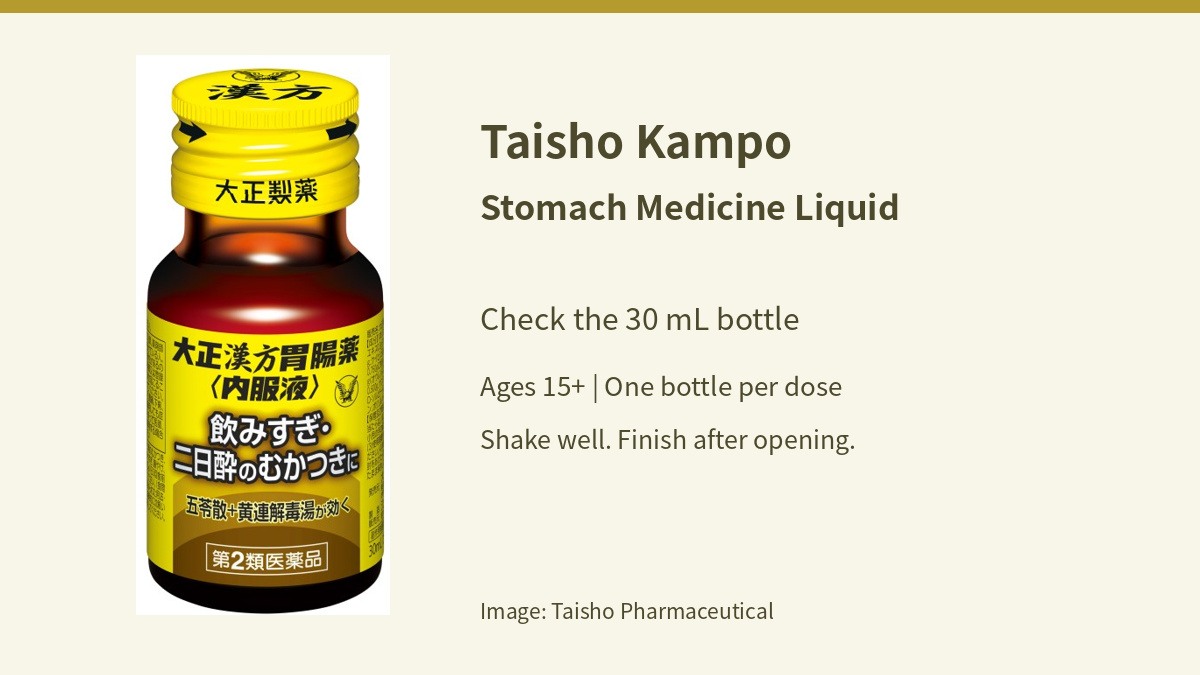
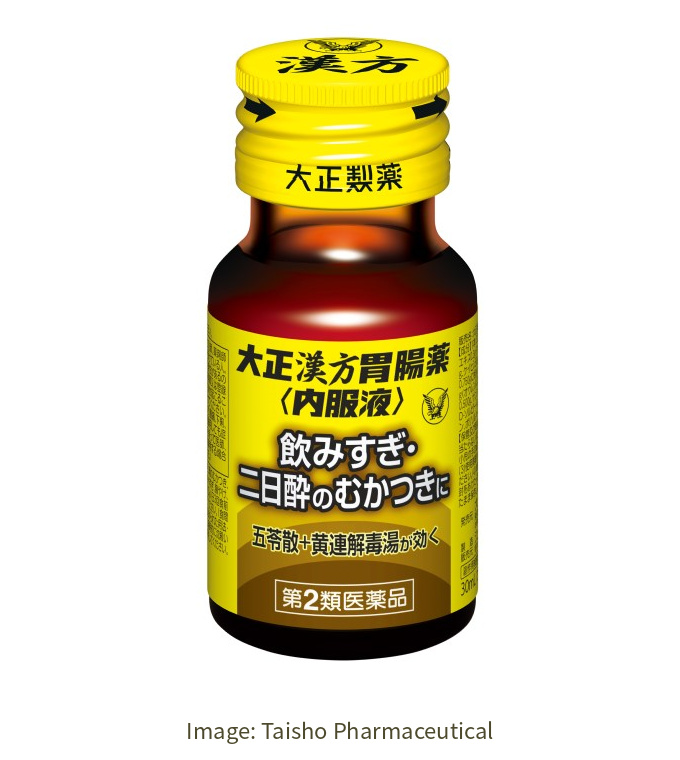
Taisho Kampo Stomach Medicine Liquid, labelled 大正漢方胃腸薬〈内服液〉, is a Japanese Class 2 OTC medicine in a single-dose 30 mL bottle. It combines Goreisan and Orengedokuto herbal formulas. It is not the brand’s usual powder dissolved into a drink.
Three essentials: ages 15 and over only; one whole bottle per dose; shake well and finish immediately after opening. Check for “内服液” and “30mL” rather than choosing by the yellow cap alone.

I’m Irene, a Taiwan-born pharmacist licensed in Japan and working in a Japanese drugstore. With this familiar yellow brand, check the word “liquid”: the formula and age limit differ from the granules and tablets.
Which symptoms is it labelled for?
The Japanese indications cover over-drinking; nausea, including hangover-related and alcohol-related queasiness; poor appetite; indigestion; stomach or abdominal bloating; weak stomach; overeating; heartburn; a heavy stomach; a blocked feeling in the chest; and vomiting. Use the directions for this exact Japanese product.
Do not assume new chest pain or pressure is a stomach symptom. Sudden severe chest or back pain, or chest pressure lasting a few minutes, calls for an ambulance; in Japan, dial 119.
Those symptom indications do not establish hangover prevention, liver protection or permission to keep drinking. Nor does every episode of feeling unwell after alcohol call for this medicine. Check the warning signs below before self-treating.
How to take it: “between meals” means after eating
- Ages 15 and over: one bottle (30 mL) per dose, three times daily, before or between meals. The label defines between meals as about 2–3 hours after a meal.
- Do not give it to anyone under 15. Do not borrow a child’s dose from another Taisho formulation.
- Shake well first. Herbal sediment can form over time; the manufacturer says this does not change the medicine’s effectiveness.
- Each bottle is one dose. Finish it after opening; do not save an opened half-bottle for later. Follow the labelled dose.
How does it differ from granules and tablets?
This guide is for the 30 mL liquid containing Goreisan plus Orengedokuto. If your purchase is a box of granules or tablets, use the Taisho Kampo granules, tablets and K-series guide to check that product’s ingredients, age limits and directions. Directions are not interchangeable across formulations.
What is in one bottle?
Each bottle contains 0.3 g Goreisan aqueous dry extract and 0.3 g Orengedokuto aqueous dry extract. The herb quantities below are the raw-herb equivalents of those extracts, not additional ingredients to add to the extract totals.
See herb quantities and additives per bottle
- Goreisan: Alisma rhizome (Takusha) 0.833 g; Poria sclerotium (Bukuryo) 0.750 g; cinnamon bark (Keihi) 0.500 g; Polyporus sclerotium (Chorei) 0.750 g; Atractylodes rhizome (Byakujutsu) 0.750 g.
- Orengedokuto: Coptis rhizome (Oren) 0.333 g; Phellodendron bark (Obaku) 0.333 g; Scutellaria root (Ogon) 0.500 g; gardenia fruit (Sanshishi) 0.333 g.
- Additives: sucrose, D-sorbitol, citric acid, sodium benzoate, parabens, polysorbate 80, ethanol and the manufacturer’s stated “two other ingredients”.
The manufacturer’s document does not name those two additional ingredients or state an ethanol concentration. Ask a pharmacist to check if you have a specific ingredient allergy or need to avoid ethanol; do not assume the bottle is alcohol-free or sugar-free.
When to ask, stop or seek medical care
- If you are receiving medical treatment: ask a doctor, pharmacist or registered medicine seller before use.
- Before prolonged use: consult one of those professionals. Do not turn it into a daily wellness routine.
- Recurrent abdominal pain, diarrhoea, constipation or bloating during long-term use: stop immediately and seek medical assessment immediately, taking the product with you. The label warns of rare but serious mesenteric phlebosclerosis, a disorder affecting veins around the intestine.
- No improvement after about a month: stop and take the product to a doctor, pharmacist or registered medicine seller. This label limit does not mean persistent vomiting or pain should be left for a month.
Do not delay care for a stomach medicine. Repeated vomiting with an inability to keep fluids down needs urgent medical advice. Vomiting blood or material resembling coffee grounds, sudden severe abdominal pain, severe breathing difficulty or unresponsiveness needs emergency help. In Japan, call 119 for an ambulance.
Storage at your hotel or at home
Keep unopened bottles in a cool place away from direct sunlight and out of children’s reach. Do not use after the expiry date. These storage directions do not make an opened bottle reusable. If symptoms persist on your trip, show a pharmacist the bottle or packaging so they can identify the exact medicine.
Sources
- Taisho Pharmaceutical: current liquid product information
- Full Japanese label currently linked by the manufacturer (PDF)
- NHS: vomiting and urgent warning signs
- Japan Fire and Disaster Management Agency: ambulance guide
Checked 19 October 2026. This guide helps identify the Japanese product and understand its label; it does not replace an individual diagnosis. Read the directions on your own pack before use.