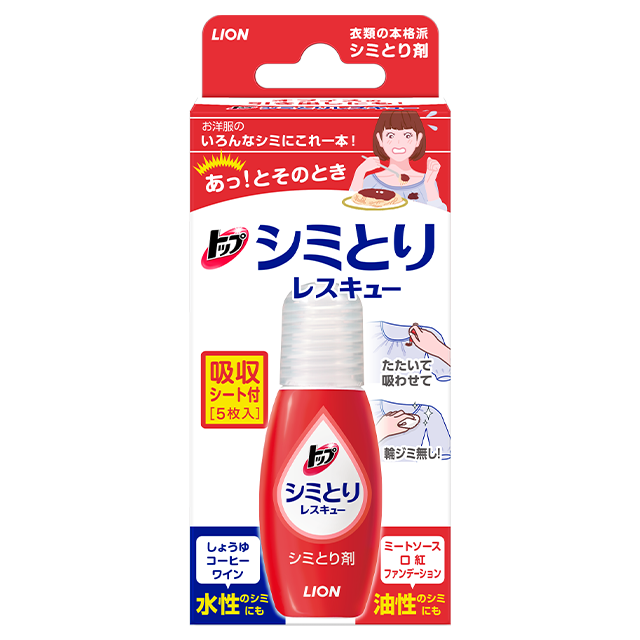
Pack the absorbent sheets and two towels, not just the bottle. Lion’s Japanese トップ シミとりレスキュー (Top Stain Rescue) treats small clothing stains, but its finishing step requires a towel dampened with water and firmly wrung out. It is not a water-free stain pen.
I’m Irene, a Taiwan-born pharmacist qualified in Japan. This is a guide to the manufacturer’s directions, not a hands-on stain-removal test.
Cover product photograph: Lion Corporation, for product identification. Packaging may vary.
Food on your travel clothes: can you use it now?
- Check the garment and stain first. An excluded fabric stays excluded—even if a spot test seems fine.
- Have the full kit? Bottle + supplied absorbent sheet + dry towel + a second towel dampened with water and firmly wrung out.
- Can you complete a hidden-area test and the cleanup? If you lack the tools or cannot confirm suitability, do not apply the cleaner to the visible stain.
First lift off food solids with tissue without rubbing. The useful decision is not “can I carry the bottle?” but “can I finish the whole process here?”
Recognise the right product on the shelf
Look for the Japanese name above and the 17 mL bottle with five absorbent sheets. Lion describes a neutral clothing stain remover for both water-based and oily stains.
Japan’s Drug Seims lists this product under code 4903301723868. That confirms drugstore distribution, not stock at every branch. Packaging can differ: Lion says its switch to a paper box and QR-linked instructions began in June 2025. Check the instructions for the pack you buy.
Check the garment and stain first
Do not use it on kimono, leather, rubber, acetate, or items that lose colour or develop water rings when wet. Hair dye, nail polish, sumi ink, stamp-pad ink, correction fluid, paint, oil-based markers and ballpoint ink are outside the listed removable stains. A stain’s age and type can also prevent complete removal.
The mention of silk, wool or non-washable garments is not blanket permission. Test in an inconspicuous place before treating any garment. For coloured/patterned or non-washable clothing in particular, check the complete application-and-cleanup procedure there first. If suitability is unclear, stop rather than experiment on the visible stain.
1. Choose the contact face before applying cleaner
After the fabric/stain checks and a complete hidden-area test, lift off any food solids without rubbing. The supplied sheet belongs under the stain; its absorbent face must touch the fabric. The stained face changes direction with the garment type:
Which face touches the sheet?
A · Thin fabric
The stain faces upward; the sheet’s absorbent face touches the fabric underneath.
B · Thick or lined garment
The stained face directly meets the sheet’s absorbent face.
Diagram: Irene, based on Lion’s current instructions, page 1 (Japanese placement diagrams). The diagrams above are explanatory, not product photographs.
If you cannot identify the absorbent face or arrange the garment as instructed, stop. For delicate items such as neckties, Lion says to cover the fabric with tissue and tap over it—not to substitute tissue for the supplied absorbent sheet underneath.
2. Two jobs: transfer the stain, then remove the cleaner
Change both the tool above and the layer below
① Transfer the stain
Gentle taps
Outer edge → centre. Tap rather than rub; do not squeeze the bottle hard. Move the sheet so a clean area receives the soil.
② Remove the remaining cleaner
Firmly wrung out
Replaces the absorbent sheet
Clean-looking is not finished. Tap from above with the damp, firmly wrung towel to remove the remaining cleaner; the dry towel sits below.
Diagram: Irene, based on Lion’s current instructions, basic steps ①–③. Read the complete instructions for your pack.
Think of the first stage as moving soil into the supplied sheet; the second removes cleaner left in the fabric. One towel cannot be both the dry layer underneath and the damp tapping towel above at the same time. Do not begin with the bottle alone.
Lion’s illustrated explanation of stain first aid also separates stain transfer from cleaner removal. Its older general advice about substitute materials does not override this product’s instruction to use the supplied sheet.
Keep the bottle safely, and know when to stop
Use only for clothing stains. Keep it away from children and anyone at risk of accidentally swallowing it, and store away from heat and direct sunlight. Wash hands afterwards. Wipe undiluted cleaner off plastic with water. Rinse skin contact with water; immediately rinse eyes if splashed. Follow the product’s first-aid instructions and seek medical advice for abnormalities, taking the product with you.
For an item you can wash at home, our Utamaro bar-versus-liquid guide covers a different decision: choosing a laundry spot-washing product and completing its washing/rinsing process. Neither guide promises complete stain removal.
Official references
- Lion: product, contents and precautions
- Lion: multilingual instructions and placement diagrams (PDF)
- Lion: packaging and QR-instruction change
Information checked 27 October 2026. The cover photograph is Lion’s official product image, used for identification; copyright and trademarks belong to Lion and their respective owners. A source credit does not imply permission or endorsement. Read the current pack and linked instructions before use; this article is not a replacement for the complete instructions.