No expiry date on your Japanese cosmetic, or just a string of numbers on the base? Identify what the marking means before working out a storage period. A manufacture date is not a use-by date. A production code is not automatically a readable date. No printed expiry date does not mean unlimited shelf life.
This guide uses Japanese public-authority and manufacturer information to help you organise packaging details, opening records and questions. It does not assess an individual product’s quality, authenticity or suitability for your skin. Do not apply this cosmetics guidance to medicines or quasi-drugs.
Separate these four pieces of information
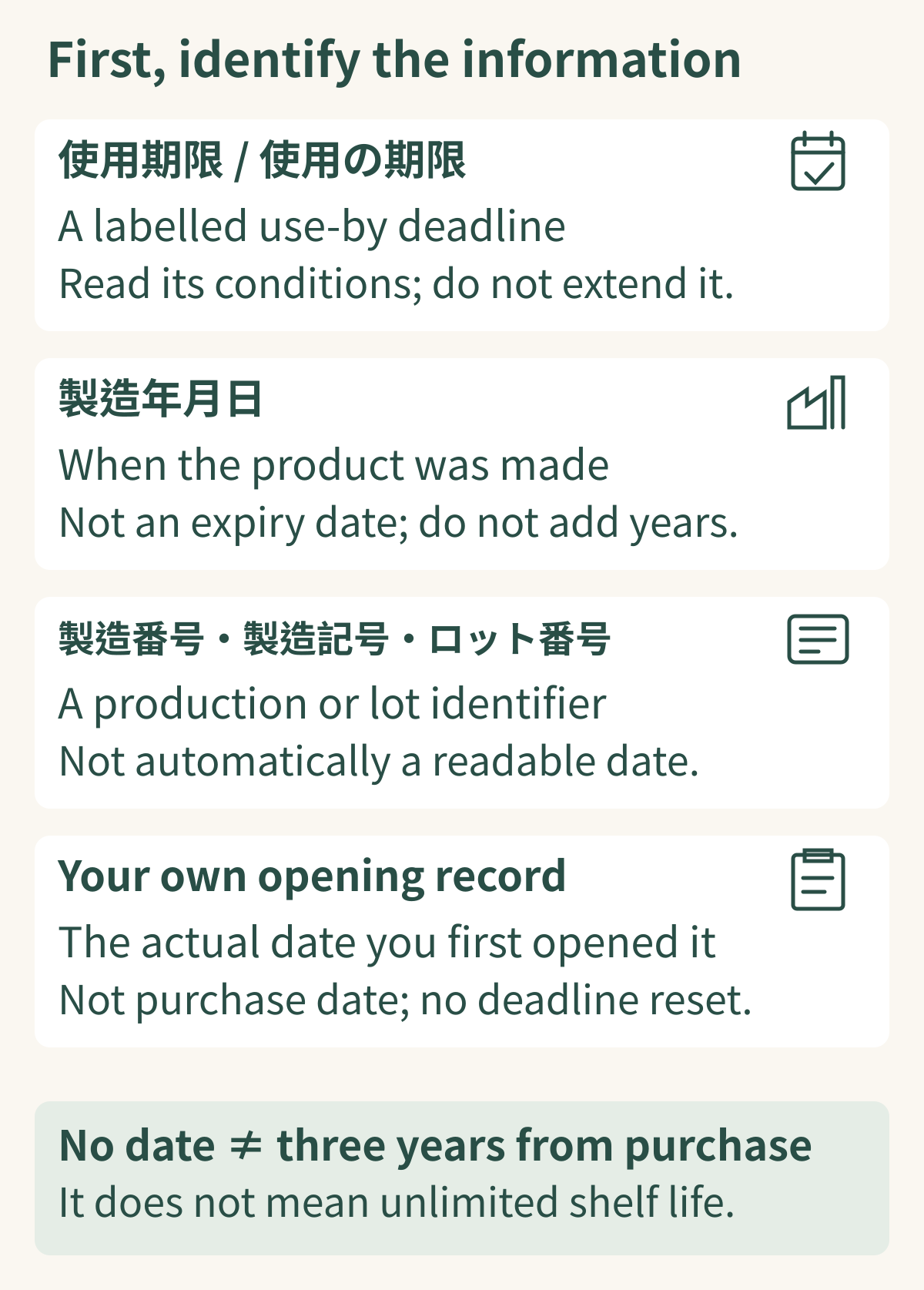
Read a printed deadline with its storage conditions and directions. Ask if the date format is unclear; do not swap the year, month and day. Keep the complete letters, numbers and a clear record of any production code for the relevant brand to check. Your opening record is not a manufacturer’s quality guarantee.
Eight digits do not establish a rule for every product
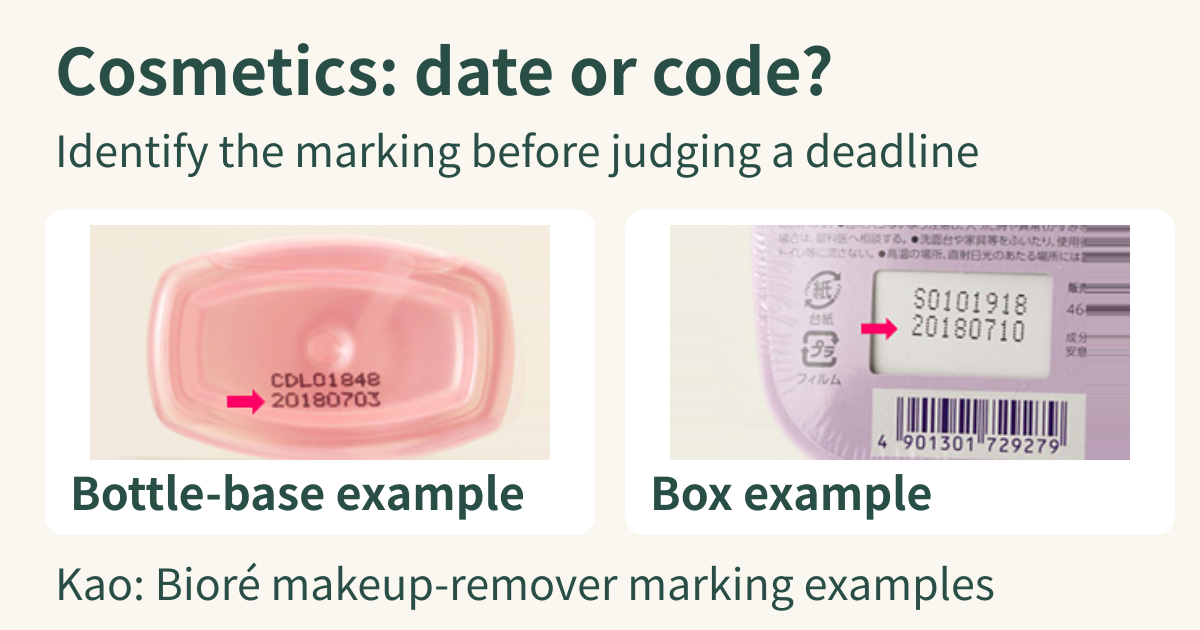
Below are the Bioré makeup-remover examples published in Kao’s official FAQ. One pack can carry markings with different purposes; this is not a rule for all brands or every Bioré product.
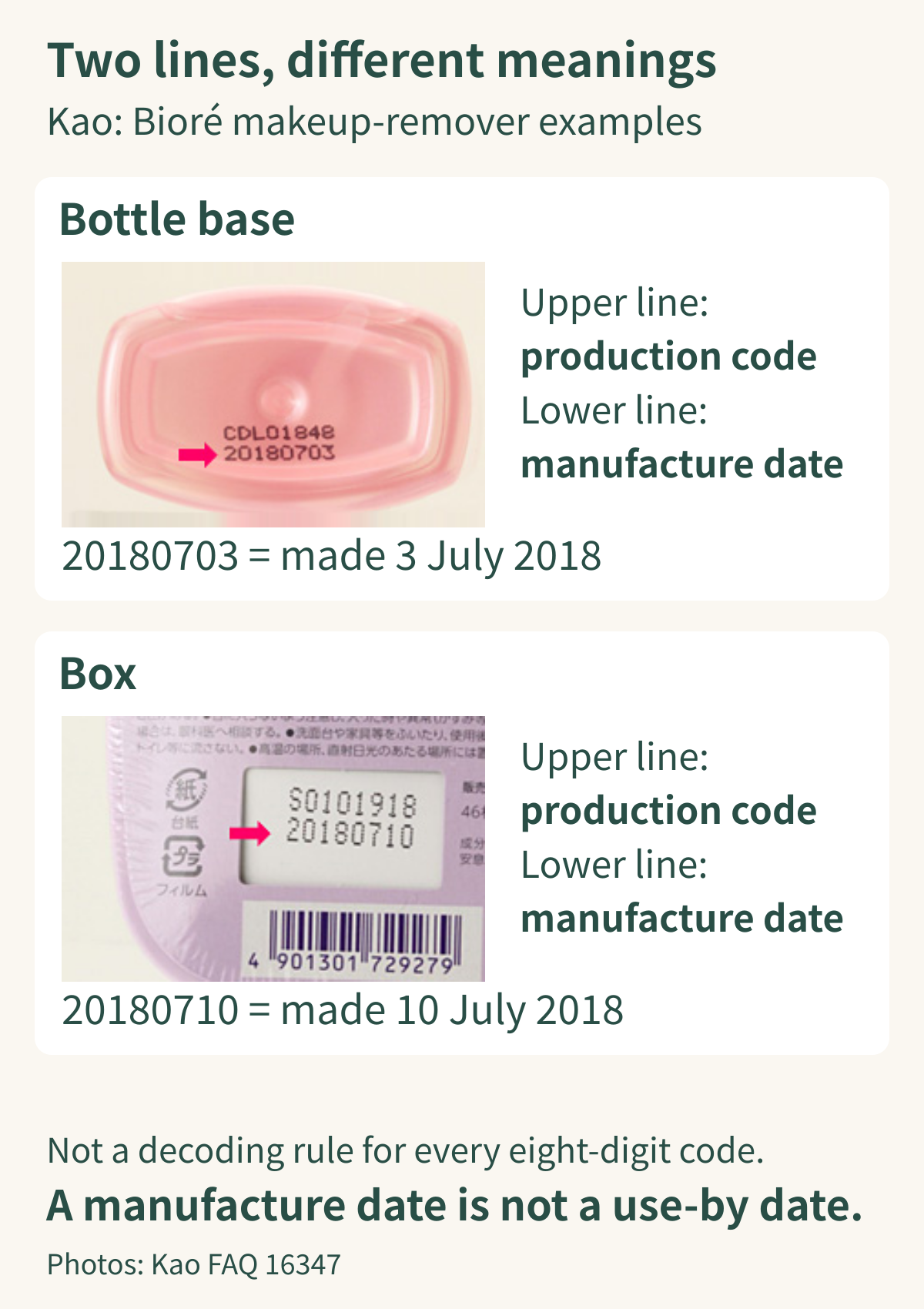
What to do: match the full product name and packaging version to the manufacturer’s explanation. Do not take selected digits and apply another brand’s decoding rules. Do not treat a date returned by an outside batch-code checker as manufacturer confirmation or a quality assessment.
Why “no date” does not mean three years from purchase
The Tokyo Metropolitan Institute of Public Health explains that cosmetics retaining their quality unopened for at least three years under normal conditions need not display a use-by date. Shiseido also explains that expiry labelling is not required except for cosmetics that deteriorate within three years of manufacture.
These are explanations of labelling conditions, not a new three-year allowance starting when you buy a bottle. Its purchase date is not its manufacture date, and an absent date tells you nothing about its storage history.
Where a product has a printed deadline, its own after-opening period or storage instructions, check those specific directions. Do not use a general explanation to override the product’s label.
Check unopened and opened products separately
Kao explains that its cosmetics are designed to retain quality for at least three years from manufacture when unopened and stored away from heat, direct sunlight, high humidity and major temperature changes. Poor storage can affect even an unopened product. Once opened, use it up promptly rather than carrying over the unopened guidance.
- Still unopened: keep the packaging and readable markings, and follow the product’s storage directions. Do not open an unpurchased shop item to search for a date.
- Already opened: note the opening date and check for product-specific after-opening guidance. Do not assign one universal number of months to every lotion, serum or makeup product.
- Not sure: tell the manufacturer that the opening date or storage history is unknown. Do not substitute the purchase date for missing information.
Kao advises against use when the contents or smell seem abnormal. However, normal appearance and smell are not this guide’s guarantee of quality or skin safety. If you are uncertain, do not use a trial application as an expiry test.
Prepare a focused question for the official contact
Find the relevant product contact through the company named on the pack or the brand’s official Japanese website. This is a preparation checklist, not a form every company requires:
- The full Japanese product name, size and variant, and whether it was bought in Japan or another market.
- The complete markings on the box and container; clear photos of the relevant areas if that contact channel accepts images.
- When and where it was purchased, whether it has been opened, and the actual opening date if known.
- The storage conditions you know about, and whether your question concerns the marking’s meaning, the product’s use-by guidance or its storage.
Check the channel’s image and language options before contacting it, and use its specified method. Do not post receipt payment details, personal information or product enquiries in public comments. Even after a date is identified, opening and storage information still matter; one number cannot decide whether you should keep using the product.
Official sources and scope
These sources support the labelling and storage explanations above. They do not mean that your individual product has been examined. Check each brand, product and market version separately.
- Tokyo Metropolitan Institute of Public Health: cosmetics labelling — production-number and production-code labelling.
- Tokyo Metropolitan Institute of Public Health: cosmetic quality and safety — Q1 on expiry labelling.
- Kao: dates and numbers on Bioré makeup removers — a product-specific example.
- Kao: how long cosmetics keep — unopened storage and after-opening precautions.
- Shiseido: why manufacture dates are not printed — expiry-labelling explanation.
- Kao: official contact options — methods and channel restrictions; use the relevant company for other brands.
Cover photos: the Bioré makeup-remover marking examples in the Kao FAQ listed above; they do not establish a rule for all current packaging.