Japanese official information checked: November 2, 2026. This guide concerns standard Atofine scar-care tape, illustrated by the M-size three-sheet pack. It does not diagnose wound closure or replace your surgical team’s instructions.
The Japanese words 傷あとケア mean scar care—not automatically care for an open wound. Covering a fresh wound and reducing pulling on a scar after the wound has closed are different jobs. Atofine addresses external physical irritation; it does not “dissolve” a scar.
- Identify the pack: tape for the scar-care stage
- Why resist stretching? Elasticity is not always the goal
- Before buying, identify the care you were instructed to use
- Five to seven days is a replacement guide—not a reason to tolerate irritation
- A better pharmacy question than “Which scar product is stronger?”
- Official sources and photograph
Identify the pack: tape for the scar-care stage
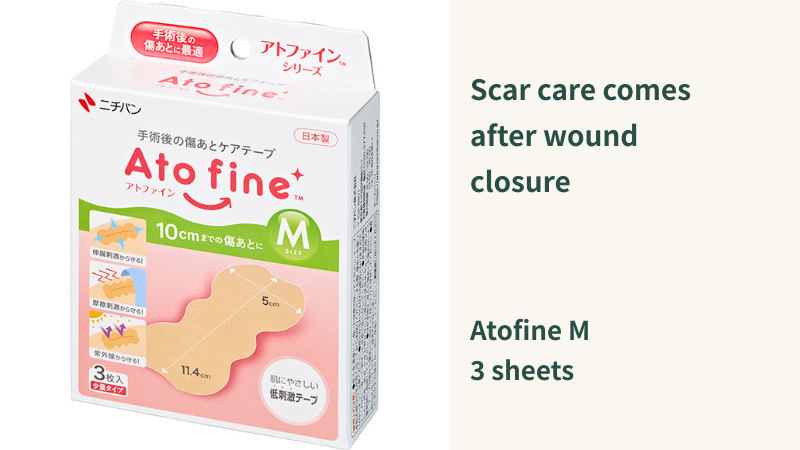
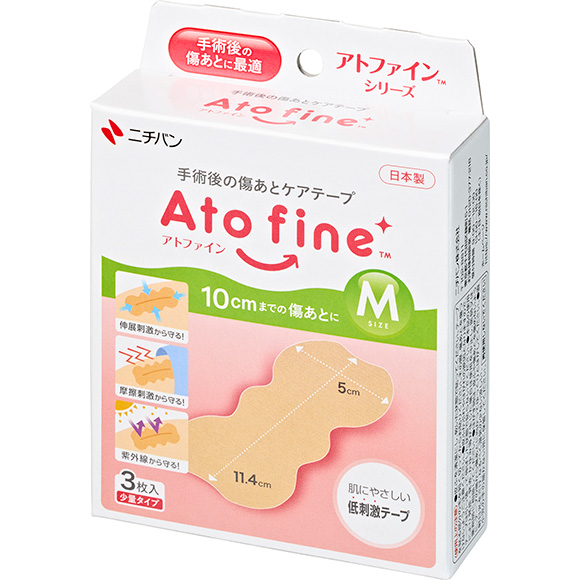
The photograph shows Nichiban Atofine (アトファイン), M size, three sheets, model ATK3M. Each tape measures 50 × 114 mm; the current pack indicates scars up to 10 cm long. Tape dimensions are not the same as scar length, and a physical fit does not establish that the tape is appropriate now. This article does not combine directions for the brand’s cream, other packs or its newer Curve/Roll products.
Why resist stretching? Elasticity is not always the goal
A wound dressing covers and protects a wound. Atofine instead concerns closed postoperative scars. Its manufacturer describes polyester woven fabric that resists stretching lengthwise and crosswise, with an acrylic adhesive. It helps limit pulling caused by skin movement and protects against friction and ultraviolet exposure.
Think of physical support rather than a medicine acting on the wound. Despite the broad term “scar tape,” this is not a silicone sheet. Nor is it a tool for pulling an open wound together. The manufacturer specifically says not to stretch the tape or gather the skin around the scar before applying it.
Physical protection does not guarantee prevention of hypertrophic scars or keloids, or make a scar disappear. The manufacturer does not claim treatment of an established hypertrophic scar or keloid with this product. Seek medical advice, including plastic-surgery assessment where appropriate, rather than substituting longer taping for treatment.
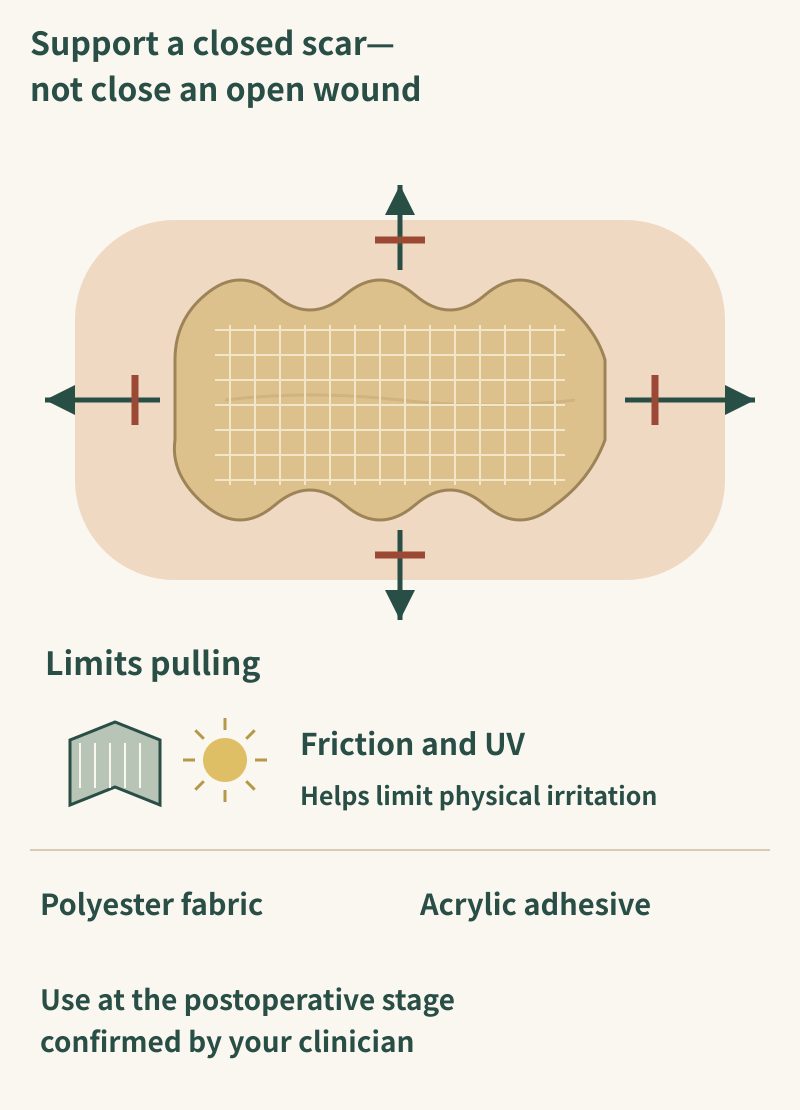
Before buying, identify the care you were instructed to use
- A wound that is not closed: do not apply directly to open wounds or sutured wounds before stitch removal. It is not for ordinary grazes, cuts or acne. Adhesive products are not interchangeable.
- Scar care has been recommended: show the product name/photo and your postoperative instructions to a professional. Confirm material, size and method. A request for silicone or a particular dressing is not permission to substitute Atofine.
- Dissolving stitches or surgical glue: the manufacturer requires complete closure without blood or wound fluid. Ask your doctor if uncertain; a day count, scab or surface photograph does not establish suitability.
Do not use during radiotherapy; after it ends, follow your doctor’s instructions. Ask the healthcare facility before examinations such as X-rays, CT or PET. For children, the manufacturer requires the ability to communicate discomfort such as itching or pain, with frequent parental observation. Small tape size is not a guarantee of suitability for a child; consult a doctor before use on an infant.
Five to seven days is a replacement guide—not a reason to tolerate irritation
The standard product gives approximately five to seven days as a replacement guide. Replace it sooner if peeling exposes the scar; even if adhesion remains strong, do not independently leave the same tape on beyond a week. Stop using it and consult a doctor or pharmacist if rash, redness, itching or other irritation occurs. Agree the overall care period with your clinician; finishing one box is not a treatment endpoint, and there is no promised number of days until a scar flattens or fades.
Follow the pack directions on clean, dry skin. If hair at the site needs trimming, avoid injuring the skin or scar. Do not stretch the tape when applying it; remove slowly from an edge towards the scar without damaging the skin. Do not reuse it. Cutting, joining sheets and changing postoperative dressings are not demonstrated here.
It may be worn while bathing; gently blot off water afterwards. This does not make it a waterproof wound dressing. Do not independently layer medicines, scar gel or cream beneath it: effects on the medicine and adhesion require individual checking. Store away from sunlight in a cool, relatively dry place out of children’s reach.
A better pharmacy question than “Which scar product is stronger?”
Explain when your clinician said to begin care, your current dressing or medicine, the material requested, and any redness or itching. Atofine’s role is physical protection after closure—not a universal answer to every scar concern.
For a different product category, see our Attonon scar medicines guide. This is a separate reading option, not a recommendation to apply it under Atofine.
Official sources and photograph
- Nichiban: standard Atofine, current M-size three-sheet photograph and precautions
- Atofine: materials, postoperative conditions and FAQs
- Nichiban: scar-care tape versus first-aid dressings
- Nichiban: existing keloids and use with topical medicines
Follow your actual pack and individual professional instructions; this guide cannot assess your wound.