Current Japanese official product information and instructions checked: November 2, 2026. This guide is limited to Japanese Vicks VapoRub; it does not transfer directions or indications from overseas products with the same name.
Taisho ending its sales does not mean the product has disappeared—and a Vicks label does not make every product an oral throat remedy. The current Japanese official website lists VapoRub jars. What matters at the shelf is the current product identity, its topical role, and the Japanese age and consultation conditions.
The useful discovery is that a product applied to the chest, outside of the throat or back is described by its manufacturer as having both an inhalation action and a topical warming action. That is not permission to put the ointment inside the nose, nor proof that an infection has been cured.
Recognize the current Japanese jar: 100g is pack size, not a dose
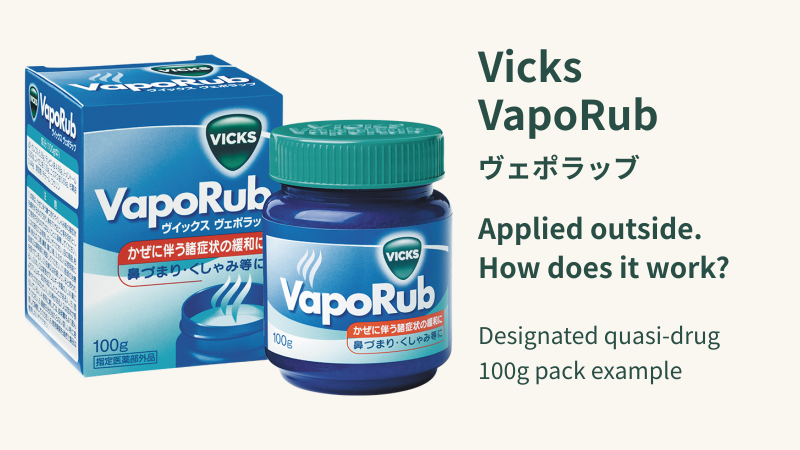
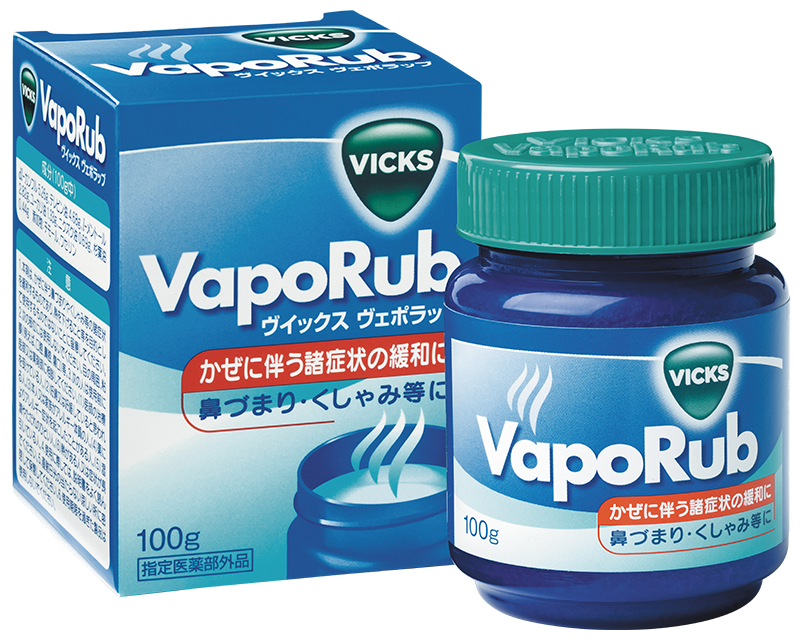
The full name is ヴイックス ヴェポラッブ / Vicks VapoRub. In Japan it is a designated quasi-drug, not an oral medicine. The current official product page lists 50g and 100g jars; the photograph here shows a 100g carton-and-jar example. Its indication is relief of cold-associated symptoms such as nasal congestion and sneezing, not eradication of pathogens or prevention of infection.
In a July 14, 2025 notice, Taisho announced that its sales would end on September 30, 2025. A subsequent succession notice identified Iwaki Corporation as taking over the manufacturing/marketing authorization on December 1, 2025, with Maruman H&B handling sales and distribution. Current instructions and product information also identify Iwaki. The notice’s planned shipment timing of around April 2026 was a forecast: it does not establish that we have verified completed shipments or stock at every drugstore.
For products used in the mouth, see the separate Vicks throat-product comparison. A shared brand cannot replace checking the route: lozenge or candy directions do not apply to this topical ointment.
Why does an ointment have an “inhalation action”?
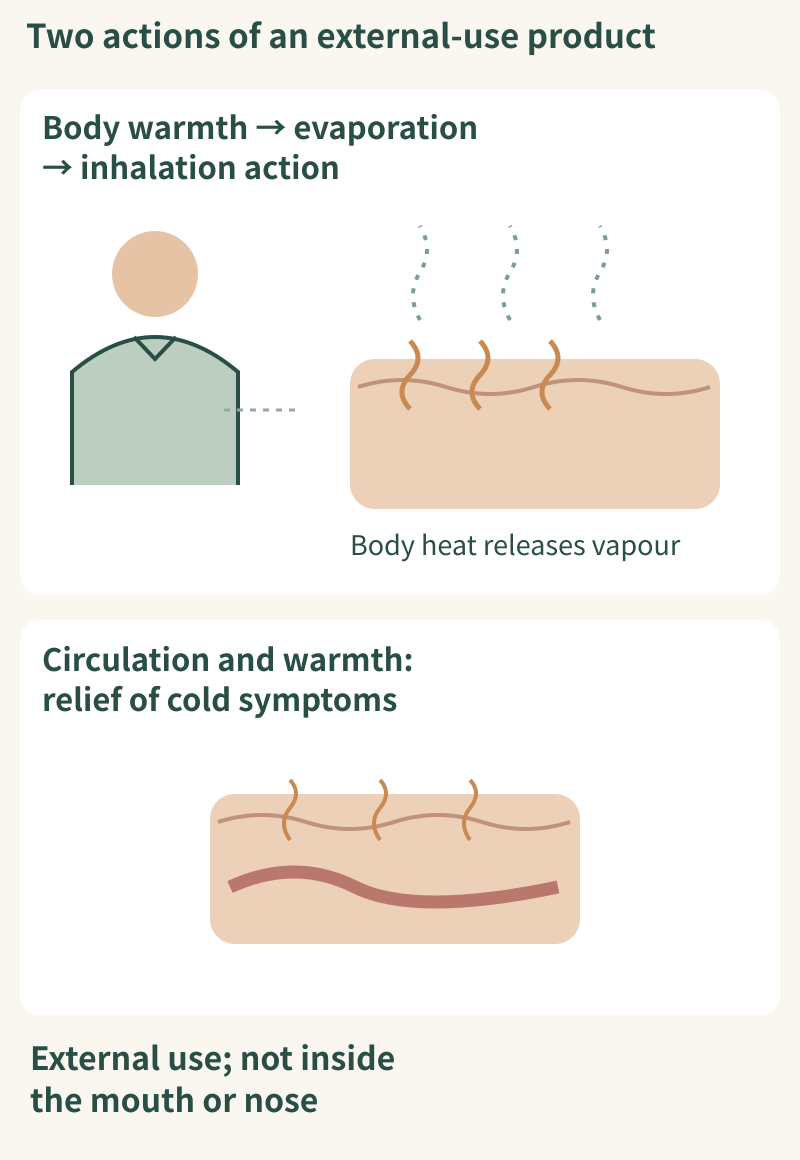
The Japanese manufacturer describes two actions for the product as a whole:
- Inhalation action: body warmth causes active ingredients to vaporize; the vapour is inhaled through the nose or mouth to ease breathing. This describes what happens after application to the specified external areas—not direct placement of ointment on nasal or oral mucosa.
- Topical warming action: the manufacturer describes improved circulation and warming, relieving cold-associated symptoms such as congestion and sneezing. Its Japanese term “湿布作用” names an action; it is not an instruction to add an external heat source or improvise an airtight covering.
This guide explains the official body-temperature evaporation and external-use instructions only. It does not provide hot-water, steam-device or additional-heating procedures. Overseas directions are not interchangeable with this Japanese product’s instructions.
The current ingredient list is expressed per 100g: dl-camphor 5.26g, turpentine oil 4.68g, l-menthol 2.82g, eucalyptus oil 1.33g, nutmeg oil 0.69g and cedar leaf oil 0.44g. Additives are thymol and petrolatum. These are formulation quantities, not a single application amount. This guide does not assign six separate organ-specific mechanisms to the six ingredients or use cooling or warmth as evidence of a faster cure.
Japanese directions: age-specific amounts, three times a day
Apply the following amount to the chest, outside of the throat or back, or cover with cloth after application. The instructions also mention gauze or similar cloth to reduce stickiness; this is not a direction to wrap tightly or add heat. Follow the complete instructions supplied with the product:
- Ages 12 and over: 6–10g per application.
- Ages 6–11: 5g per application.
- Ages 3–5: 4g per application.
- Age 6 months through 2 years: 3g per application.
- Under 6 months: do not use.
For the eligible age groups, the frequency is three times daily. The official guide describes 3g as approximately one teaspoon, not a guarantee that any household spoon measures it precisely. Children must use it under a parent’s or guardian’s guidance and supervision. Meeting the age threshold does not rule out allergy, fever or other prior-consultation conditions. If unsure about amounts or directions, show the actual product to a doctor or pharmacist rather than estimating from jar size.
For external use only; do not swallow. Do not use around the eyes, on mucous membranes such as inside the mouth or nose, on wounds or similar prohibited areas. Avoid eye contact. If it enters an eye, rinse immediately with water or lukewarm water; seek an ophthalmologist if symptoms are severe.
Who should ask first—and when must you not wait seven days?
Consult a doctor or pharmacist before use if any of the following applies:
- You are receiving medical treatment.
- You are pregnant or may be pregnant.
- You or a family member has an allergic tendency, or you have previously had an allergic reaction to a medicine.
- The affected skin is severely weeping or eroded.
- You have fever or symptoms that have persisted for a long time.
If rash, redness or itching occurs after use, stop immediately and take the instructions to a doctor or pharmacist. Also stop and consult if symptoms have not improved after seven days of use. Seven days is not a required waiting period for an adverse reaction, and does not override the need to ask first for fever or prolonged symptoms.
External use does not mean side-effect-free or universally compatible with other medicines. If receiving treatment, explain your symptoms and show your oral medicines and topical products so a professional can check the actual product conditions; “not swallowed” is not a reason to skip that check.
After opening, check both storage and expiry
Keep tightly closed in a cool place away from direct sunlight and out of children’s reach. Do not transfer into another container, because misuse or changes in quality may result. Do not use beyond the expiry date; even within that date, use promptly after opening. These instructions do not provide a fixed number of months after opening to extend on your own.
The shelf decision: identify the current Japanese product and external route, then check age, application amount and consultation conditions. “Inhalation” describes evaporation with body warmth, not nasal application; a current official listing is not a promise of shop stock.