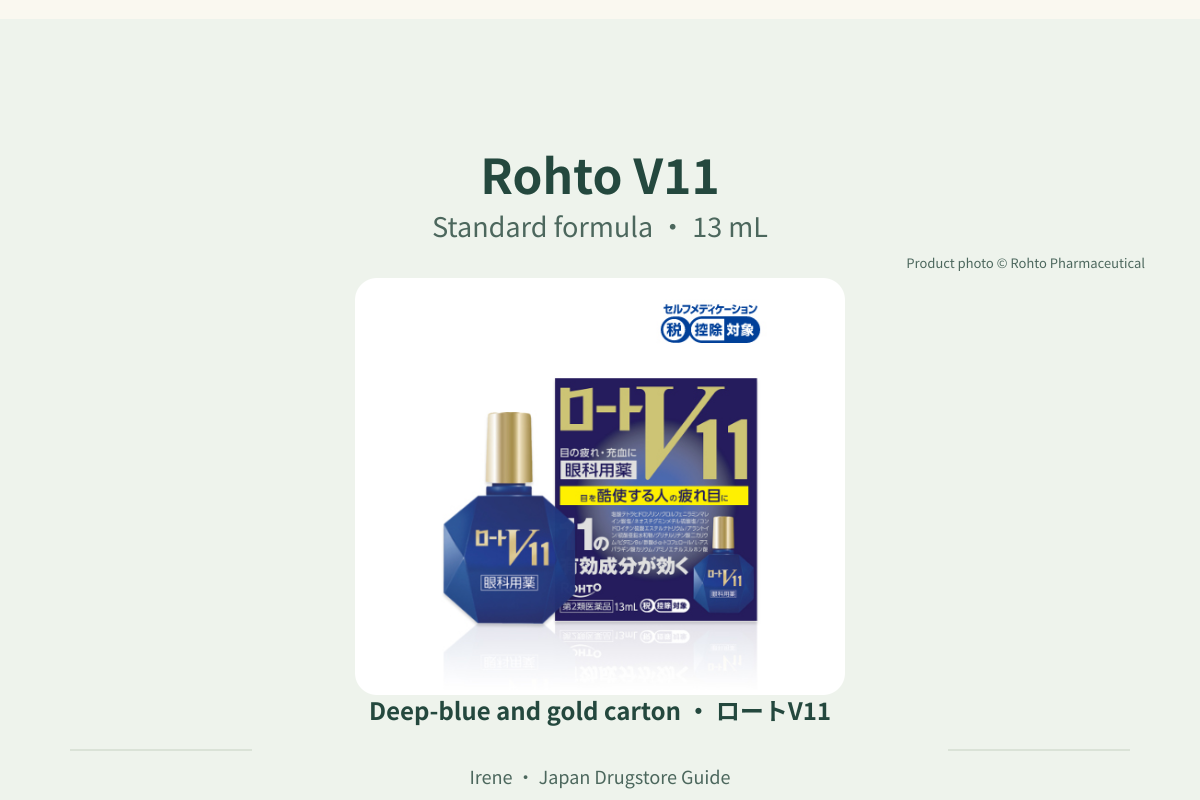
 I’m Irene, a Taiwanese pharmacist working in a Japanese drugstore. Rohto V11’s dark-blue and gold pack stands out on the eye-drop shelf. Before choosing it for its eleven ingredients, check your contact lenses, your symptoms and the directions on this exact product.
Identify the Japanese Rohto V11 pack
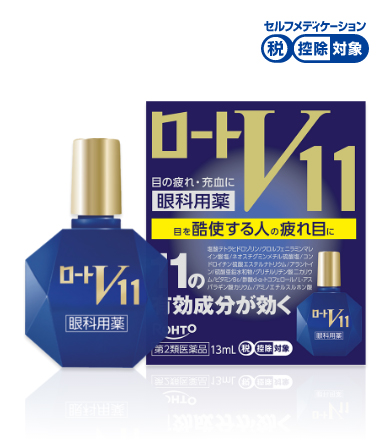
Look for ロートV11, 13mL and 第2類医薬品 (Class 2 OTC medicine). The Japanese barcode is 4987241100545. The large V11 lettering and capacity on the pictured carton help identify the product; similar colors alone are not enough.
This guide covers standard Rohto V11 only. Do not apply its directions to V11 Mild, V Rohto Premium or the oral V5 supplement. V11 is for use in the eyes, not for swallowing.
Check lenses first, then the dose
If you are unsure what lenses you have, or when you can reinsert them after taking them out, show both packs to a pharmacist. The V11 leaflet does not give a universal reinsertion waiting time.
Labeled uses include tired eyes, conjunctival redness, itching, blurred vision such as when discharge is excessive, blepharitis and inflammation caused by ultraviolet or other light. It also lists prevention of eye disease after swimming or when dust or sweat enters the eyes. These indications do not establish the cause of every red eye or vision change. Severe eye pain needs advice before use.
Keep the tip away from the eye, eyelid and lashes to prevent contamination. Do not use cloudy liquid. Children must use it under a parent or guardian’s supervision. If you use other eye medicines or receive eye treatment, check with your doctor or pharmacist first.
Store in a cool place away from direct sunlight and out of children’s reach. Avoid temperatures of 40°C or above, including cars and areas near heaters. Turn the cap until it clicks shut.
Do not share the bottle, transfer the contents or add anything to it. Never use it after the expiry date. Even within that date, this V11 leaflet says to use it as soon as possible after opening; it does not specify a fixed number of months.
Crystals may form on the tip or inside the cap during storage. The leaflet allows these to be wiped gently with clean gauze. That is different from cloudy liquid, which should not be used.
All eleven active ingredients
The Japanese V11 label lists these concentrations:
- Tetrahydrozoline hydrochloride 0.05%
- Chlorpheniramine maleate 0.03%
- Neostigmine methylsulfate 0.005%
- Vitamin B6 0.1%
- d-α-Tocopheryl acetate (vitamin E) 0.05%
- Potassium L-aspartate 1%
- Taurine 0.5%
- Allantoin 0.1%
- Zinc sulfate hydrate 0.05%
- Dipotassium glycyrrhizinate 0.1%
- Sodium chondroitin sulfate 0.1%
The formulation combines ingredients addressing redness, itching, inflammation and tired eyes. Tetrahydrozoline constricts blood vessels; temporary relief of redness should not distract from persistent symptoms. Rohto rates its cooling sensation 4 out of 5. Cooling strength and ingredient count do not rank how suitable a product is for you.
Inactive ingredients include menthol, camphor and benzalkonium chloride. Anyone with a medicine or ingredient allergy history should check the complete leaflet, not just this active-ingredient list.
When to ask first or stop
Stop immediately and seek advice if you develop a skin rash, redness or itching, or eye redness, itching, swelling or painful stinging. These may be side effects. Take the leaflet to a doctor, pharmacist or registered OTC medicine seller.
Stop and seek advice if blurred vision does not improve, or symptoms have not improved after 5–6 days. Do not wait that long if you suspect a side effect.
A useful question at the drugstore
「ロートV11を考えています。このコンタクトレンズで使えますか?ほかの目薬も使っています。」
“I’m considering Rohto V11. Can I use it with these contact lenses? I also use other eye drops.” Include the last sentence if it applies, and show the lens and medicine packs.
Official sources
Checked November 10, 2026. This is a product-identification and general-information guide, not an individual diagnosis. Follow the complete instructions supplied with your pack.