 I’m Irene, a Taiwanese pharmacist working in a Japanese drugstore. Before choosing a Yuskin itch cream, check the full name. Japan’s Asemo Cream is a topical medicine for heat rash and itching, and belongs to a different product line from the familiar orange-lidded moisturizer and Sisora.
- Identify Yuskin Asemo Cream 32 g
- What is it for, and when should you ask first?
- How to use it: three steps
- Five active ingredients, without a steroid
- Face, children, pregnancy and breastfeeding
- Keep these similarly named products separate
- Storage and travel
- A useful question at a Japanese drugstore
- Official sources
Identify Yuskin Asemo Cream 32 g
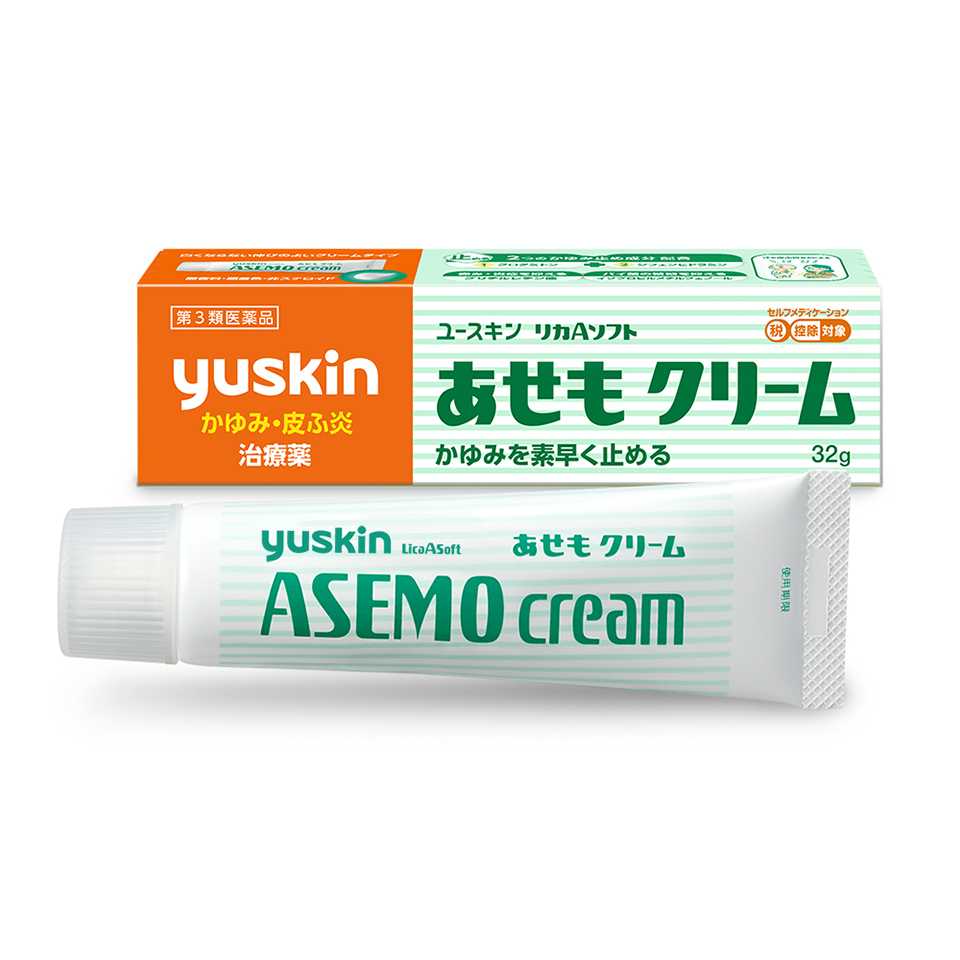
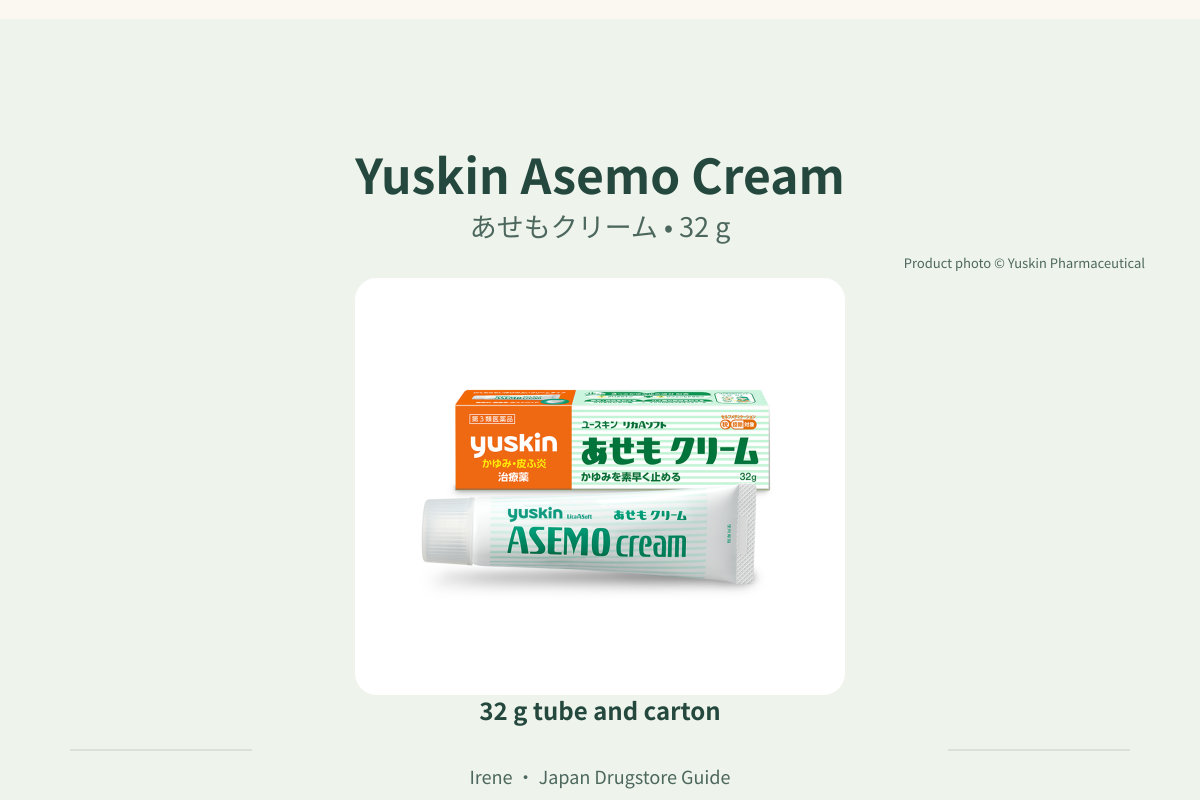
Look for あせもクリーム, 32 g and the approved Japanese sales name ユースキン リカAソフト. It is a class 3 OTC medicine in Japan. The current carton has an orange section on the left and green lettering over pale green stripes on the right; the white tube says “ASEMO cream.”
Yuskin introduced this packaging from March 2025 without changing the ingredients, formulation or quantity. Older packs can look different. “Yuskin A” or an orange label alone is not enough to identify it. The similarly named powder cream and medicated gel also need separate checks.
What is it for, and when should you ask first?
Japanese labeled uses include heat rash, contact dermatitis, eczema, dermatitis, itching, skin erosions, hives and insect bites. This list does not diagnose a rash. In particular, the Japanese term ただれ, meaning eroded or raw skin, should not be read as permission to treat every wound.
How to use it: three steps
The label says to clean the affected area first. For a first application, Yuskin’s FAQ recommends trying a small amount on soft skin, such as the inner arm, and checking for redness or another abnormal reaction. A clear test does not guarantee that a later reaction cannot occur.
The Japanese directions specify a suitable amount, several times a day. They give neither a fixed number of grams per application nor an exact three-times-daily schedule. Use it on the affected area as directed, rather than continuing all-over daily application just to finish the tube.
For external use only; do not swallow. Children need adult guidance and supervision. Keep it out of the eyes. If it enters an eye, rinse immediately with water or lukewarm water; seek an eye doctor if symptoms are severe.
Stop immediately and seek advice if use is followed by a rash, redness, itching, swelling, contact dermatitis, dryness, irritation, a hot sensation or stinging. These may be side effects. Bring the leaflet to a doctor, pharmacist or registered OTC seller.
Also stop and seek advice if symptoms have not improved after 5–6 days. Do not wait that long when a suspected side effect appears.
Five active ingredients, without a steroid
Amounts below are per gram of cream, not an instruction to apply one gram each time:
- Crotamiton 20 mg: an anti-itch ingredient.
- Diphenhydramine 10 mg: an antihistamine for itching.
- Glycyrrhetinic acid 10 mg: an anti-inflammatory ingredient.
- Isopropylmethylphenol 5 mg: an antibacterial ingredient.
- Tocopherol acetate, a form of vitamin E, 5 mg.
Yuskin states that the formula contains no steroid, urea or cooling ingredients, and no added fragrance or color. Lack of a cooling sensation does not mean it is ineffective; it also does not guarantee irritation-free use. Check the complete inactive-ingredient list if you have an allergy. It includes hydrogenated soybean phospholipids, olive oil and parabens, among other ingredients.
Face, children, pregnancy and breastfeeding
- Face: Yuskin’s FAQ allows facial use if the cream suits your skin. Test a small amount under the chin or on another soft area first, and avoid getting it in the eyes. This is not an eye medicine.
- Children: the leaflet gives no numerical minimum age. The manufacturer says it can be used at any age if suitable for the skin, with adult supervision. Have an uncertain rash in a baby or young child assessed rather than treating “no minimum age” as proof of suitability.
- Pregnancy and breastfeeding: the manufacturer allows use if it suits the skin, while noting that skin may be more sensitive during these periods. Stop and wash it off with water or lukewarm water if redness, itching or irritation develops during use, afterward or following sun exposure. Ask a doctor if concerned.
Keep these similarly named products separate
- Orange-lidded Yuskin and Sisora: see the separate Yuskin moisturizer and Sisora comparison. Do not transfer this medicine’s indications to those products.
- Asemo Powder Cream: its approved sales name ends in “P.” It has a different formula, including zinc oxide powder to protect the affected skin. Its active-ingredient combination differs, so do not treat it as interchangeable with this regular cream.
- Medicated Asemo Gel: a Japanese quasi-drug intended to help prevent heat rash and sweat-related skin irritation. It is not another name for this treatment cream.
Storage and travel
Close the cap tightly and store somewhere cool, away from direct sunlight, heat, humidity and children. Do not transfer it to a travel pot. Do not use after expiry, or if its color or smell changes even before expiry. Yuskin advises using an opened tube promptly but gives no fixed number of months after opening.
A useful question at a Japanese drugstore
“I’m looking for Yuskin Asemo Cream 32 g. Can I use it for these symptoms?” Tell the pharmacist the person’s age, the affected area, how long the symptoms have lasted and any medicines being used.
Official sources
Checked 10 November 2026 for the Japanese product. This guide supports product identification and general medicine information, not an individual diagnosis. Follow the complete directions supplied with your pack.