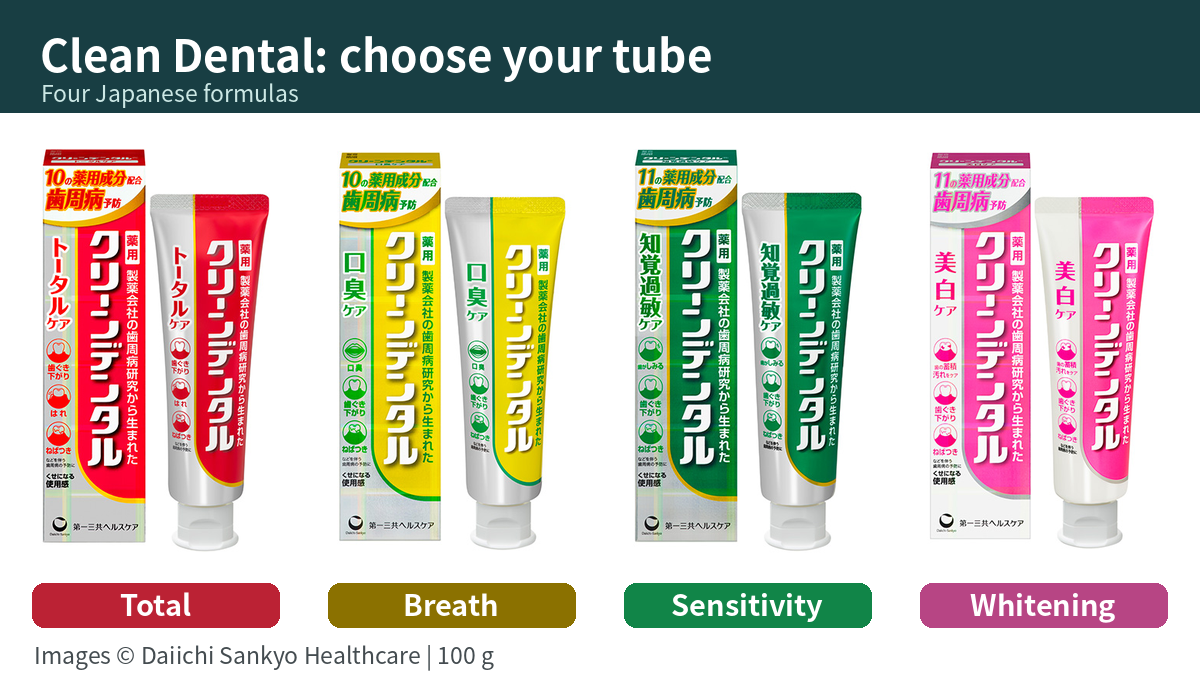
Asked to bring home the red Clean Dental toothpaste from Japan, then faced with several colors on the shelf? Look for トータルケア (Total Care) first, and check the tube size. The yellow, green and pink versions offer different formula features and flavors for more specific preferences.
Bleeding or swollen gums, pus, loose teeth, toothache or unexplained sensitivity need a dental assessment. These four Japanese quasi-drug toothpastes are for everyday preventive care. They cannot replace treatment for gum disease or tooth decay.

I’m Irene, a Taiwan-born, Japan-licensed pharmacist working in a Japanese drugstore. When you’re shopping for someone else, a familiar flavor and the right size matter too. Let’s turn “that red tube” into a clear shopping list.
Japanese-market information checked on 12 October 2026. Products sold in other countries may have different formulas or directions.
- A quick way to narrow the choice
- Match the Japanese name to the box
- Fluoride: do not reuse the old 1,400 ppm figure
- How much to use and how to brush
- Dentures, implants and electric toothbrushes
- Similar-looking Clean Dental products are separate choices
- Three checks before you buy
- Manufacturer information and image sources
A quick way to narrow the choice
All four have labeled uses that include preventing gingivitis, periodontitis and tooth decay. Their colors help identify them; they do not indicate a treatment-strength ranking.
| What you want | Start with | Check before choosing |
|---|---|---|
| The familiar red tube for general preventive care | Red: Total Care | Distinctive peppermint flavor and the widest size range |
| Bad-breath prevention with a lemon flavor | Yellow: Breath Care | Formula includes an additional adsorbent; ongoing bad breath still needs assessment |
| Prevention of sensitivity symptoms | Green: Sensitivity Care | Contains potassium nitrate; does not relieve pain caused by decay |
| Surface-stain care alongside gum-disease prevention | Pink: Whitening Care | Aims to restore natural tooth whiteness through cleaning |
If you wear dentures, have bridges or implants, or use an electric toothbrush, check the compatibility section below before buying.
Match the Japanese name to the box
Red Total Care: the usual starting point for “the red tube”
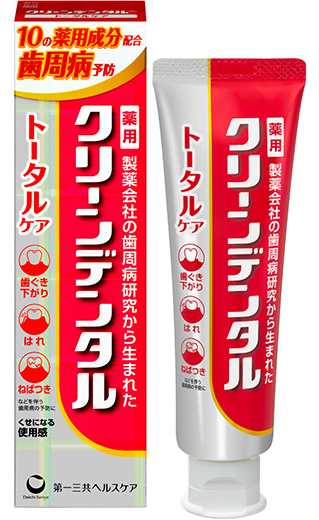
Look for クリーンデンタル トータルケア. Its Japanese registered sales name is DS薬用歯磨きLb. Current sizes are 50 g, 100 g and 150 g.
This is the general-care option, with 10 medicinal ingredients. Its labeled preventive uses cover gum disease, cavities, bad breath and tartar formation and deposits. If you have no specific additional preference, compare the flavor and size first.
The manufacturer describes a distinctive peppermint flavor; the range is also known for its salty taste. Taste intensity is not a measure of effectiveness. A 50 g tube may be a practical first purchase. For someone else, ask for a photo of their tube rather than relying on color alone.
Yellow Breath Care: lemon flavor and an additional adsorbent
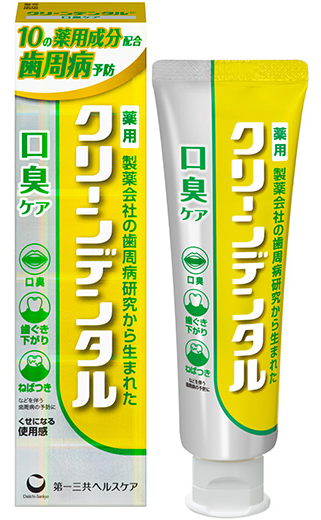
Look for クリーンデンタル 口臭ケア, sales name DS薬用歯磨きMb. It comes in 50 g and 100 g, with a lemon flavor.
It has 10 medicinal ingredients, including zeolite for breath-related care. It also contains beta-cyclodextrin as an adsorbent. Beta-cyclodextrin is an additional formulation ingredient, not an eleventh medicinal ingredient.
The other three toothpastes also have a bad-breath prevention claim. Choose yellow for its particular formulation and flavor, rather than assuming it alone offers that benefit. Persistent bad breath is a reason to investigate the cause with a dentist.
Green Sensitivity Care: check why your teeth hurt
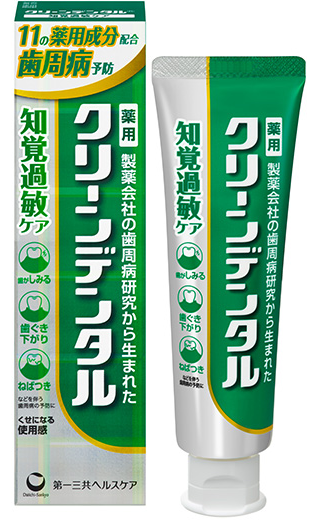
Look for クリーンデンタル 知覚過敏ケア, sales name DS薬用歯磨きSb. Sizes are 50 g and 100 g, with a fresh-mint flavor.
Its 11 medicinal ingredients include potassium nitrate for preventing sensitivity symptoms. POs-Ca, listed as calcium phosphoryl oligosaccharides, is a separate calcium-supplying formulation ingredient. It is not counted among those 11 medicinal ingredients and should not be interpreted as repairing a cavity.
The manufacturer explicitly warns that this toothpaste does not work for tooth pain caused by decay. Sensitivity caused by a cavity needs dental treatment. If you do not know why a tooth hurts, have it checked rather than repeatedly changing toothpaste.
Pink Whitening Care: surface stains and natural tooth color
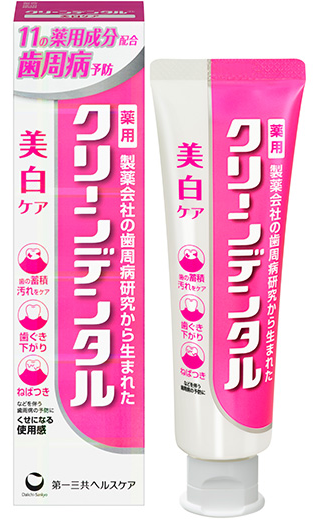
Look for クリーンデンタル 美白ケア, sales name DS薬用歯磨きWb. It comes in 50 g and 100 g, with a herbal-mint flavor. The manufacturer describes this as slightly sweeter than the green version’s fresh mint.
Its 11 medicinal ingredients include polyvinylpyrrolidone (PVP) to help lift accumulated stains during brushing. The whitening claim concerns restoring the teeth’s natural whiteness. It does not promise a change to their inherent color or the result of a professional bleaching treatment.
All four contain abrasive cleaning ingredients. Green does not mean abrasive-free, and the word “whitening” is not enough to rank pink as the most abrasive. The manufacturer does not provide a relative abrasivity ranking for these four.
Fluoride: do not reuse the old 1,400 ppm figure
All four list sodium fluoride as a medicinal ingredient. However, the manufacturer states that the February 2024 reformulation reduced fluoride from the previous 1,400 ppm level.
The current Japanese product pages, pack information and range FAQ checked for this guide do not state the replacement concentration in ppm. Do not substitute an old figure, a Premium-series figure or a retailer’s claim. If your dentist recommends a specific fluoride concentration, confirm the actual pack or ask the manufacturer before choosing.
How much to use and how to brush
All four direct you to put a suitable amount on a toothbrush and brush the teeth and gums. The range FAQ gives a general guide of about 1 g, or a 1–1.5 cm strip. This may vary with the teeth and method of use; it is not a standard dose for young children.
- Spit out the toothpaste. Do not swallow it. The manufacturer suggests one light rinse, rather than imposing a strict one-rinse limit.
- Stop using it and consult a doctor, dentist or pharmacist if you develop a rash, redness, itching or swelling.
- Store it somewhere cool, away from direct sunlight. Suitable brushing, cleaning between the teeth and regular dental checks remain important.
Can children use it? The FAQ for this range sets no numerical age limit, but gives conditions: the child should be able to use a non-sweet adult toothpaste and rinse well, using only a small amount. This is not blanket permission for babies or toddlers, or an instruction to give children the adult 1 g amount. Ask a dentist about an appropriate fluoride concentration and amount for your child.
Pregnancy or breastfeeding? The manufacturer’s FAQ permits use during both. Follow the directions and stop if an adverse reaction occurs.
For a large accidental ingestion, the manufacturer advises immediately drinking one or two glasses of water and consulting a doctor with the product. Toothpaste is not intended to be swallowed.
Dentures, implants and electric toothbrushes
- Removable dentures: the manufacturer says not to clean them with these four toothpastes because the abrasive ingredients may scratch them. Use a denture-specific product.
- Bridges and implants: designs vary; ask your own dentist about compatibility.
- Electric toothbrushes: check the toothbrush instructions or contact its manufacturer before pairing it with an abrasive toothpaste.
These compatibility checks are more useful than choosing by popularity.
Similar-looking Clean Dental products are separate choices
- Blue 無研磨a: a separate 90 g gel toothpaste with no ingredients added as abrasives. Check the full name if you want this version; green Sensitivity Care is not an equivalent substitute.
- Premium and Premium Cool: different formulas with their own fluoride and age instructions. Do not carry the directions in this guide across to them.
- 薬用リンス: a liquid dentifrice that requires brushing, rather than an ordinary rinse-only mouthwash.
- クリーンデンタルN: a Category 3 OTC gum ointment, not everyday toothpaste.
Three checks before you buy
- Full name: red Total Care, yellow 口臭ケア, green 知覚過敏ケア or pink 美白ケア.
- Size: all four offer 50 g and 100 g; only red Total Care also offers 150 g in this comparison. Store availability varies.
- Version and user: the manufacturer lists the old L/M/S/W products as discontinued in February 2024. Do not use an old shopping screenshot to verify the current formula. The red 150 g tube has also changed to a screw cap, so a different cap does not automatically mean the wrong range.
You do not need one of every color. Choose a suitable formula and flavor that fits the person’s daily routine. If the problem is actually a mouth ulcer, see the separate Japanese mouth-ulcer patch comparison. Bleeding gums, swelling and tooth pain should be assessed by a dentist.
Manufacturer information and image sources
- Daiichi Sankyo Healthcare: Total Care, Breath Care, Sensitivity Care and Whitening Care. Each page links to its Japanese pack-information PDF.
- Range FAQ: quantity, children, pregnancy, breastfeeding, rinsing, accidental ingestion and compatibility.
- Brand information and fluoride change, current lineup and discontinued products.
- Japanese Society of Periodontology: gum-disease Q&A and Japan Dental Association: symptoms to have checked.
Product photographs are copyright Daiichi Sankyo Healthcare and are used to identify the products discussed. Read the complete instructions on your own pack. This guide cannot replace individual dental care.