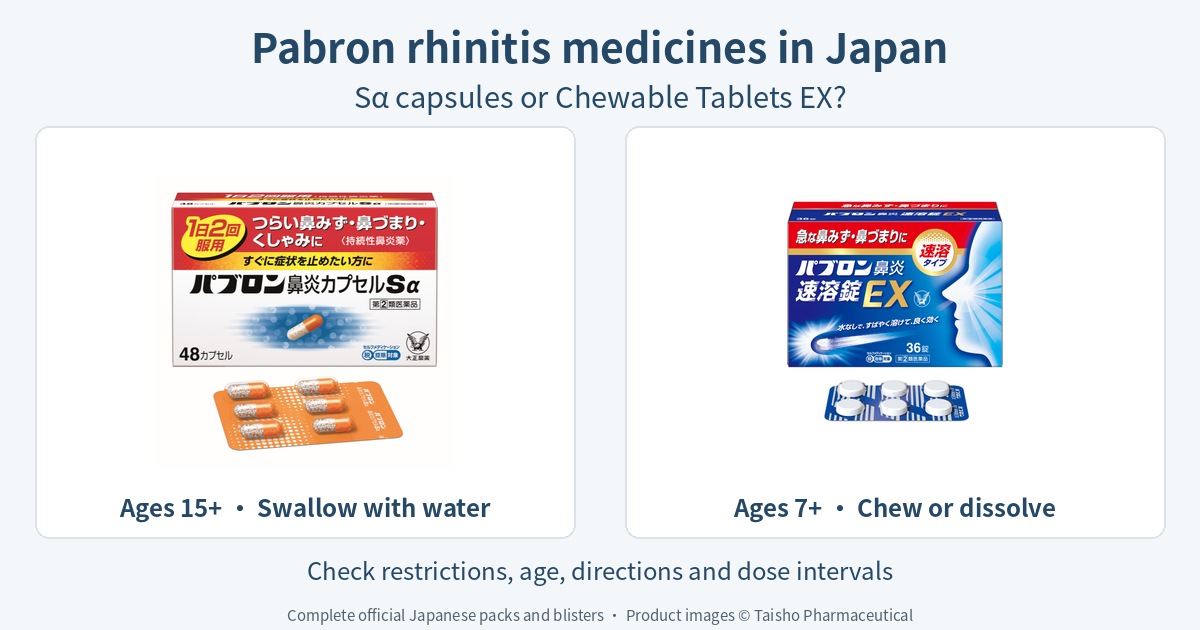
Start with age and how you will take it. Pabron Rhinitis Capsules Sα is for ages 15+: two capsules every 12 hours, twice daily, with water. Pabron Rhinitis Chewable Tablets EX has age-specific doses from age 7: three times daily, at least four hours apart, chewed or dissolved in the mouth without necessarily needing water. Their formulas differ. Neither permits driving after a dose, and they must not be taken together.

I’m Irene, a Taiwan-born, Japan-licensed pharmacist working in a Japanese drugstore. Pabron covers cold, cough and rhinitis medicines. Let’s start with the complete name, then look at how each nasal medicine fits your needs.
- Match the full Japanese name before comparing convenience
- Sα: every 12 hours. EX: three times daily, at least four hours apart
- EX is a different formula, not simply a dissolving Sα capsule
- Who should avoid them, and who needs advice first?
- No improvement after five or six days? Stop and seek advice
- A few details worth checking before you buy
- Sources and reading notes
Match the full Japanese name before comparing convenience
This guide covers the Japanese adult Sα capsules and Chewable Tablets EX. Both are designated Class 2 OTC medicines in Japan (指定第2類医薬品). The English names below follow Taisho’s translations; keep the Japanese names with your shopping list so you can identify the right pack.
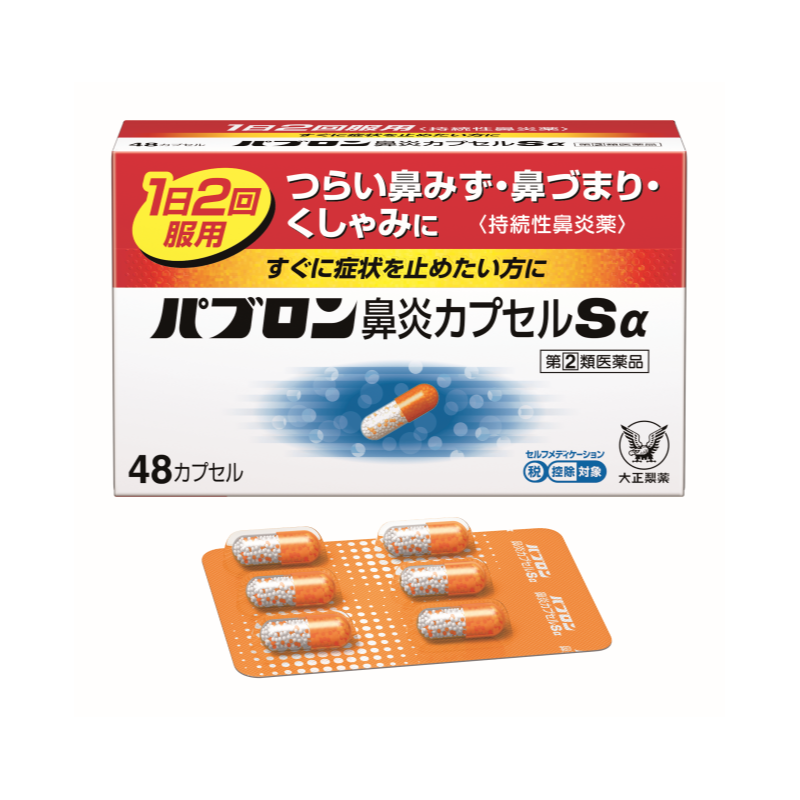
パブロン鼻炎カプセルSα
Complete 48-capsule box and blister shown. Image source / copyright: Taisho Pharmaceutical.
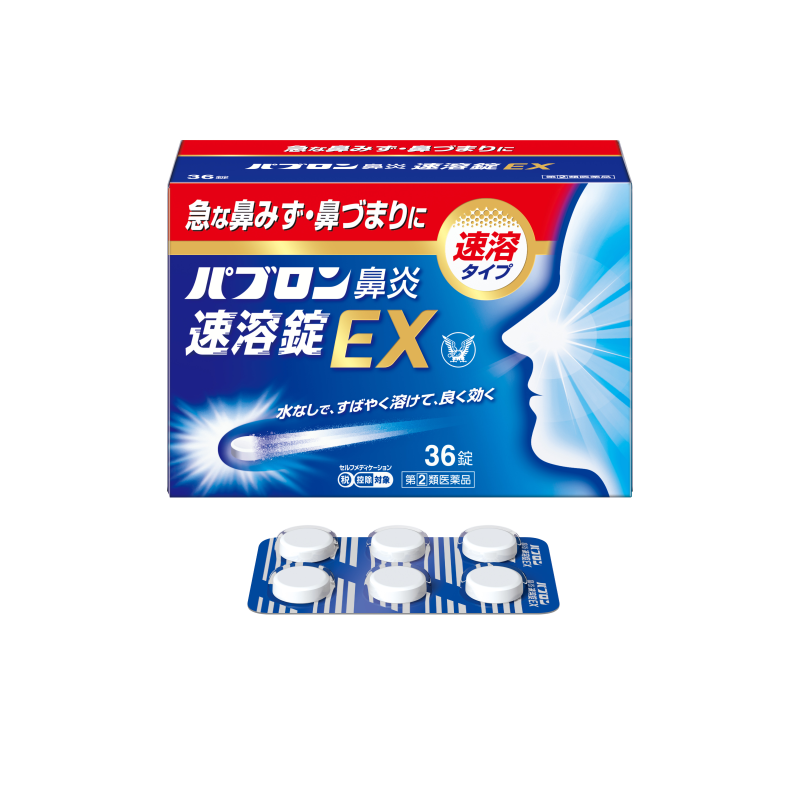
パブロン鼻炎速溶錠EX
Complete 36-tablet box and blister shown. Image source / copyright: Taisho Pharmaceutical.
- Ages 15+ and looking for twice-daily dosing: if the medicine is suitable for you, Sα offers a 12-hour dosing interval and is swallowed with water or lukewarm water.
- Need a form that can be taken without water: EX can be chewed or dissolved in the mouth. The single dose changes between ages 7–14 and ages 15+.
- Driving, taking other medicines or managing a health condition: check suitability with a pharmacist first. “EX,” “fast dissolving” and caffeine do not make either product safe to drive after.
Do not use either product with diagnosed high blood pressure, heart disease, thyroid dysfunction or diabetes, or difficulty urinating caused by an enlarged prostate. Pregnancy, possible pregnancy and breastfeeding require advice before use. The restrictions and consult-first situations are separated below.
Sα: every 12 hours. EX: three times daily, at least four hours apart
Check when you last took a dose before reaching for another. A returning runny nose is not a reason to shorten the interval or add extra tablets.
| Product | Age and single dose | Frequency and interval | How to take it |
|---|---|---|---|
| Adult Sα capsules | Ages 15+: 2 capsules Under 15: do not use | Twice daily, every 12 hours | Swallow with water or lukewarm water |
| Chewable Tablets EX | Ages 15+: 2 tablets Ages 7–14: 1 tablet Under 7: do not use | Three times daily, at least 4 hours apart | Chew or dissolve in the mouth; can be taken without water |
- Sα: remove → swallow with waterPush two capsules out of the blister before taking them. This is the ages-15+ dose. Do not split an adult capsule into a homemade child dose.
- EX: count for age → chew or dissolveTwo tablets for ages 15+, or one for ages 7–14. A parent or guardian must supervise children. These are medicines, not sweets to keep taking throughout the day.
Never swallow either medicine inside its blister packaging. Taisho’s timing guidance says these two products can be taken regardless of meals. That flexibility does not change the dose interval or daily frequency.
EX is a different formula, not simply a dissolving Sα capsule
Both are labelled to relieve sneezing, runny or blocked nose, watery eyes, sore throat and a heavy-headed feeling associated with acute rhinitis, allergic rhinitis or sinusitis. Symptom relief does not establish that either treats the cause of a sinus infection.
The quantities below are per adult single dose: two Sα capsules or two EX tablets. They are not per tablet/capsule or daily totals. The EX dose for ages 7–14 is one tablet, so do not use the adult two-tablet amount for a child.
| Active ingredient | Sα: per 2 capsules | EX: per 2 tablets |
|---|---|---|
| Pseudoephedrine hydrochloride | 60 mg | 40 mg |
| dl-Methylephedrine hydrochloride | None | 10 mg |
| Antihistamine | Carbinoxamine maleate 6 mg | d-Chlorpheniramine maleate 2 mg |
| Dipotassium glycyrrhizinate | None | 15 mg |
| Total belladonna alkaloids | 0.2 mg | 0.2 mg |
| Anhydrous caffeine | 50 mg | 25 mg |
Sα contains both faster- and slower-dissolving granules inside the capsule. EX is designed to break down in the mouth; it also adds dl-methylephedrine and dipotassium glycyrrhizinate and uses a different antihistamine. Fast dissolving describes a useful dosage-form feature. It is not a head-to-head demonstration of stronger or faster symptom relief.
For example, the 60 mg and 40 mg pseudoephedrine figures look different, but both give 120 mg per day at the labelled adult frequency. That calculation does not make the formulas interchangeable: the other ingredients and release characteristics still differ. Do not combine them. Caffeine does not cancel the driving restriction. This table lists active ingredients; check the inactive ingredients too if you have a medicine-allergy history.
Who should avoid them, and who needs advice first?
Do not take either product if these apply
- A previous allergic reaction to that product or any of its ingredients.
- Difficulty urinating caused by an enlarged prostate.
- Diagnosed hypertension, heart disease, thyroid dysfunction or diabetes.
- Below the product’s age limit: under 15 for the adult Sα capsules, or under 7 for EX.
Consult before using either product
Get advice first if you are receiving medical treatment, pregnant or possibly pregnant, breastfeeding, older, or have a history of medicine-related allergy. High fever, difficulty urinating, glaucoma and kidney disease also require consultation. General urination difficulty is a consult-first condition; difficulty known to be caused by an enlarged prostate rules out use.
Tell the pharmacist if cold, cough/expectorant or oral rhinitis medicines have previously caused insomnia, dizziness, weakness, tremor or palpitations. Treatment with a monoamine oxidase inhibitor (MAOI), such as selegiline, also requires advice before use. Bring the names of everything you take.
Other medicines, driving and alcohol
While taking either product, do not use other oral rhinitis medicines, oral medicines containing antihistamines (including some cold, cough/expectorant, motion-sickness and allergy medicines), or gastrointestinal pain-relieving antispasmodics. Sα’s leaflet additionally specifies other oral medicines containing pseudoephedrine hydrochloride or pseudoephedrine sulfate. EX’s leaflet does not spell out that extra category, but this is not permission to add another decongestant yourself.
Do not drive vehicles or operate machinery after taking either, even if you feel alert. As a general precaution with sedating antihistamines, avoid alcohol, which can increase drowsiness. Ask a pharmacist before use if you take sleeping tablets, sedatives or other medicines. Oral sleep aids containing antihistamines fall under the no-combination rule above. Do not stop a prescribed medicine yourself to make room for an OTC purchase.
No improvement after five or six days? Stop and seek advice
Both leaflets say to stop and consult if symptoms have not improved after five to six days. This means days, unlike the five-to-six-dose stopping point on some Pabron cough products. Do not use continuously for a long period or exceed the dose. There is no need to finish the pack.
Stop immediately and seek advice for new rash, redness or itching; nausea/vomiting or loss of appetite; dizziness, insomnia, nervousness, headache or convulsions; difficulty urinating; flushing or unusual sensitivity to light. Dry mouth, sleepiness, constipation or blurred vision that persists or worsens also requires stopping and consultation.
Get medical attention immediately for serious warning signs
Both leaflets warn about a rare serious skin reaction: high fever with widespread redness or rash, small pustules, and feeling very unwell, especially if symptoms persist or worsen quickly.
EX additionally lists anaphylaxis and serious blood disorders. Warning signs include sudden breathing difficulty or impaired consciousness; unexplained bruising, nose/gum bleeding, pallor or breathlessness; or sudden high fever, chills and a sore throat. Seek immediate medical help for these. A severe reaction such as breathing difficulty after either medicine should never wait for the five-to-six-day review point. These are key warnings, not a substitute for reading the full leaflet.
A few details worth checking before you buy
Why do older EX listings show 24 or 48 tablets?
The current Taisho catalog lists EX in 18- and 36-tablet packs, and Sα in 24- and 48-capsule packs. Older EX pack information still appears online. Match the actual box, expiry date and enclosed leaflet rather than treating an old listing as the current pack. A pack-size difference is not a strength difference.
Can a child take half the adult Sα dose?
No. The adult Sα capsules covered here must not be used under 15. A separate product with 小児用, meaning children’s use, in its name is outside this comparison; its age limit and directions cannot be transferred to the adult pack. For EX, ages 7–14 take one tablet per dose, three times daily at least four hours apart, under adult supervision and subject to the other restrictions.
What if I already have Pabron Select or a Pabron cough medicine?
Do not add a nasal medicine without checking the combination. Pabron Select N, T and CV are combination cold medicines; the three Pabron cough medicines are another group. Their formulas and directions do not carry over to these rhinitis products. If the brand on your box is Contac, use the Rhinitis Z versus 600 Plus s guide to identify it, then have a pharmacist review your complete medication list.
Can I save an opened pack for my next trip?
Keep both products in their original packaging in a cool, dry place, away from direct sunlight and children. Do not transfer them to another container. Use within six months of opening and before the printed expiry date, whichever comes first. That is a storage limit, not permission to keep taking the medicine for six months.
My practical takeaway: save the full name, the user’s age, current medicines and any driving plans alongside the pack photo. Those details are much more useful at the pharmacy than the Pabron logo alone.
Sources and reading notes
Checked on 18 October 2026 using current Japanese catalogs and their linked Japanese leaflets; translations support product identification. This guide covers Japanese-market products, not every overseas medicine with the same brand name. Alcohol and sedative precautions also draw on official health-service antihistamine guidance. Read your own pack’s leaflet and get individual advice when needed.
- Taisho: current Sα rhinitis capsules product information · Japanese leaflet, revised May 2026 · Purchaser information and OTC category
- Taisho: Sα rhinitis capsules English leaflet
- Taisho: current Rhinitis Chewable Tablets EX product information · Japanese leaflet, revised May 2026 · Purchaser information and OTC category
- Taisho: Rhinitis Chewable Tablets EX English leaflet
- Taisho: when to take these rhinitis medicines in relation to meals
- NHS: antihistamines, alcohol and other medicines
- Cambridge University Hospitals: sedating antihistamines, alcohol and sleeping tablets