Before choosing a flavour, show your pharmacist the exact medicine and ask whether a medication jelly is suitable. Grape, lemon and chocolate-flavoured products do not all have the same mixing instructions.

I’m Irene, a Taiwan-born, Japan-licensed pharmacist working in a Japanese drugstore. This guide helps you identify medication-support jellies and check preparation and storage. It is not a medicine-mixing recipe or treatment for swallowing disorders.
Japanese official information checked: 22 October 2026. The three specific packs below are foods.
Check the purpose before the brand
These jellies help enclose medicine; they do not contain the medicine you need to take. Ryukakusan also sells throat medicines with very different directions. See the Ryukakusan powder, Direct and troche guide if that is what you need. Do not turn a medicine intended to dissolve slowly in the mouth into something swallowed inside jelly.
Dessert jelly, konjac jelly and Morinaga in Jelly nutritional products are not interchangeable with the medication-support products here.
Identify the exact pack
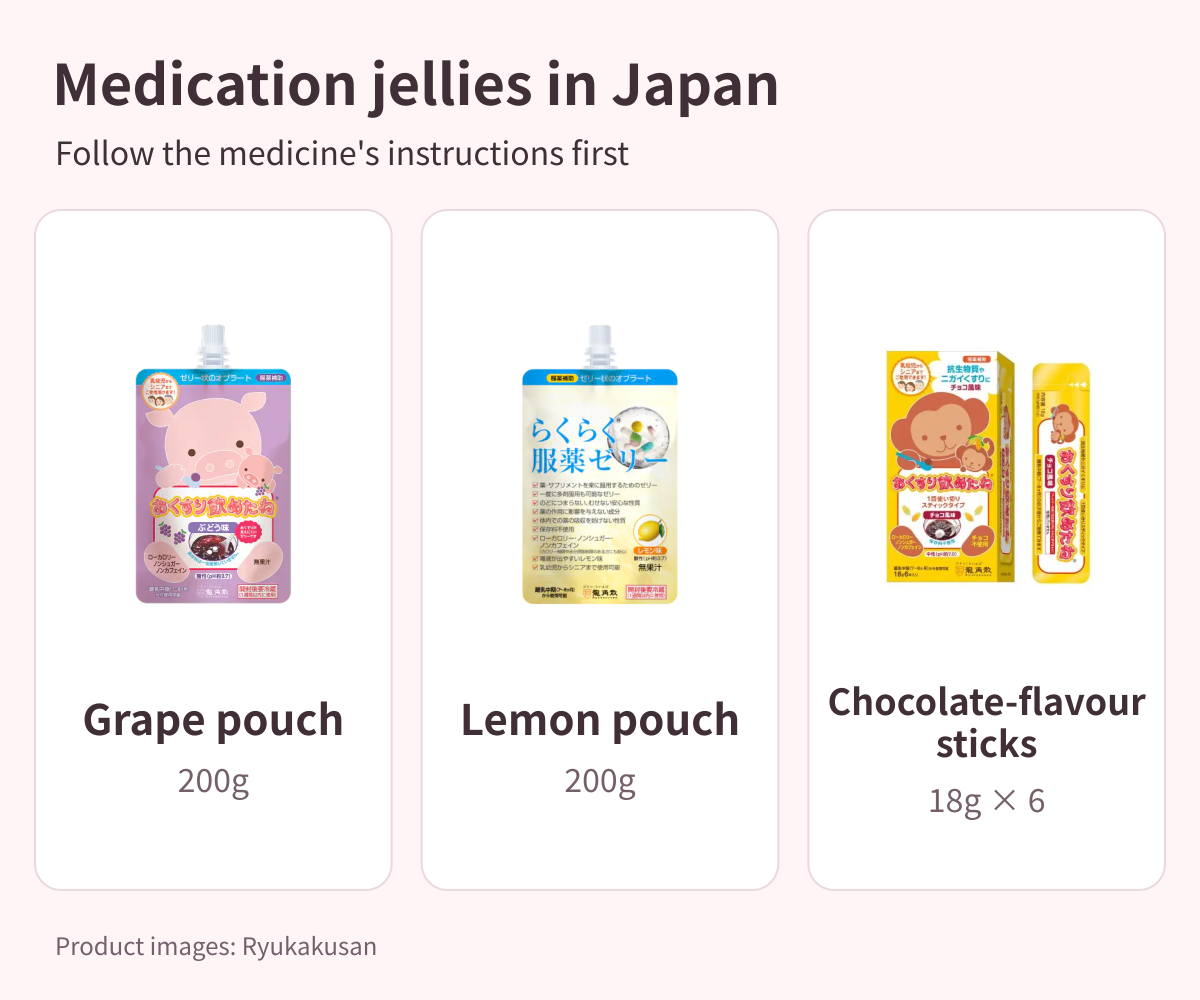
Grape, 200g: enclose, do not stir
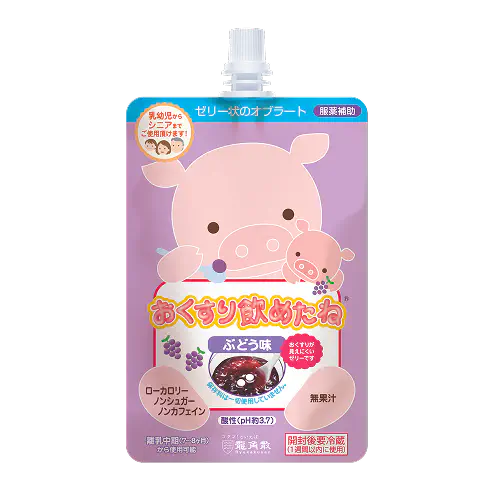
Okusuri Nometane grape is acidic, with a labelled pH of approximately 3.7. Even powdered medicine should be enclosed rather than stirred into this jelly.
Some antibiotics can taste more bitter when mixed with acidic jelly. A child’s favourite flavour is therefore not enough to choose a compatible product.
Lemon, 200g: the same enclosing principle
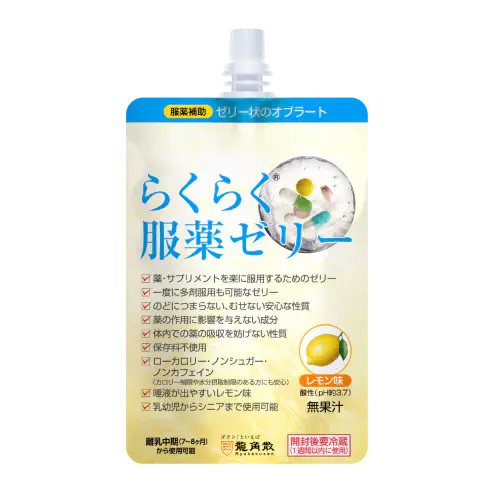
Rakuraku Fukuyaku Jelly is lemon-flavoured, also approximately pH 3.7. Its directions say not to stir in powdered medicine, and to adjust the jelly amount to the medicine and swallowing ability.
This does not establish suitability for someone who has a swallowing disorder. Repeated coughing or choking during meals, drinking or medication needs assessment.
Chocolate flavour, 18g × 6: use opened sticks immediately
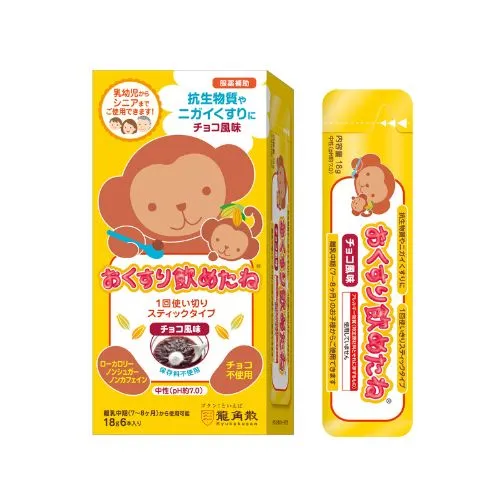
This neutral jelly is approximately pH 7.0 and contains cocoa powder, but no chocolate. The manufacturer positions it for bitter medicines and antibiotics and allows mixing with a generous amount of jelly.
That is not permission to mix every medicine. Confirm compatibility first. Do not crush tablets, open capsules or combine medicines on your own. An 18g stick is a pack size, not a universal serving.
Prepare only after compatibility is confirmed
- Put jelly into a clean cup or small deep dish, then add the prescribed amount of medicine.
- Enclose it with jelly and scoop with a teaspoon. Do not stir powder into grape or Rakuraku jelly. The chocolate-flavour mixing option applies only after checking that your medicine can be taken this way.
- Keep each mouthful manageable. A teaspoon is the manufacturer’s suggestion, not a guarantee of safe swallowing at every age. Supervise children; do not use a large spoon to rush the process.
The Okusuri Nometane brand instructions say to discard any separated water that comes out first, so the jelly can enclose the medicine, and not to knead the pouch.
Choose packaging you can store correctly
- Both 200g pouches: keep the cap and outlet clean, close tightly, refrigerate after opening and use within one week. Marking the opening date helps.
- Chocolate-flavour sticks: use after opening; do not save leftovers.
- Follow the actual pack for unopened storage and expiry. The pouch’s one-week rule does not apply to sticks.
If your accommodation cannot provide suitable refrigeration, consider packaging before buying a large pouch. A time limit does not make contaminated or abnormal contents usable.
Zero sugars does not mean zero carbohydrate
The grape pouch lists 36kcal and 27g carbohydrate per 200g; Rakuraku lists 36kcal and 30g per 200g. Chocolate flavour lists 4kcal and 3g per 18g stick. All three list sugars as 0g. These are label reference amounts, not instructions to consume a whole pouch.
All three contain ingredients including erythritol, reduced maltose syrup and agar; chocolate flavour also contains cocoa powder. The manufacturer states that Japan’s specified and corresponding listed allergenic ingredients are not used. This does not rule out allergy to every ingredient. Show the full label to your care team if you have allergies or dietary/fluid restrictions.
What to ask your pharmacist
- With this exact medicine, formulation and dose, can I use this jelly? Enclose only, or mix?
- Is this method appropriate for the user’s age and swallowing ability?
- How do I keep following the medicine’s water and fasting instructions?
- If several medicines are prescribed, which must stay separate?
If a dose is unfinished, spat out or vomited, ask a pharmacist or doctor rather than repeating a full dose yourself. Medication jelly does not guarantee freedom from choking or aspiration and does not replace assessment for swallowing difficulty.
Official sources and images
Product images are unmodified manufacturer images, not photographs taken for this blog. Check the label on your own pack.