If you spot a small bottle of ムヒベタV液 (Muhi Beta V Liquid) in a Japanese drugstore, check more than the MUHI logo. This is a 10g roll-on containing the corticosteroid betamethasone valerate. Its formula and applicator differ from Liquid MUHI S2a and Liquid MUHI Alpha EX. Start by identifying the bottle, then check whether it is appropriate for the affected skin.

Hi, I’m Irene, a Taiwan-born, Japan-licensed pharmacist working in a Japanese drugstore. Let’s look at this MUHI roll-on, especially the details that are easy to miss between “no menthol” and “suitable for my skin.”
Three points to remember: it contains ethanol and must not be applied to wounds, the eyes or eye area, or mucous membranes. If you are pregnant or might be pregnant, ask a professional before use. Stop and seek advice if there is no improvement after 5–6 days. Worsening symptoms or possible side effects need attention sooner.
- Check the full name: ムヒベタV液, the 10g roll-on
- Check the skin first: “do not use” and “ask before use” are different
- How to use the roll-on: roll gently rather than pressing hard
- Children, pregnancy and breastfeeding: check this product specifically
- When to stop: side effects immediately, no improvement after 5–6 days
- How does it differ from Liquid S2a and Liquid Alpha EX?
- Close the cap and keep the original bottle and leaflet
- Sources and scope
Check the full name: ムヒベタV液, the 10g roll-on
- Japanese name: ムヒベタV液, manufactured and marketed by Ikeda Mohando.
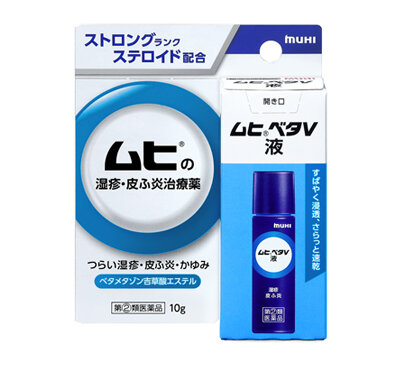
- Size and identification: 10g, a roll-on applicator, and JAN barcode 4987426003333. Although it is a liquid, the pack size is stated in grams, not 10mL.
- Japanese medicine category: designated Class 2 OTC medicine, marked 第②類 on the packaging. This category is separate from corticosteroid potency.
The outer packaging is shown here to identify the product discussed in this guide. Check the full name ムヒベタV液, the 10g size and the 第②類 medicine-category mark. The MUHI logo alone does not distinguish it from Liquid MUHI S2a or Alpha EX; their ingredients and restrictions must be checked separately.
One corticosteroid, no menthol, but still ethanol
The active ingredient is betamethasone valerate (Japanese: ベタメタゾン吉草酸エステル), at 0.12g per 100g, or 0.12% by weight. It reduces inflammation associated with eczema, dermatitis and other labeled conditions. This concentration is not the amount to apply at one time.
The manufacturer places the ingredient in the “Strong” (ストロング) category of Japan’s five-level topical corticosteroid classification. That is not a universal international category, does not mean “the strongest steroid,” and does not establish that this bottle works faster than another MUHI product.
The formula does not contain menthol, camphor or the antihistamine diphenhydramine found in some other MUHI liquids. Its inactive ingredients are BHT, hydrophobized hydroxypropyl methylcellulose, citric acid, sodium citrate and ethanol. No cooling ingredients does not mean that it cannot sting, that it suits sensitive skin, or that it can be applied to skin scratched open.
Japanese labeled uses: eczema, dermatitis, itching, contact dermatitis, heat rash, hives, chilblains and insect bites. A matching symptom name does not remove the application restrictions or the need for advice in the situations below.
Check the skin first: “do not use” and “ask before use” are different
Do not use it in these situations
- You have previously had an allergic reaction to this product or any of its ingredients.
- On chickenpox, fungal infections such as athlete’s foot or ringworm, or areas with pus.
- On the eyes, around the eyes, on wound surfaces or on mucous membranes. Skin scratched open is also a wound.
- Over a large area of the face. Facial skin is thinner and requires particular care. This restriction is not permission to use it anywhere on the face; the eyes and eye area remain prohibited.
The manufacturer’s FAQ additionally says not to use it on the lips, boils, acne, or an area larger than two palms. Its application FAQ describes the two-palm area as including the fingers. This is not a guarantee that any smaller area is suitable for self-treatment. The manufacturer does not recommend genital use. Burns are not a labeled use, and the FAQ explicitly says not to use it for burns.
Five situations that need advice before use
According to the Japanese leaflet, consult a doctor, pharmacist or registered OTC medicine seller in Japan before use if any of these apply:
- You are receiving treatment from a doctor.
- You are pregnant or might be pregnant.
- You have had an allergic reaction to medicines or similar substances, such as a rash, redness, itching or contact dermatitis.
- The affected area is extensive.
- The skin is severely weeping or eroded.
A general medicine-allergy history means “ask first.” A known allergy to this product or its ingredients means “do not use.” If you cannot tell whether the problem is eczema, an infection or something else, have it assessed rather than repeatedly trying the medicine to find out.
How to use the roll-on: roll gently rather than pressing hard
- Clean the affected skin first. If it is dirty, wipe it gently with water or lukewarm water.
- At the start, roll the ball lightly until liquid appears. Then apply with gentle strokes to skin that is suitable for treatment, without pressing the ball hard.
- The leaflet says to apply an appropriate amount several times a day. The manufacturer’s FAQ gives 2–3 times a day as a guide and says to reduce frequency as symptoms improve. This is guidance, not a replacement for the leaflet or a reason to keep reapplying.
- Do not cover the treated area. The leaflet prohibits occlusive coverings such as plastic wrap; the FAQ also lists gauze and adhesive bandages. On an area in contact with a diaper, do not use a tight diaper or airtight plastic pants. This instruction does not mean the product suits every diaper rash.
For external use only; do not swallow. Do not use it as a makeup base, after shaving, or as routine preventive skin care; it is not an insect repellent and should not be applied to symptom-free skin to prevent bites. Do not use continuously for a long time. If it gets into the eyes, rinse immediately with water or lukewarm water. Seek eye care for persistent redness, pain, uncontrollable tearing or similarly severe symptoms.
Children, pregnancy and breastfeeding: check this product specifically
Can children use it?
The official product pages, leaflet, FAQs and 2026 product catalog checked for this guide do not give a starting age in years or months for Muhi Beta V Liquid. Do not borrow the age guidance for S2a or EX, or interpret the absence of a number as suitability for all ages.
The leaflet requires adult guidance and supervision when children use it. For a young child, I suggest giving a doctor or pharmacist the child’s age, application site and symptoms before deciding whether it is appropriate.
Pregnant or possibly pregnant: ask before deciding
The manufacturer’s pregnancy FAQ and Japanese leaflet use different wording. This guide follows the leaflet’s requirement to consult a doctor, pharmacist or registered OTC medicine seller in Japan before use. Do not take the FAQ’s short answer as assurance that you should self-treat during pregnancy.
Breastfeeding: the application site still matters
The manufacturer’s FAQ says it can be used while breastfeeding. That answer does not specifically establish how to use it on the nipple, areola or areas that may contact a baby’s mouth. Ask a doctor or pharmacist before applying it to those sites rather than assuming they are covered by the general answer.
When to stop: side effects immediately, no improvement after 5–6 days
Stop immediately and take the leaflet to a doctor, pharmacist or registered OTC medicine seller in Japan if any of these develop after use:
- Rash, redness or itching.
- Fungal infection such as athlete’s foot or ringworm, acne, pus, persistent irritation, or whitening of the treated skin.
If there is no improvement after 5–6 days, stop and seek advice with the leaflet. If symptoms worsen earlier or any of the reactions above occur, stop using it and seek advice immediately; do not wait until day six.
Using large amounts or continuing for a long time can cause skin thinning or dilation of skin blood vessels. Even if there is some improvement, seek medical advice when symptoms linger. Do not keep applying it aimlessly after symptoms improve, or transfer another MUHI product’s duration guidance to this one.
Irene’s practical tip: note when you started, roughly how often you apply it, and whether the skin is broken, weeping or turning white. Bring the box when you ask for advice. Switching to a different MUHI bottle does not reset the time you have already spent self-treating.
How does it differ from Liquid S2a and Liquid Alpha EX?
- ムヒベタV液 / Muhi Beta V Liquid: 10g roll-on; betamethasone valerate corticosteroid; no menthol or camphor, but contains ethanol.
- 液体ムヒS2a / Liquid MUHI S2a: 50mL sponge-tip bottle; dexamethasone acetate corticosteroid; also contains diphenhydramine hydrochloride, menthol, camphor and other ingredients, with ethanol.
- 液体ムヒアルファEX / Liquid MUHI Alpha EX: 35mL sponge-tip bottle; prednisolone valerate acetate (PVA) corticosteroid; also contains diphenhydramine hydrochloride, menthol, camphor and other ingredients, with ethanol.
All three are designated Class 2 OTC medicines in Japan, but they are not the same medicine in different bottles. Ingredient percentages alone cannot rank their clinical effects, and there is no need to work through S → EX → Beta on your own. For the wider S range or the two EX forms, see the MUHI S series guide and MUHI Alpha EX liquid and cream comparison.
If you already use another medicine on the same area, especially a topical corticosteroid, ask a doctor or pharmacist to check the products before adding this one. Do not layer them on your own.
Close the cap and keep the original bottle and leaflet
Keep it tightly closed in a cool place out of direct sunlight and children’s reach, away from flames. Do not transfer it to another container. Avoid drips, especially onto painted furniture, glasses, watches, jewelry, plastics, synthetic fabrics or leather, which it may damage. Do not use it after the expiry date. Even within that date, use it promptly after opening.
Air shipping and travel: The manufacturer identifies this product as dangerous goods under Japan’s aviation law. Before sending it by air, tell the shipping carrier that it is dangerous goods and check the conditions for acceptance.
Separate baggage rules apply to medicines for personal use. Before travel, check with your airline whether it can go in carry-on or checked baggage, and what quantity and packing requirements apply.
Remember the three identifying points: a 10g roll-on, a corticosteroid plus ethanol, and skin suitability to check before use. A convenient applicator does not change the prohibited sites or when to stop.
Sources and scope
This guide summarizes public information for the Japanese version and is not a substitute for individual medical care. Read the complete leaflet supplied with your product. Japan’s medicine category does not establish approval, sale or import eligibility in another country. The Traditional Chinese and English guides are independent summaries, not official manufacturer translations.
- Ikeda Mohando: Muhi Beta V Liquid, ingredients and packaging; official Traditional Chinese product page
- Japanese leaflet (PDF, 2 pages): primary source for restrictions, the five pre-use consultation conditions, directions and stopping points
- Official 2026 product catalog (PDF page 7 / printed page 9): size, barcode and age-guidance field
- Official FAQs: roll-on technique, frequency guide, covering treated skin
- Official FAQs: prohibited application sites, scratched skin, cooling ingredients and ethanol, genital use, burns
- Official FAQs: pregnancy (also read the leaflet’s pre-use consultation requirement), breastfeeding, duration of use
- Formula comparisons: Liquid MUHI S2a, Liquid MUHI Alpha EX
- Japan MLIT: carry-on and checked-baggage restrictions: passenger baggage rules and checks with your airline