No—you do not have to buy the gel to use Japan’s NONIO Tongue Cleaner. Lion’s instructions say to wet the brush with water. That answers a practical shopping question: the cleaner and the separately sold tongue-cleaning gel are not a compulsory pair. It does not establish that water and gel give identical results.

I’m Irene, a Taiwan-born pharmacist qualified in Japan. This guide explains the Japanese product’s official instructions and shopping distinctions. It is not a hands-on review or a diagnosis of tongue colour or bad breath.
Identify the tool, not just the NONIO name
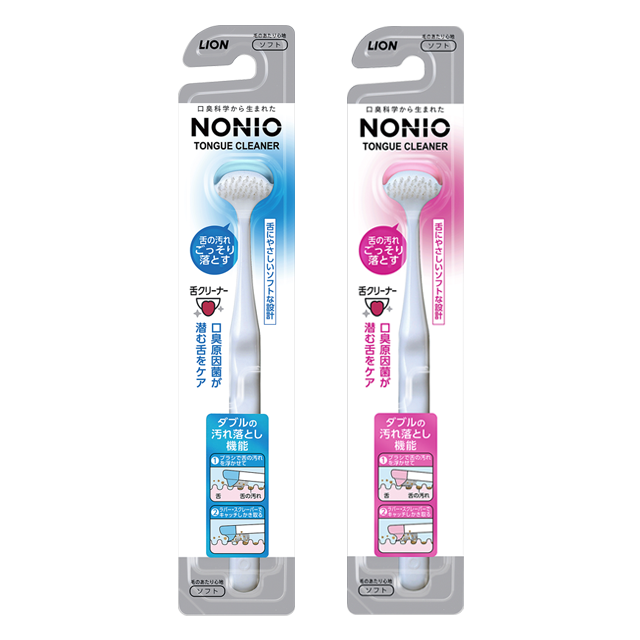
Look for NONIO舌クリーナー. This is a tongue-cleaning tool with brush tufts and a rubber scraper, not toothpaste or mouthwash. Lion lists blue and pink versions, without describing these colours as different strengths. The brand describes a compact head; that does not guarantee a comfortable fit or prevent gagging for everyone.
Use a light, one-way movement
The following combines the product directions with Lion’s general tongue-cleaning guidance:
- Use a mirror and bring your tongue forward. Areas without coating do not need scrubbing.
- Wet the brush with water and rest it lightly on the tongue.
- Draw it slowly from farther back towards the tip. Do not push it towards your throat or scrub back and forth.
- Rinse your mouth thoroughly after cleaning.
“Back to front” describes the direction—not an instruction to reach as far back as possible. Do not force the tool deeper or continue through gagging, pain or bleeding. You do not need to remove everything in one session, and the amount scraped off is not a target to beat.
How often? Not after every meal
Lion recommends about once a day when tongue deposits are a concern, and suggests the morning. Repeated rubbing can injure the tongue. This is not a recommendation to keep cleaning until every visible pale area disappears; nor does the morning recommendation mean other times are forbidden.
What is the separate gel for?
Optional addition, not a required purchase
NONIO舌専用クリーニングジェル is a 45 g tongue-cleaning gel classified in Japan as an oral cosmetic, not a medicine. Lion describes it as helping loosen tongue deposits. It is not the usual NONIO toothpaste, and the cleaner’s water-based instructions do not require it.
If you choose it, the official directions specify about 1.5 cm on a tongue brush or toothbrush, followed by slow back-to-front cleaning. Do not swallow it; rinse with water afterwards. It is not a rinse that you simply swish and leave in your mouth.
Choose for control, not a “no-gag” promise
Consider whether you can guide the tool gently without pushing it deep into your mouth. A compact head is a design feature, not proof that it will solve a gagging problem. If you cannot clean comfortably, stop and ask a dental professional about a suitable tool and technique rather than trying to get used to discomfort.
Already have a comfortable tool and individual advice from your dentist? There is no need to replace it simply to match the NONIO brand. Tongue cleaning is also not a substitute for brushing teeth or cleaning between them. If you were actually looking for toothpaste, see the separate NONIO toothpaste guide.
When to seek advice instead of scraping more
These are general NHS health cautions, not NONIO package instructions. See a doctor or dentist for tongue pain or itching that persists or worsens, or white patches on the tongue. Do not assume every white area is removable coating or diagnose the cause from colour.
See a dentist if bad breath persists after a few weeks of self-care, or you have painful, bleeding or swollen gums or toothache. More pressure or more gel is not a substitute for checking the cause.
A simple shop-counter question
Show staff: 「NONIOの舌クリーナーはありますか。」 This asks whether they have the tongue cleaner, without requesting a gel bundle. Check the Japanese product name and the instructions on the package you buy; do not transfer another brush’s replacement or disinfection instructions to this one.
Sources and scope
Checked 26 October 2026. Product guidance refers to the Japanese versions; follow the current package. This article does not replace individual dental advice.