Looking for an antigen test in a Japanese drugstore? Start with what it tests for, its approval label, the sample required and what to do after the result—not just price or apparent ease of use. Two boxes labelled “antigen test” need not test for the same infection or use the same sample.
I’m Irene, a Taiwan-born, Japan-licensed pharmacist working in a Japanese drugstore. This guide uses one Japanese general-use Kowa saliva kit to show what to check before buying. It is not a diagnosis or a procedure for every test.
Official information checked: 31 October 2026. Example: アンスペクトコーワ SARS-CoV-2(一般用), single use, JAN 4987973123973. Individual shop stock and every physical batch have not been checked.
Check “general use” and the Class 1 label
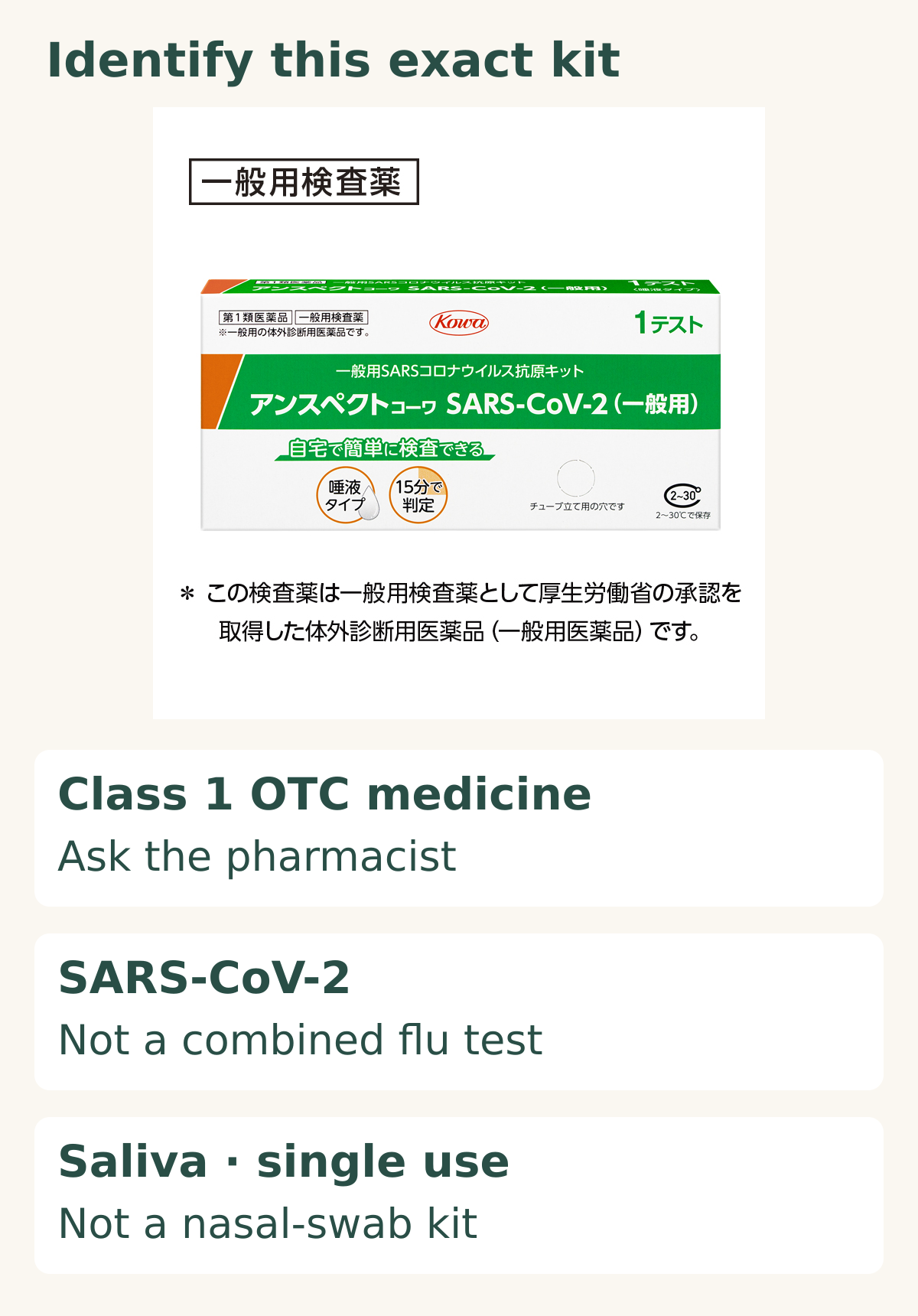
Japan’s Ministry of Health, Labour and Welfare lists approved OTC antigen tests by exact name, manufacturer, product photograph and sample type. When choosing a Japanese general-use kit, match the complete name and 第1類医薬品 (Class 1 OTC medicine) label, and check with the pharmacist. “Antigen” in a shopping-site title is not enough.
A kit labelled 研究用 (research use) is not an approved product whose performance has been confirmed by the government. Do not substitute it for an approved kit for your own health checks. Medical-use products also exist, but medical-use and general-use packs are not interchangeable identities or instructions. This guide uses only the general-use example below.
What does this box test? Saliva does not mean a nasal swab
アンスペクトコーワ SARS-CoV-2(一般用) is a Class 1 OTC medicine that detects SARS-CoV-2 antigen in saliva to help assess suspected infection. Look for 唾液タイプ (saliva type) and 1テスト (one test). It is not a combined flu/COVID test or a nasal-swab kit.
For example, someone looking for a combined flu test could pick up this SARS-CoV-2-only box by mistake. Both may say “antigen,” but their purposes differ. Do not change the sampling site or mix swabs, liquids or components from different kits.
“Saliva” does not establish that everyone can collect the sample independently. When buying for a child, an older person or someone who needs assistance, ask the pharmacist whether the product’s collection instructions can be followed. If not, ask about an appropriate testing option rather than forcing collection.
Can you meet the conditions where you are staying?
Before buying, check the full leaflet and your setting with the pharmacist. This kit has restrictions on eating and other activities before collection, requires a clock or timer, and specifies temperature and humidity conditions. Storage conditions and conditions for running the test are different: the storage temperature on the box does not establish that any room is suitable.
Check the expiry date, complete contents and whether you can understand the collection and result-reading instructions. Open it only before use. Ask about anything unclear. This guide deliberately does not reproduce collection steps, drop counts or reading times: a shortened procedure or another kit’s instructions must not replace the leaflet in your pack.
Used swabs, liquid and other components may be infectious. Follow the leaflet’s bagging instructions and local disposal arrangements where you are staying; do not leave used parts loose in the room. Keep unused kits out of children’s reach too.
The next action matters more than staring at the lines
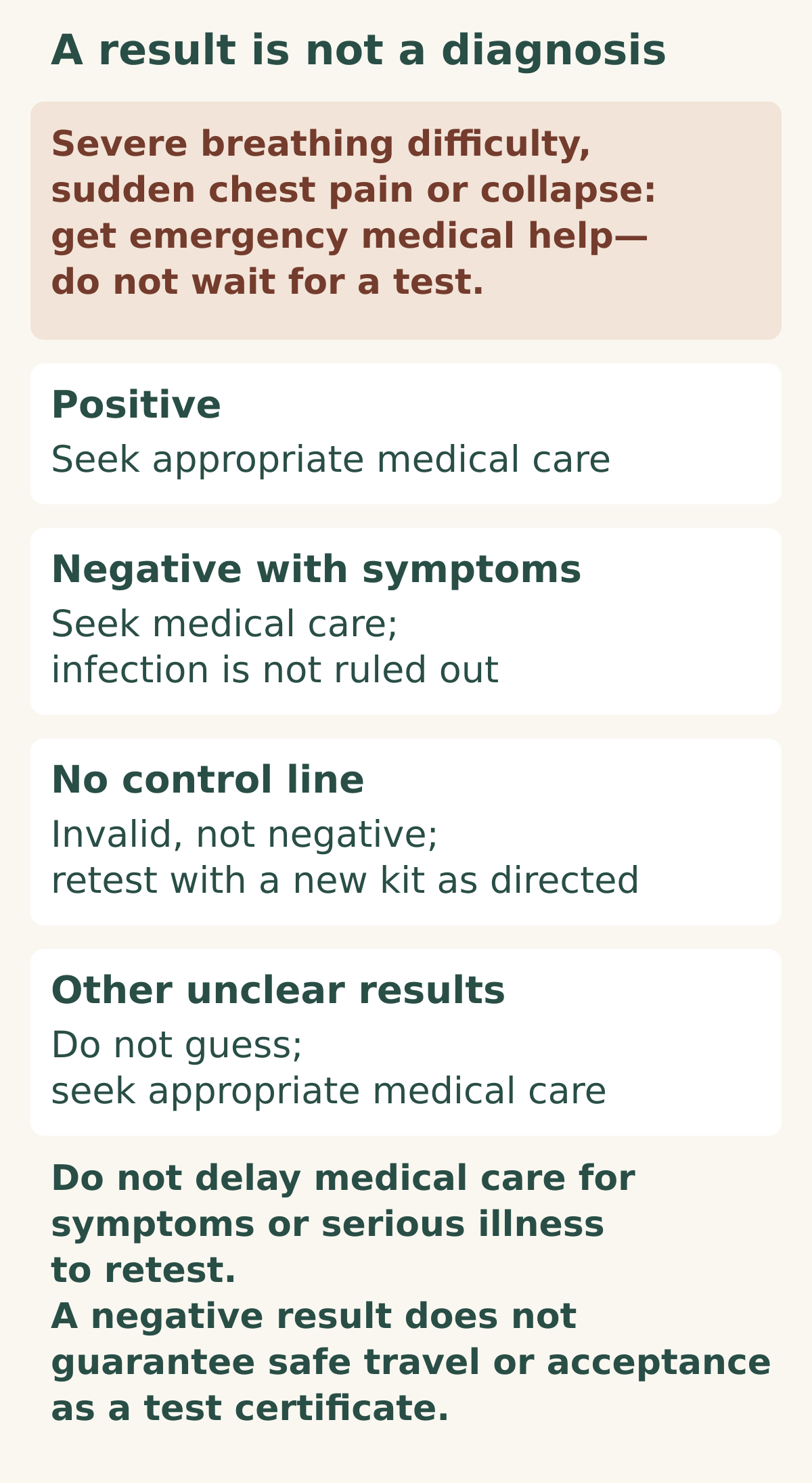
Seek appropriate medical care for a positive result or a negative result with symptoms, following current local arrangements; do not diagnose yourself or choose treatment independently. False negatives are possible: one negative does not rule out infection. No control line means an invalid result, even if a test line appears—not a negative result; retest with a new kit according to the complete instructions. For other unclear results, this kit’s leaflet directs medical care as for a positive result: do not guess.
Do not delay medical care for symptoms or serious illness to retest. A negative result without symptoms is not a guarantee that you are uninfected or safe to travel or meet others. Do not assume a self-test result serves as a negative-test certificate accepted by an airline or another organisation.
Show the pharmacist this, then explain your situation
自分の体調を確認するための、国が承認した一般用抗原検査キットを探しています。症状と、いつから始まったかをお伝えします。使える製品と注意点を確認してください。
This means: “I’m looking for a government-approved general-use antigen kit to check my health. I’ll explain my symptoms and when they began. Please check which product I can use and its precautions.” Also explain the user’s age, pregnancy if applicable, significant medical conditions, treatment and ability to collect a sample. Say when something is uncertain.
The guide to speaking with a pharmacist in Japan can help you organise those details. Before leaving, make sure you can find this kit’s full instructions and know the next step for a positive, a symptomatic negative or an invalid result—not just where to buy a box.
Official and medical sources
- MHLW: approved OTC antigen tests
- Kowa: アンスペクトコーワ SARS-CoV-2(一般用), product information and official photograph
- Japanese leaflet for this kit (revised September 2024)
- NHS: symptoms and when to get medical help (warning signs only)
These sources establish the example product, its limitations and care boundaries; they do not provide a personal diagnosis. Use the latest instructions matching your full product name and the pharmacist’s guidance.